Saturday, March 23, 2013

WATER AND SUGAR

Fruitless last-minute efforts to save houses on Plum Island, Massachusetts.


Water


On the morning of March 7, the first of several dangerous high tides clawed at the sand tubes (“coirs”) and concrete blocks homeowners had placed to shore up the foundations of their homes on Plum Island.  I happened to be in Newburyport the week of the storm and we checked out the beach at the first dangerously high tide.  (Plum Island serves as Newburyport’s barrier beach.)  The distance between houses and ocean had already been drastically shortened by earlier storms.  It was clear that some wouldn't make it through this storm.  Two high tides later, several of the houses were upended by the waves, others in danger of the same fate. 


Photo from the New York Times shows how the beach looked two days later.


Sugar


The days grew warm and the nights remained cold later that week back in Vermont.  Perfect conditions for the maple sap to start running.  The Hustons and Goudeys (Newburyport had come to Vermont) rounded up the sap barrels and spent most of the weekend overseeing a boil. 

Hans checks out the line-up of sap-filled bins.


A load of sap, plus Ben, riding to the sugarhouse.
(Re the snow:  photo taken two weeks after the first boil.)


Audrey using the hot sap to boil an egg.  (Why not?)


The first boil is on!


While the sap was boiling away, and just to keep busy (waiting for the sap to evaporate is a long boring process!), Cliff and Chris built us a bridge over the narrow end of the pond.


Water


The second day of the boil it rained on the snowless ground all day and all night. The directions that water seeps through the meadow were clearer than ever.  Three different seeps feed the pond.  We watched the pond rise, and the new bridge nearly floated.  All in just a few hours.


Left to right, Carly, Audrey, Ben (nearly obscured next to Hans),  Hans and Olin inspect the flood


Peak flood.  (The bridge awaits a railing.)


The big drainpipe at the other end of the pond lowered the water level fairly quickly as the rain slackened.  There was now a roaring brook on the other side.  Ice had probably helped impede the flow.


Sugar


Last year’s weather didn’t allow the trees to produce as much sap.  It was a poor sugaring year for everyone, including commercial producers.   Plus we knew less about making syrup.  This year our prime brewers (sugarers?) made sure that the syrup was at the proper temperature when it was finished.  The higher the sugar concentration in a sugar solution, the higher the temperature at which the sap boils.  As you evaporate water from the sap the temperature of the boiling liquid increases.  Finished syrup boils at 7 degrees Fahrenheit above the boiling temperature of water (212 degrees).  Hence, 219 degrees is optimum for finished syrup. Boiling it longer will result in syrup that is too dark or too thick.  (Somehow we’ve never had a problem with “too thick.”)  We filtered the finished syrup, a tedious process, through several layers of cheesecloth to get a clearer product.  (When sap is boiled, the minerals that are naturally present in the sap are concentrated or hardened into a grainy substance called niter, otherwise known as sugar sand.)


Our set-up for filtering out the sugar sand.

After the first weekend boil we ended up with over 45 jars of the sweetest maple syrup I’ve ever had. The first day’s syrup was light but tasty.  The second was darker and more robust.  And there is more to come.


The jars of syrup begin to accumulate.  The earliest syrup is on the right.

Water


After all the rain there was a dusting of snow.  About the right amount for a day in March.  Time for pruning, I thought.  But all I had a chance to trim were the apple trees.  Then winter returned with a new fall of snow–enough to cross-country ski on our own land and create the best downhill ski conditions of the season.  Cold enough, too, to have the snow last longer than you might expect for late March.   And snowy enough to postpone the rest of the pruning.

Olin on the TAM (Trail Around Middlebury).  About the right amount of snow for March.


Snow again, a week later.  Following the trail to the Mitchell's land.

 ***

Still, it is officially spring.


Some of the things that are probably happening now, even if it's not obvious:

·       Pussy willows are beginning to open.
·       Great horned owls are nesting in old retailed hawk nests.
·       Skunk cabbage is flowering in swamps.  
·       Brown creepers are among the earliest spring migrants, perhaps because they don’t migrate far.
·       Male woodcocks return as soon as the ground has thawed enough to make earthworms accessible.
·       When the snow melts, tunnels in the lawn are revealed. The tunnels were made by moles.*

And...on a warmish day a week ago, before the fresh snow came, the red-winged blackbirds arrived in large numbers.  Even with snow still on the ground we hear them chirping––in truth, more of a “conk-a- reeeee” sound, not especially tuneful, but one we will hear every day from now through summer.  They will build nests in the meadow.

Spring?


 * Items in this list are from The Place You Call Home, “A Look at the Season’s Main Events: Spring,” Center for Northern Woodlands Education, a publication of Vermont Fish and Wildlife, 2008

Tuesday, February 26, 2013

WAITING FOR THE SEEN, while the unseen happens


February is a waiting time.   

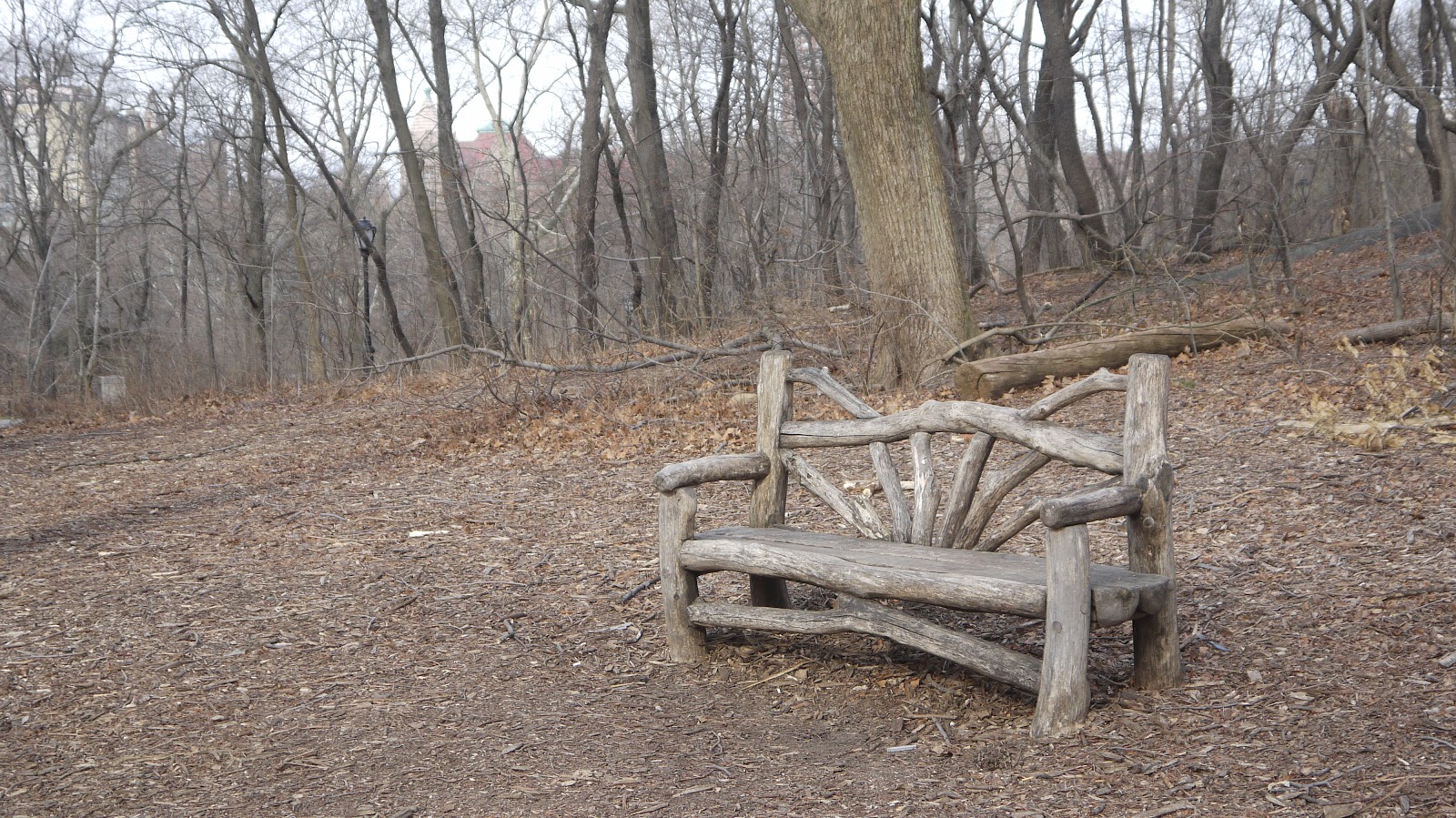
(The bench, above, is not even in Vermont, but an empty bench suggests waiting, doesn't it?  Since I've included the bench, I might as well include the tree that stood opposite.  I'll call it the Nose Tree.)

I digress.


In a winter that has been seesawing back and forth between freeze and thaw, those of us who ski are waiting to learn the final score on this winter’s snow.  Will a late storm (just one big one, please, before it’s all over) give the winter of 2012/13 a statistical kick?  How much more skiing, snowshoeing, or plowing is there going to be?  If any.  As the snow melts away I miss the fresh tracks that hinted at who-did-what when we weren’t looking.  Evidence of the unseen.


 Some Things That Happen this Time of Year*
             You may hear the loud drumming of single male pileated woodpeckers, advertising for females.  Once mated, a pair will remain together throughout the year.
             Sometimes crows gather in large groups at this time of year.
             Coyotes are sexually active.  Five to nine pups will be born from mid-April to May.


A guy in line at a store the other day was buying 100 maple tree taps.  He’s getting ready.  Sugarbush tappers are waiting for the first flowing of maple sap.  That should be any time now.  A few more warm days, around 40 degrees or so, with nights below freezing are all that’s needed.  We’ve had some of those already, although it’s still February.  Wood for the sap burn has long been cut and stacked.  In our little shack a new evaporating pan waits.

 More Things That Happen
             Cattail flower heads disintegrate throughout the winter, releasing their 125,000 or so seeds.
             Sometimes the fruits of wild grapes turn into raisins and stay well into winter, a plus for wildlife.

Local farmers are waiting for births–new calves, lambs and goat kids.

Dairy calves–Holsteins, Jerseys or a mix, mostly–are born here on dairy farms the year-round, but beef calves, kids and lambs are generally born in February and March.  Ewes and does become fertile as the day length decreases in the fall.  To me, an animal’s response to light in this way puts me more in mind of plants than animals. Pregnancy–gestation” is the term usually used for goats and sheep–lasts about five months.*  In the case of cows, it’s about nine months. 

The tag gives her age:  Born two springs ago


For local 4-H’ers (“4-H” signifying a union of activities for “head, heart, hands, and health”) it’s mostly about cows.  Now is the time for selecting the calf they will get to know for the next five-plus months and show at the county fair in August.  Since Ben, Audrey and Carly will each be doing this, I have an opportunity to observe the process. 


Checking out the calves born in the fall


 Even More Things That Happen
             Wild turkeys seem to get braver as their food supplies dwindle.  They may venture into yards and orchards for spilled birdseed and fallen fruits.
             Skunks come out to look for mates, and sometimes can be heard squabbling in the night.  Baby skunks, usually six or seven, are born two months after mating occurs.


Some one-year olds are candidates for someone aged 12 or older to handle


For farmers, 4-H is one more way to “gentle” their animals.  Calves used to handling by people will be less likely to spook and cause trouble.  “You wouldn’t stand in the middle of a bunch of cows like this with just any cows,” said the farmer (below) who knew the name of every cow. “My father always pays a lot of attention to his cows.  They (the 4-H’ers) help socialize them.”   


Young calves almost look like fawns.  They’re small and doe-eyed with long eyelashes.  Adult cows are immense.  It’s hard to notice lashes.  You have to pay attention to that size.  The daughter of someone we know who was training to be a farmer was kicked in the face by a cow and almost lost an eye.  Over a summer grazing cows demolished an old bench that sat under an apple tree in the field next door.  It’s not that the cows were aggressive toward it, but they probably merely leaned against it, or bumped or pushed it from time to time. They are big.


Only nine days old, the choice of all those under 12.  By the time the county fair begins in August,
she'll be just the right size.

 More Things
             Foxes will cache food caught during good hunting days in pits they dig in the snow.  Then it is covered over;
             Chickadee flocks are breaking up; listen for the two-note territorial song of the male–‘feebee’–the first note higher than the second;
             Acrobatic aerial courtship displays by ravens are under way.  Rolling, tumbling, and soaring are accompanied by the loud territorial call, a resonating ‘quork.’


A graceful cloud drifts by one clear day


Ah, Vermont.  NY Times book reviewer Dwight Garner recently reviewed–blisteringly–a Jamaica Kincaid novel set in Vermont, a Vermont he described as:  “the Vermont of the cartoonist Ed Koren...where people are fuzzy and semi-adorable and drive old Saabs; their sweaters smell faintly of peat and wood smoke. NPR simmers in the background like fish stock.

I love it.  But lets say we are actually fuzzy and semi-adorable, why not? but we drive Subaru’s, for goodness’ sake, we wear fleeces and down vests, sweaters not so much, and the fleeces probably do smell of smoke, but that would be wood, not peat.  Must have been thinking of Ireland.  The stuff simmering in the background?  That would more likely be chicken stock, given where we are.  Somebody better invite the guy to Vermont.


NOTES
 * Excerpts in boxes are from The Place You Call Home, “A Look at the Season’s Main Events: Winter,” Center for Northern Woodlands Education, a publication of Vermont Fish and Wildlife, 2008
** Information from a column by Joe Klopfenstein, DVM, Addison Independent

Friday, February 8, 2013

NEW OLD URBAN LANDSCAPE: NYC

From "The Ramble" in Central Park


The shape of the land


I never appreciated New York City until I moved away.

I don’t live in the “real” America, was how my thinking went when I was growing up.  Although I was born in Brooklyn and lived in Queens until I left for college,  “America,” my idea of it anyway, was of some other place, a place where there weren’t apartments or attached houses, but open fields, forests, maybe even mountains, where you could actually see the shape of the land.  (Right, I know, Vermont!)


What's not to appreciate?  A fancy nest in a yellow aerie.


Where else but NY?


It’s not easy to see the shape of the land when you’re in New York.  When Madison Avenue gently climbs uptown it’s a reminder that Manhattan isn’t a totally flat grid.  It just seems that way.  Knowing the lower Manhattan subways flooded after Hurricane Sandy, is a reminder that there is water all around, and lower Manhattan really is lower.  Central Park, thanks to Franklin Law Olmstead, is, of course, a hugely enhanced reminder of how things once looked––those primeval rocks sticking out of the ground––but other city parks are mostly manufactured.  And all the buildings, because of their immense height and size, create a kind of giant concrete sequoia forest, the throngs of people––if you can bear with this metaphor––like underbrush you need to push through if you want to get to the edges to see things like rivers. 


The High Line rises above that–literally.   You can see the Hudson River from it at every cross street.  It was created in 2002 after a couple of guys from the neighborhood envisioned an urban park cum walkway in the long-abandoned elevated railway line by then sprouting tall weeds and even trees.  (It starts at W30th Street for now (an extension over the rail yards is in the works) and ends downtown at Gansevoort in the meatpacking and one-time spice warehouse district.

A winter garden on the High Line; art work on building in background.

Sometimes you walk close to buildings...

Other times it widens; opposite the steps, the side of a building serves as a movie screen in summer


Places, things


A whole week in NYC offered a chance to do more than we do on the usual weekend visits:  the MoMA and the Metropolitan Museum of Art (not just one day, but twice, and still not near enough to see it all), and the Museum of the American Indian (at Battery Park, a locale that reminds you the sea is out there).  Scratching the surface, in other words.  Still, when you have more time you see more, and you see differently.  At the Met, where it’s so hard to spend enough time when the only time is a single afternoon, we were half way through the second day's visit before we viewed a single painting, although paintings, and a few large objects, comprised most of my memory of past visits. 


At the Met I was struck by the weight of the armor:  ~90 pounds on the horse, maybe ~60 on the man, and then there was the weight of the man, plus lance.


The armor of Henry VIII in his late years; I could sense him inside, having just
read Hilary's Mantel's "Bringing Up the Bodies," about Henry VIII and
his long time chief advisor Thomas Cromwell.


One of the Met's magnificent big spaces

Probably not color-correct here,  one of several Van Gogh "Sunflowers" 


I had been eager to see Van Gogh’s “Starry Night,” having spent countless hours on an annoying 1,000 piece jigsaw puzzle of the painting with its challenging swirls and lacings of every conceivable color in sky, tree, mountains, town.  It wasn’t a complete waste of time, however, because I got to know intimately every shade Van Gogh used, and every section of his painting.  But what a revelation to see the original again!  How vibrant!  I couldn't get my eyes off it.  I felt as if I knew every brushstroke.  I found new colors I hadn't seen before.  I'd been working with a faded imitation that had several inches lopped off the top.  


 My stupid lousy puzzle.  Those aren't birds in the sky; six pieces got sucked up by the vacuum.  And my photo missed including bottom part.  But you get the idea. 


The original (well, sort of) at the MoMA  

Among other entertainments ("The Mystery of Edwin Drood, an award-winning musical that somehow lacked that elusive magic quality, a cabaret performance by chanteuse Ute Lemper that supplied the missing magic), we saw a remarkable play.  Memorable, you could say.  “The Perfect Crime" it was, and it has to rank as the worst play I have ever seen.  I include elementary school productions.  The crappy theater, the outdated set, the acting ("amateurish" would be a compliment), the utterly  incomprehensible plot––uniformly atrocious.  It is–unbelievably–the longest running play in New York theater history.  There are four roles and everyone was awful.  The leading lady has played hers for over 10,000 performances without missing a day since the show opened in 1987.  1987!  That’s when Reagan was President, and before cell phones, 9/11, and iPods.  What circle of hell must she be in?  

(My TripAdvisor review:Was this a high school play rehearsal? Was the script written by furiously typing monkeys? Did leading lady Catherine Russell have a plane to catch? Did George McDaniel’s emoting belong to a different play entirely? Which correspondence course did John Hillmer take to learn his British accent? Why is this perfect mess still playing after all these years?)  The sentiment was shared by numerous others.  It was oh so very bad we actually kind of enjoyed it.


Constructions


NY is in flux, as usual, with buildings coming down, others going up.  As in a forest, it’s sometimes hard to pick out individual ones because there are so many assembled close.  Suddenly there may be a break between streets or a corner turned, and you see what otherwise you might have missed.


To enter the 9/11 memorial site you are required to line up and pass through a security check, like boarding a plane (belts off, pockets emptied).  After that you emerge onto a large open park, a place you might want to linger in if you didn’t feel so boxed in.  I hope it won’t always be this way. It signals menace.  Which, I suppose, is fitting.  I got the same feeling from the memorials themselves.  The dark pit into which the black water flows is creepy. That, too, seems fitting. 


Shattered remains of the Trade Center walls and piles of rubble were still here when we came to this place in October of 2001.  The air still smelled of unidentifiable substances.  Ash still filled several store windows.  Tourists were still posing with abashed-looking policemen.

The new World Trade Center


Speaking of buildings, it is the 100th anniversary of a great one:  Grand Central Station.  It's one-time counterpart, Pennsylvania Station, is nothing more than a subway entrance to the trains below.  Grand Central is a beautiful survivor.