Friday, July 10, 2015

THE HOLE IN THE BANK, AND OTHER TALES

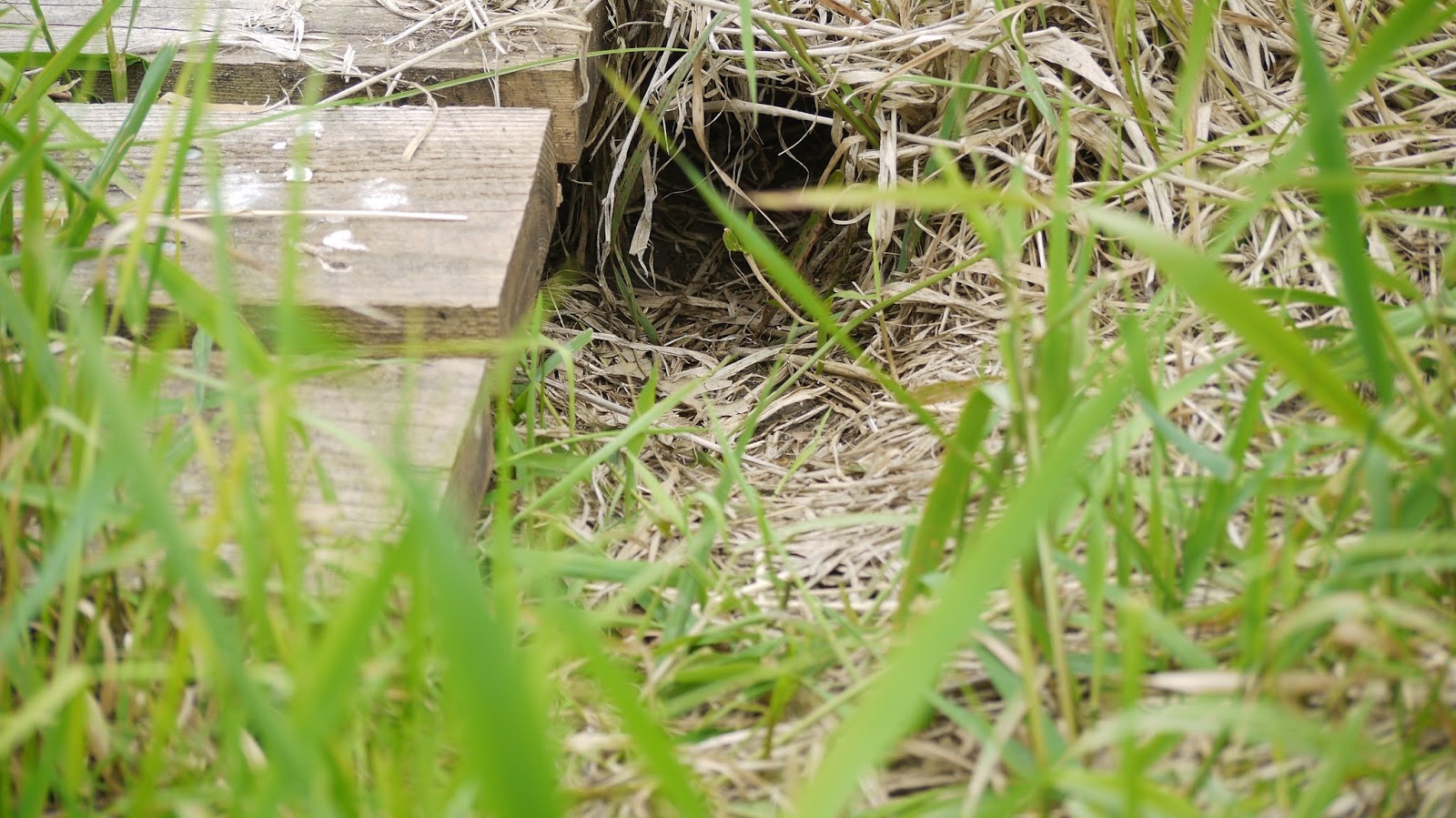
The hole in the bank.  Who lives there?


Cycle of Life, I:  On the House and Around It


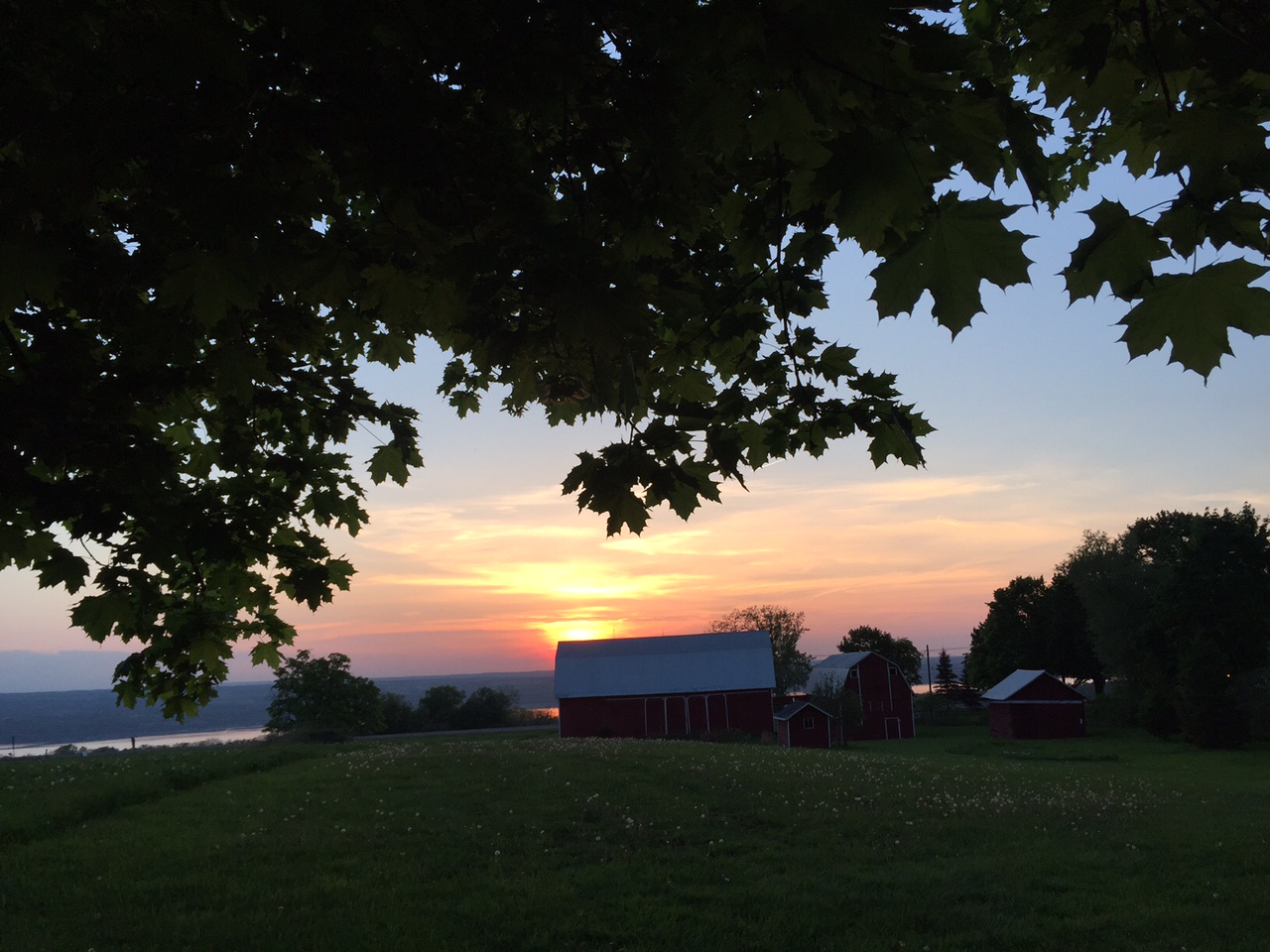
The sand cherry bush behind the house held nearly thirty goldfinches at once.  That was in May, when spring was still unfolding. Its dark purple leaves hadnt opened yet.  After the goldfinches the bird visitors were other kinds of finches, plus woodpeckers, cardinals, nuthatches, chickadees, titmouses (titmice?), grosbeaks, and mourning doves that picked up what seeds fell on the ground.  In July the feeder has become a draw for aggressive starlings and a few red-winged blackbirds.  Nevertheless chickadees, finches and grosbeaks still stop by when the big birds aren't hovering.   On a recent hike we found a bird feeder lying on the forest floor, one of those feeders that have a cage around the main tube to screen the seeds from large birds.  Were giving it a try.  But we werent encouraged when we saw a couple of starlings stretching their necks through the opening to cop a few seeds.  We could just stop feeding, but we don't want to.  At least we havent had bears at the feeders.  Even when they're hungry I suspect crossing a large open area to get to the seeds would be intimidating.  


A few of the goldfinches decorated the sand cherry bush in May

Come to think of it, our raspberry patch is very close to the woods...

And that reminds me, what exactly was out there that night last week when Skyler got all wrought up?  Around ten o'clock or so he got very agitated and began to whine, whimper, pace, and bark.  He would not stop barking, and kept trying to look out of windows.  Of course we were trying to sleep.  It was nearly two in the morning when I decided to get out of bed and take him outside to face down whatever he thought it was.  (My thinking was, if we confronted what was or wasnt there––I had decided on the wasn't, that he was only barking at ghosts––he would understand and would therefore stop barking.)  I put him on the leash and we headed out.  The motion detector light had switched on illuminating a circle around the cars.  Beyond that was complete blackness.  I hadn't thought to grab a flashlight so when Skyler started up a low growl I turned us around and headed for the front door.  He didnt calm down for another hour.


Skyler stands guard against whatever

Woodpeckers seemed bent on eating the house last week.  The pileated, the downys, they were all in on it.  Theres a corner section they seem to favor near the bird feeder where one after another likes to perch and thump away.  Insects underneath rotting wood, wouldn't you think?  A search finds nothing noticeable.  They keep at it.  We look again.  Theres no rotting wood.  No sign of insects.  We give it a heavy dose of bug spray anyway, follow that up with a thick layer of wood filler, and follow that up with a coat of fresh paint.  Later that day, a woodpecker lands on the same corner and starts to peck.  Maybe hes just showing off.  Nobodys going to tell me where I can peck!  Or maybe its only habit:  Well, it was perfectly fine this morning!  This bears watching.

On the front porch we are on constant lookout for burgeoning wasp nests.  Last year I was slow to notice; too much looking down at book or iPad and not enough gazing at the ceiling.  Glued up there  in places where the rafters toe in tight Vs there were about ten starter nests that I knocked down, each a bit smaller than a golf ball.  As for the swallow nests, we had left the ones from last season thinking the swallows might reuse the nests, hence avoiding the messy (for us) project of making them anew.  They didnt.  A new nest appeared right next to the top of one of our doors to the porch.  In no time heavy droppings began to appear and thicken.  Eventually four chicks appeared and fledged days later.  The last time we saw the chicks there were three perched next to the nest.  Then there were two.  Then they were gone.  But not gone very far:  its hard to say which swallows are which, but five or six or more continue to swoop under the porch ceiling as they scoop insects around the yard and pond.

 
Three of the four swallow fledglings next to their nest.  The fourth has probably already flown off the perch.


Cycle of Life, II:  In the Field

I dont know how many creatures live in our field.  Many.  Fortunately for them, our local farmer doesnt mow until August when everything has bred and left the nest.  Birds fly out every several yards as you walk around the paths Ken has cut in the high grass.  Deer nap in groups in the dense cover.  (We see the parted grass giving away where they walked, and the large flattened areas where they bedded down.)


The meadow is full of wild flowers and the grass is getting tall

A turkey with three poults (chicks) appeared in the field last month.  According to my readings, a turkey may lay 10-14 eggs, usually one a day, and incubate them for nearly a month.  (At that rate it could take a month and a half for them all to be incubated.)  The nest is merely a shallow depression, so it was probably right in the field.  Of course turkeys are everywhere, even on suburban lawns, but here they prefer open forest, preferably with oak and hickory with interspersed clearings and fields.  Ideal territory, this.  On the down side (if you are a turkey, that is) there is a long list of turkey predators in addition to man:  skunks, raccoons, groundhogs, foxes, bobcats, coyotes, and hawks, all of which we have in varying degrees of abundance.  To that add: dogs. While Ken was walking Skyler on a long leash Skyler pounced on a half grown chick that popped out of the tall grass onto the trail.  Ken pulled him back, but it was too late.  One dead poult.


Cycle of Life, III:  The Hole in the Bank

Doings in the pond pick up in early spring.  Ducks come to visit:  mergansers first, then mallards.  They hang around for a day or two, then disappear.  The occasional heron.  One duck party left behind a single egg, only discovered last month.  (Were there more?  What happened at the nest?)  A pair of Canada geese stayed the longest.  Wisely, they never strayed from the far side of the pond.  Skyler threw them the occasional bark, but mostly got used to their presence.

One day not long ago we saw something brown swimming across the pond. The long way, from the bank to the bridge.  Almost every day he (she?) swam this same route, disappearing under the bridge.  Sometimes it had a small branch in its mouth.  It had to be a muskrat.  One day we noticed a path in the grass that led in a straight line from a small opening in the tall reeds at the pond edge across a mulched planting of shrubs and on into the uncut meadow.  The trail was only about 6 inches wide and was some twenty feet long from pond to tall grass.  It was as if someone had dragged a small bag of sand across the lawn.  
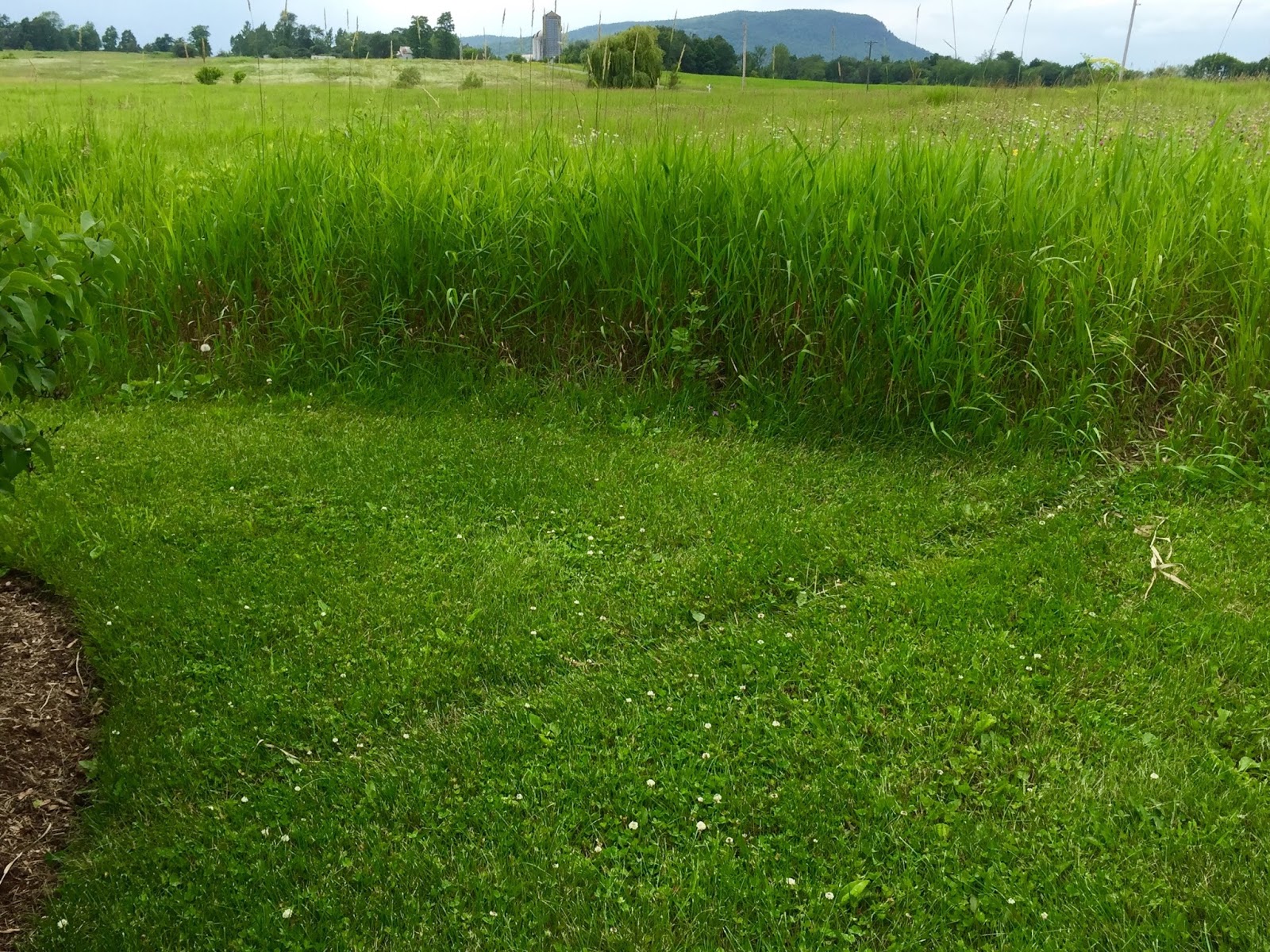

The mysterious trail

What was more surprising was that once it entered the meadow the path meandered in several directions and circled around on itself in a section of maybe ten yards or so.  We puzzled over this.  The creature that swam across the pond was clearly a muskrat.  Would a muskrat have made this trail?  Could it have?  (Their long tails drag when they walk across land.)  What else, if not a muskrat?  Muskrats build lodges that generally protrude from a marsh or muddy pond (ours certainly qualifies).   But we saw no lodge.  

The disturbed meadow at the end of the muskrat's trails, probably the result of foraging.

A tunnel next to the bridge.  Another muskrat creation.


Wikipedia reports:


“In areas where they become abundant, they are capable of removing much of the vegetation in wetlands. They are thought to play a major role in determining the vegetation of prairie wetlands in particular. They also selectively remove preferred plant species, thereby changing the abundance of plant species in many kinds of wetlands. Species commonly eaten include cattail and yellow water lily."


More than likely the muskrat(s) are entering the meadow for sedges or other plants they like.  I have no idea what those might be, as all I see are clover, a bit of wild parsnip, buttercups, and the usual meadow grass.   At one end of the pond our usually abundant cattails are nearly gone.  Muskrats also eat the occasional frog and tadpole (which we have in abundance). I’m saying “they” because like every other creature muskrats are surely reproducing.   And muskrats reproduce mightily:  Two or three litters a year of six to eight young each is a lot of muskrats. But where are they?  We looked for a small lodge or “push-up” and thought that maybe they lived on the other side of the pond where the water drains into a seasonal stream.  Then I remembered they like to burrow into steep banks.  There’s only one section where the pond has steep sides and that is alongside the driveway.  There it was:  a large hole in the bank just inches above the water.   There were also hints of possible underwater entries.  A muskrat family is what we have.  How many muskrats are too many?  We will have to wait and see what comes of these neighbors.

Entrance to the muskrat lodge

Sunday, May 31, 2015

HUDSON RIVER SCHOOLING


In Thomas Cole's studio


Even though we look across Lake Champlain to New York State every day, we have never spent as much time exploring it as we have explored, say, New Hampshire.  Or Maine.  Simply saying New York State is a pretty vague reference, considering that it literally covers a lot of ground.  I suppose I still see it as an ex-New Yorker, NYC having been known to me as the City when I grew up there, as in the City, with its sphere of influence that coats everything within a hundred miles in every direction with NYC pixie dust.  But then theres all the humongous rest of it.  This includes the known world (the Adirondacks, the Catskills, possibly the Finger Lakes) and the unknown world (the almost-Midwest part and whats called upstate, meaning whatever else.) 

Sunset over Seneca Lake from the eastern side


On the northern head of Seneca Lake, one of the Fingers (lakes that from the air really look like skeletal digits) is Geneva, our destination for the graduation of grandson Nick from Hobart/William Smith.  En route we had been entertained by the names of places we were passing through.  What better than Ninety Six Corners, Holland Patent, Hoffmeister, Speculator, or Street Road?  Later on a Graco-Roman patch arrived with Syracuse, Seneca, Rome, Ovid, Pompey, and signs to Ithaca and Troy.


Hobart College docks in Geneva, Lake Seneca fogging up

Then it was bagpipes and Elgars Pomp and Circumstance.  Both would be repeated a week later for the graduation of grandson Hans from the Waring School in Massachusetts.  Nick was one of two student speakers at Hobart, talking of his dads influence and support for his experience at Hobart.  Hans was one of 28 speakers (yes! three minutes each) at Waring where each student in this small class spoke humorously, seriously, poignantly about themselves, and their past four years at Waring. 

Nick, with proud parents Mike and Christine


Hans.  All 28 graduates wore wreaths made by parents the previous evening.  Next year:  Here at Middlebury!


Between graduations we crossed through the rolling hills and apple country of eastern upstate to the Catskills and, ultimately, Hudson, New York.  Hudson is a town that bridges two parts of New York State:  the upstate part and the NYC sphere, the latter more strongly than the former these days.  


Dining in Hudson:  Ken shadowed, at Ca'Mea

Dining in Hudson:  Limoncello dessert, at Ca'Mea


A mere two-hour Amtrak trip from Penn Station brings New Yorkers up the Hudson River to the oldest continuously operating train station in the country.  (Given our second-rate national railroad system that might not be saying much.)  The NYC pixie dust sprinkled somewhat unevenly in Hudson is responsible for the many good restaurants, art galleries, boutiques, and exorbitant prices in local B&Bs.  The town has good bonesa treasury of 19th century and early 20th century buildings– making for a beautiful downtown.  All is not entirely rehabbed or gentrified, as is evident by decay amidst the restorations, as well as the less-than-chic housing around the edges of town. 


Some houses have restoration potential...

Others are looking terrific...

And some are just amazing looking, like our B&B.  (That's not our car.)


But there are streets that look a bit depressing

A still functioning old Hudson firehouse, right on Warren Street, hard by galleries and restaurants


When you drive across the Rip Van Winkle bridge and cross the Hudson River immediately east of the Catskills you can't miss seeing Olana.  The creation of 19th century painter Frederick Church, Olana, just a few miles south of Hudson, adorns the mountaintop like a Christmas ornament on a tree.  I've wanted to see it up close ever since I saw it years ago on a return trip from Pennsylvania.   We took a tour the next afternoon. 

Olana, in an orangey light  (NYTIMES)


Church was a member of the Hudson River School of 19th century American landscape painting.  His mentor was Thomas Cole, one of the best known of that group of artists.  Many people have undoubtedly heard of the Hudson River School since the artists most famous works are as often found in American history texts as museums.  They illustrate an age, a time when the Industrial Revolution was being felt in areas once pristine, trees were being churned into lumber, and railroads were being blasted through.  Up to that time landscape painters of quality were expected to be European and European-trained.  Hudson River School was a derisive term at the time for a group of artists who were self-taught and very much unschooled. No Beaux Arts for them.  How un-European!  How American.  They took their inspiration from the natural world of this newer country, and put it on the map for Art. The Catskills were inspiration for Cole who painted the mountains as Gods creation rather than translating them photographically.  Enhanced, in other words, by admiration, worship even.  You can take several hikes out of Hudson to see some of the places that inspired  paintings like Kaaterskill Falls.  One can still see the mountains to the west from Coles porch looking pretty much as he saw them.


The Thomas Cole house.

The Catskill view, from Cole's porch

Cole's studio


Frederick Church, like his contemporary Albert Bierstadt, painted big:  great wide-angle landscapes, imagined like enhanced visual memories.*  They say to us: Nature is spectacular!  Look!  Appreciate!  This in the mid 1800's when the development of roads, destruction of forests, and the rise of industry was chugging away big-time.  The 20-odd painters of this era helped put the American landscape on the map, and became the most popular artists of their time.


The entrance facade.  "Welcome" is written in Arabic atop the front door.

With wealth from his huge commercial success as a painter (he was a savvy promoter of his work) Church designed his dream house in the late 1860's.  It incorporated his ideas of beauty and his admiration of oriental architecture discovered in his wide travels.  The house was technologically advanced as well:  central heating and plumbing!  Mark Twain visited and was inspired architecturally.  (His house in Hartford, Connecticut, built a few years later, is about as elaborate as Olana.)  Thanks to long-lived heirs with no penchant whatsoever for change, the home remained intact to this day, inside and out.  (Although rescued at the last minute from sale by a nephew in 1966 following the death of Church's daughter in 1964.)  The vast grounds, albeit somewhat less vast than they once were, had been shaped by another contemporary, the Frederick Law Olmsted of Central Park fame.  The sweeping drive to the house, the rounded meadow with trees in just the right places, the view of the Hudson River mirrored in the artificial lake––it all reminded me of World's End in Massachusetts, also an Olmsted design.  


Landscape by design:  the shape of the lake at left mirrors the shape of the Hudson.  Not seen so clearly on a misty day.

A view toward the Catskills from an Olana porch.  You can see the Rip Van Winkle bridge.


Sadly no photography was allowed inside Olana.  This was disappointing because the interior was completely furnished down to the last teacup, and as eclectic as the exterior. Olana also hosted, as did the Cole house, a contemporary art exhibit sponsored by the guardians of both homes, a group called River Crossings.  My second-favorite piece was an outline on the wall in brilliant silver of the entire Hudson River by Maya Lin.  My favorite piece, though, was an easel set in the dining room that held a copy of one of Churchs landscapes well on its way to being turned into Swiss cheese by carved woodpeckers.  A comment on his relation with the natural world, perhaps?  He was an early conservationist as well as painter.  An admirer, one may assume, of woodpeckers.

 
Landscape, with woodpeckers.  No, I couldn't have taken this photo.  Ripped from the pages of the NYTIMES.


 *My favorites of the Hudson River School?   Albert Bierstadt's "Estes Park," and Church's "Niagara Falls." Both highly romantic pieces.

Wednesday, April 29, 2015

EATING LOCAL IN LOCAVORIA*


Here we are at Agricola, almost 30 hungry people.  We are, all of us, being taken on a tour of the barn that houses animals we will be eating in a half hour or so.  (More accurately, the relatives of animals we will be eating.)  Talk about a short trip from source to table, this is about as short as it gets. 


Some of our hungry group, awaiting the start of the barn tour


Inside, Alessandra Rellini, at right, tells us about their plans for the barn and the animals


Here in this ancient barn, formerly a milking factory with a vast array of cow stations, we are looking at the animals that now occupy roughly a quarter of the space that has so far been cleaned up and converted from dairy production.  There are many several-hundred-pound pigs of the Large Chester and Durac variety and their piglets, an old breed that does well in Vermont’s climate, and one boar (all the sows' needs are satisfied by a lone uncastrated boar, domestic variety).  The chickens are Buff Orpington and Welsummer, the sheep Icelandic (mmm, Icelandic wool).  Somewhere out of our sight may also be guinea fowl, Narragansett turkeys (a heritage breed) and quail.


Why this combination of animals?  The leader of our tour is Alessandra Rellini (Ale), owner and chief farm enthusiast, who created and manages this enterprise with her husband, small daughter, and, we fervently hope, countless other helpers.  We do see a few helpers in the barn.  Later at least one or two appear to help serve dinner.  Ale explains their animal strategy on Agricola’s website:  

The pigs, with their mighty snouts, till the land. In come the chickens, the cleaning squad, taking care of unwanted worms and seeds and fertilizing the fields. Once the grass reaches the perfect height, the sheep come by for a snack. By trimming the grass, they help promote the health of those tender and precious plants that so efficiently turn the power of the sun into energy for the pigs, and the chickens, and the sheep...they are one of the few three-purpose breeds, providing meat, milk, and fiber.  But the benefits don’t stop there.  Icelandic sheep's meat, free of the mutton taste, is considered a delicacy.”  

The chickens range everywhere (“Not free range!  It’s anarchy!” says Ale).  Her daughter, fortunately, is talented at locating the eggs they lay here and there.  When there are hawks flying Ale says the chickens seek protection near the great lumbering pigs.


Several of the Icelandic sheep.  They are very fuzzy.


We are impressed with her ambition.  No, we are in awe.  Imagine purchasing a farm of some 50-plus acres with enormous ancient outbuildings in dire need of repair, the primary barn the size of a football field (nearly!) and ankle deep in old cow manure with yet more manure piled just outside, all still imprinted with the decaying detritus of dairying.  Then imagine building an enterprise that unites all this:  making and marketing charcuterie products like prosciutto, salame, coppe, guanciale, pancetta and tesa, running a Farm Assistant Program, teaching others how to butcher pork, lamb and poultry or make ravioli, and––this is where we come in––running a Dinner Club that offers a gourmet dinner with products from the farm.  This list may not be inclusive.  Ale learned pork butchery in Italy and shears her own sheep.  She is on the board of Slow Food Vermont.  


This is tonight’s menu:

That antipasto, Ale assured us, is lamb broth not, definitely not, consommé!  In Italy, unlike France, you understand,
the impurities are not removed!


Lamb rack

The restaurant.  For the evening, anyway.


So we eat.  Our dinner is served Italian family style but with individual plating, and lasts nearly four hours.  Ken and I, together with our friend Susan, manage over that period of time to polish off two and a half bottles of wine and taste a few others.  Our table-mates appear to be to be there for at least partly professional reasons as they include a chef, food buyer, and owner's family member from our local Basin Harbor Club.  The talk at our section of table––what little I can hear of it over the din created by 30 of us in the two connected rooms and Ken with his hearing loss hears nothing at all––is, perhaps unsurprisingly, about artisanal food, raising sheep, and goats.  I have virtually nothing to add to the conversation.  The chef for this night's dinner is a Burlington-based caterer Alessandra met while involved in the pop-up restaurant scene there.  (And I thought only New York had a pop-up restaurant scene!) 


Two of our three tables.  Several diners are from Vergennes, and some have visited here before.


Eating locally sourced food is so easy here.  Even in winter.  (In summer, of course, we can harvest a few things we grow ourselves, and there’s also the local Farmer’s Markets in Middlebury and Vergennes with local cheeses, meats, greens and what-all.)  Our eggs year-round usually come from the Scholten Family Farm on the road to Middlebury, unless our daughter next door has an overflow of eggs from her chickens.  That rarely happens as her chickens are pretty much pooped out.  The Scholten farm, like many others, also makes a cheese that we occasionally buy at the farm itself.  We could just as easily buy from the Duclos Farm on Sheep Farm Road.


Inside the egg, cheese, and meat shed at Scholten Family Farm.  The honor system rules. 


Even closer, at the corner of our road and Route 17 farmer Brian Kayhart sells his pork, including sausage, and beef at Chalker Farm.  We drive past our food regularly.  The grass-fed beef we get there and elsewhere always has outstanding flavor, although sometimes that lovely meat is less tender than one would like.  (A price to pay; those steers enjoyed cavorting in their field.)  Six months ago we bought a pig ourselves, half a pig, really, the other half going to my daughter and family next door, and filled our freezer with smoked bacon, ribs, loin, shoulder, chops, ham, and a few mysterious hunks that we haven’t quite figured out how to cook.   If I had a pig I would name her Hamlette.


The meat source at our "corner"


As for chickens, at our Natural Food Co-op (imagine a smaller friendlier Whole Foods) the chickens are usually from Misty Knoll Farms in our town, unless our family/neighbors decide to raise meat chickens again.  (Note:  Meat chickens bear no resemblance either physically or mentally to egg chickens.)  Or we can skip the farms and shop for meat at Green Pasture Meats on Route 7 a few miles away.  There are plenty more choices.  Did I mention that all this good healthy meat is not necessarily cheap?  Although it can be reasonably priced when you raise it yourself, it's not a bargain.   The cost of feed and bedding or whatever has to be added in, and so does slaughtering and packaging.  Maybe your time, too.  It's a choice.  

The ACORN guide to local farms distributed by our local newspaper, the Addison Independent, lists 191 farms and local food sources in the county that offer everything from apples and hard cider to plants or meat and veggies.  And that’s just Addison County.  It’s a Vermont thing.  Locovoria!*


*Yes, I know.  There's no such word.  But how else to say local food utopia?


Sunday, April 5, 2015

SUGARTIME, SUGARTIME, SUG SUG SUGARTIME


(I imagined those were the lyrics.  But no, it was “Summertime, Summertime, Sum Sum Summertime,” by The Jamies, 1958. Never would have guessed.)


The evaporator going full tilt


It’s that time.  Here at last, the sweet pungency of a smoky fire in a small space heating up an evaporator pan of maple sap.  Chris collected the sap from several of the Hustons’ sugar maples and other of ours (our very own sugarbush) in the woods behind our small sugarhouse.  It was so cold much of last week that the collecting buckets were filled with ice instead of liquid.

There is never enough wood...
Ben helps too.


Might as well read (that's Audrey, reading) while waiting for Dad

The hours can go by slowly while tending the evaporation process.  Ken helps Chris out with a sustaining beer.

The evaporator has walls dividing the pan into sections but the walls aren't closed all the way.  Sap, or shall we say syrup, moves freely between compartments.  The dividers help separate the more concentrated syrup.  Sap is added to one end and the finished syrup–many hours later!–migrates toward the pour-off valve at the other.  Commercial operators are into vacuum pumps to draw the sap from the trees (replacing mere gravity-feed), preheaters to recycle the heat lost to steam, and a process called reverse-osmosis takes a portion of the water out of the sap before it's boiled.

The non-commercial operation:  A sketch of how the evaporator works. Pretty simple, really.

The result, very fine and very sweet.


Inside the sugarhouse it’s too smoky to hang out for long.  We take time to put another log or so into the fire and dip a ladle into the bubbling sap to see how the flavor is coming along.  When you cradle a small mug in your hands full of the not-quite-finished sap it’s like drinking very sweet hot tea.  It warms you up, too, for outdoors there’s a chill breeze and remaining stubborn remnants of snow.  For two nights in a row we awoke to a white world after overnight snow.  But after only a few hours of morning sunshine it disappeared so completely that the sight of it early in the morning in retrospect seems like a hallucination.


Only Skyler's early morning footsteps disturb the snow


Only hours later the snow has gone, the ice melting–again.


I know this is a tired old cliché. but honestly, just as the trees rev up their juices, so we too feel something astir:  a need to get out there in the garden, a desire to clean things up, to walk in the woods––to do something that couldn’t, or wouldn’t, be done in winter.  It doesn’t matter if you were out there and skied or snowshoed in the cold, when you are walking freely in the woods or meadow on an even slightly warmer day it offers a feeling of freedom.  And it takes you only seconds to get out there:  not ten minutes worth of donning jacket, hat, gloves, boots and what-all.  Even the dogs (I include Skyler’s sister Daisy, a frequent visitor) stay outside longer.   


The woods behind the sugarhouse, woods we tend to forget about much of the year.  Until spring.

A hummingbird nest from last season in the forsythia in front of the house.  Will it be used again?


Time to think about maybe grilling outdoors again–eventually.


Daisy (left) and Skyler sit atop the hill keeping an eye on the sugaring and the cleaning up.

.