Friday, March 4, 2016

NYC, WONDERFUL TOWN (Yeah, Really!)

One way to experience the subway (Whitney Museum)


TRAINS AND PEOPLE


In all the years I lived in New York City I never had a discussion on the subway with complete strangers.  Never. Much less an intense conversation that ranged from the personal to the political.   Hard, even, to imagine.  But it happened.  On a crowded A train one mid-afternoon heading downtown from Penn Station, suitcases jammed against our legs, a man offered me his seat.  No, thanks, I replied, it feels good to stand.  The seated guy was middle-aged, blousy, overweight.  Standing closest to me was a young woman with a beautiful smile.  Once you claim your space you feel like you want to keep it, she said.  My suitcase disclosed I was either coming home or heading out of town. Coming home?  Nope, I said, I grew up here, but we were coming from Vermont.  Bernie Country!  That moved the conversation into gear.  She was a Bernie supporter.  The seated guy said he pretty much was, too.  We agreed Bernie was authentic, trustworthy, real.  She was a runner, she said, showing me her Apple watch timer.  She planned to vote for Hillary in November, because it was also important to elect a woman.  The seated guy enthusiastically agreed with all our statements nodding yes, yes.  He began to fire off a bunch of questions to the young woman and me­­––Ken stood out of hearing range––like, did we really think Bernie could win?  Didn’t we agree this political scene was totally crazy?  Wasn’t Trump awful?  Did we agree with Apple or with the government about unlocking the Apple phone?  (We sided with Apple.)  Our responses were mostly in sync, as if we already knew each other.  He continued:  Did we agree Reagan wasn’t actually a good president?  How about what happened in Lebanon?  The guy’s timeframe kept retreating:  What did we think of Jimmy Carter?  (Probably the best post-president of all time, we responded.)  I began to wonder if maybe he had no one else to talk to and wanted to try out his whole line of political thought.  This conversation needed to be continued in a bar, I thought. But our station appeared before we got beyond the Carter administration, and we had to wave goodbye.


You meet such interesting people in New York.  (Puppets resembling actual artists. Whitney Museum)


Downtown on West Broadway one day we passed a demonstration headed toward City Hall.  It was a “Black Lives Matter” protest, with several hundred people marching and solid police presence on the sidelines as well as fore and aft.  Participants were almost all white.  Black police officers outnumbered black marchers.  Following the “Black Lives Matter” a bunch of signs appeared reading “Bernie,” and “Bernie for Women” plus a mystifying (to me, anyway) anti-Hillary sign reading something like “Hillary = Saudis” or “Hillary and Saudis.”  Was this a Bernie rally or a co-opted Black Lives Matter rally? 

"Black Lives Matter" march, with Bernie figure and at least one black person.

Where they were headed:  City Hall, looking gorgeous from this angle


SPACES 


Installation:  Sound (Whitney)


Politics of a kind were at the Whitney Museum too.  Indirectly.  One of the floors of the terrific new building is entirely open, the largest open uncolumned interior space in the city.  At first you wonder what the exhibit could possibly be as there is nothing but the space itself.  The installation, however, is sound.  People in the room create background sounds, but from above, from everywhere, there is ambient sound––actually the recorded sounds of a Sing Sing prison block.  Prison sounds are loud, clangy, with people yelling.  Consider:  both prisons and museums have increased greatly in number in recent years.  One represents the loss of freedom, time limits, physical limits, punishment, ugliness.  The other represents freedom, space, pleasure, beauty, the breaking of barriers.


Hopper's "Sunday Morning"

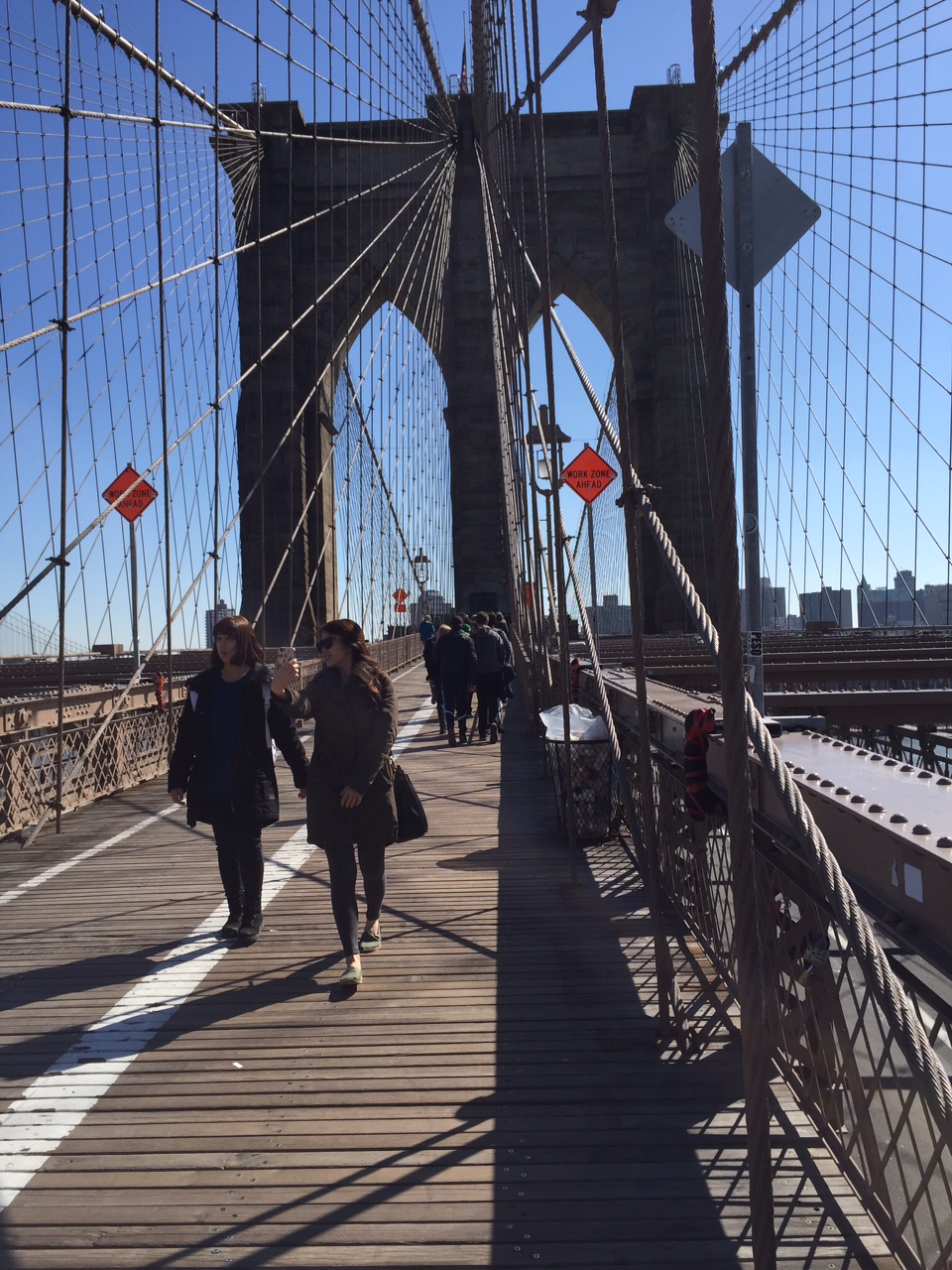
Sunday morning is quiet in New York.  Well, quieter.  When it’s a beautiful day there is no better time to walk across the Brooklyn Bridge.  I thought I hadn’t walked it before, although I’d driven across a couple of times.  But actually I must have walked it,  because I remembered walking on wooden planks.  It seems fitting that on an old bridge the walkway is wood.


SPACES AND TRAINS


At the World Trade Center, the memorial in the foreground, the new winged PATH station in the center

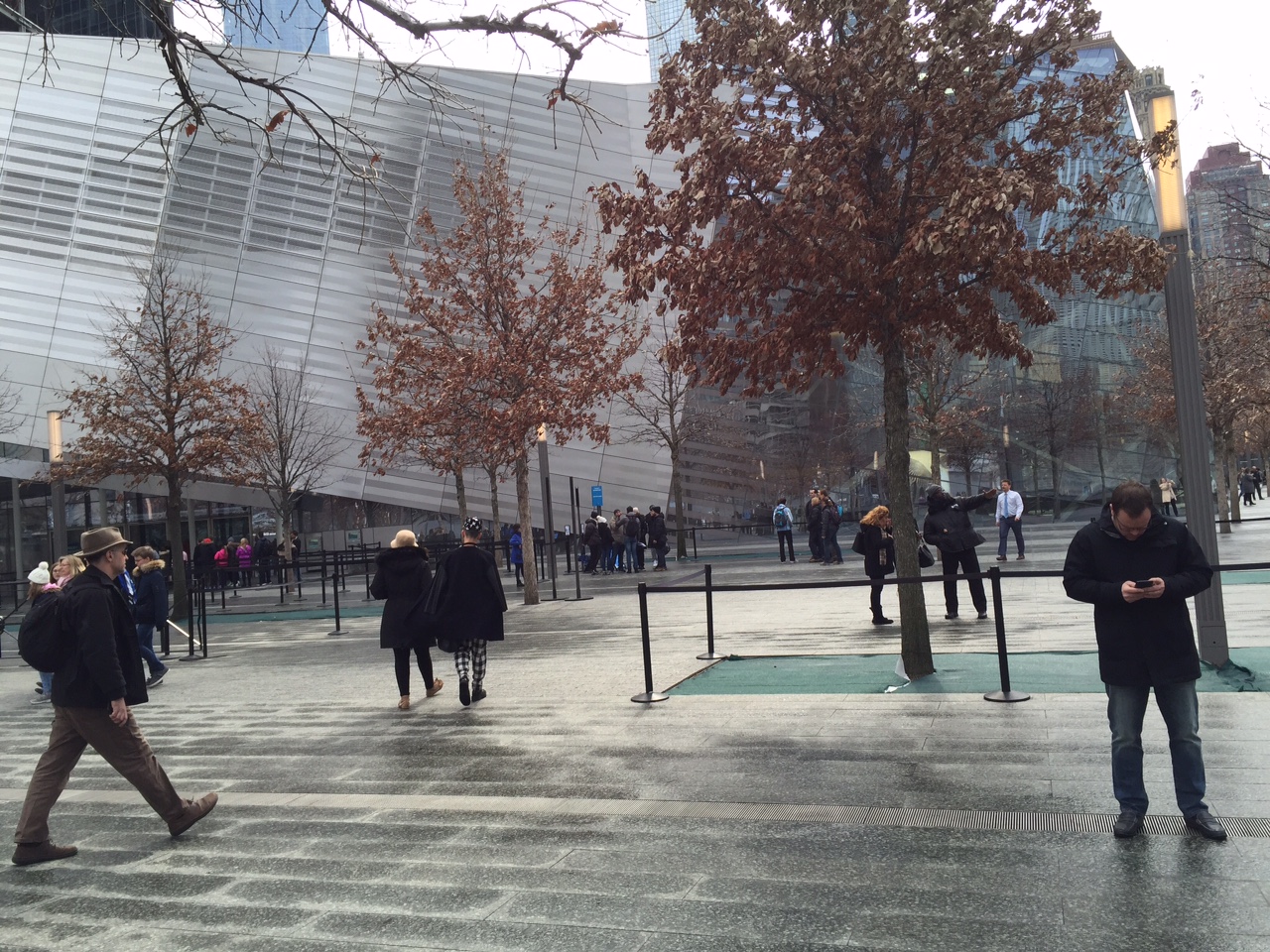
With time to kill the day we were to take the train back we walked a few blocks further downtown from our hotel and found ourselves at the World Trade Center.  We were here in early October 2001, when the debris of the collapsed towers hadn’t yet been cleaned up.  Tourists were still taking photos of themselves hugging firefighters and police.  A strange smell was still in the air and dust lined the street and filled nearby shop windows. A jagged piece of one of the Trade Center’s outer wall was was sticking out some twenty or thirty feet in the air rom a pile of debris.  Left as it was I thought it would make a great memorial. What we have in place now is much different.  When we were here last the new WTC building was still under construction and the museum hadn’t yet opened.  We had  looked at the two square holes, spooky then as now, the waterfalls disappearing into an unfathomable dark pit.  The new museum building captures something of this feeling in its downward slant, as if it were sinking. 


The reflective section of the WTC museum

The opaque part of the museum

The white wings of the new PATH (Port Authority) train station are dramatic, even flamboyant.  I’m not sure how I feel about them.  The project, only just officially unveiled, was called the most expensive train station in the world in an article in the New York Times:  “Santiago Calatrava's Transit Hub Is a Soaring Symbol of a Boondoggle.”  One can understand why.  It cost nearly $4 billion (billion!) and serves fewer commuters than Grand Central Station (46,000 compared with 208,000, daily).  Penn Station, where our train arrived, is a complete joke architecturally.  Actually there isn’t even a building. The once magnificent station completed in 1910 was very grand, inspired by the Paris’ Gare d’Orsay.  Alas, it was deemed too grand in the 1950’s for a declining railroad industry and was completely demolished.   (What were they thinking?  No more trains at all?  Ever?) When you arrive you’re already underground, so you simply exit from the train into the subway. Or climb up to street level.  Madison Square Garden looms somewhere vaguely overhead.  Penn Station serves over 600,000 people daily, and is the busiest transportation hub in all of North America.   You would think it could have some presence above ground. 

It was nice to be able to look backward, and possible as we were in the last car.


Monday, February 15, 2016

WHY ARE THERE ICE FEATHERS?

Or, Up and Down With Winter


ICE FEATHERS (Photo by Chris Huston; not black and white)


The other day, a real bone-chiller (minus 30 on Sugarbush summit that morning) son-in-law and neighbor Chris took a walk in a field behind his house where a small stream winds its frozen way.  He took a photo of what he saw.  


In December we (not only “we”) could have spent a couple of days at the beach, wearing bathing suits practically, had we chosen to, yet a week or so later we donned ski layers for some downhill at Sugarbush and cross country at Rikerts, up Breadloaf way.  Shortly afterward––I’ve lost track of these changes––I heard some commercial maple syrup farmers (do we call them farmers if the crop is sap?) were starting to tap their trees because the sap was running.  Spring.  In January.


Skyler and me on the mountain near our house in January (Note the lack of snow!)

Whenever the snow vanishes it reveals what the dogs have left behind. (You know what I mean.)   For reasons only a dog understands, all the turds are located, appropriately, atop the septic mound.   This is where Skyler and his sister Daisy who’s often here like to sit and view the woods and the field, and where they bark at things no one else can see.  They’ve worn a straight line to what they think of as the back edge of their domain––at least a dozen feet from the invisible fence––where it makes a 90-degree turn and heads to a second spot with a slightly different vantage point.  Creatures of habit.


Halfway up at Mount Ellen, Sugarbush, one good snow day


 It’s hard to know what to do:  outdoors you can ski one day, walk along kicking fall leaves another day. 


Birds accumulating on the bush near the bird feeder one cold day


Is it because of El Niño, the warm Pacific currents that the weather pattern has been so perturbed?  In the Galapagos in December we heard about the disastrous effects of a previous El Niño. This year’s is particularly strong.  I should say, disastrous for some.  Unusual amounts of rain in that archipelago mean tough times for sea lions and some other ocean animals––their food vanishes­––but good times for land animals like iguanas and tortoises.  Deer probably benefit here because every other week the snow melts and they can browse the grasses.  The have only to wait out a couple of days of extreme cold.

One of those warmer days grandson Hans christened the dinghy (plus oars) he’d crafted this fall in the bay in Newburyport.  He arrived here a couple of days later to begin Middlebury College life (he and about a hundred other freshmen are called “Febs”) just in time for the three coldest days.  They spent the coldest day of all at the Snow Bowl where the wind chill was about 20 below (minus 29 Celsius).


Checking out the dinghy in Newburyport, in early Feb


When Chris showed us his photo of ice feathers I thought of hiking over to that stream and having a look.  I wondered whether the conditions were such that every area of frozen water would exhibit the same phenomenon.  I walked around and onto our pond.  It was smooth, the ice covered with a thin film of snow.  But near the overflow that goes beneath our driveway where the water is less likely to be still, I saw the feathers.  Not as beautiful nor as large as the ones Chris saw, but ice feathers nonetheless. This is how they are made: in really cold air wind blows the water away before it can freeze in some places while allowing it build in others.  Some water evaporates, other bits attach to already frozen bits.  The physics of crystals.  Rime ice like this is often seen on the stunted trees at mountaintop level, the ice crystals facing away from the prevailing wind.

Looks cold, doesn't it?  


Why are there ice feathers?  Because they’re beautiful, of course.

Tuesday, December 29, 2015

NOTES FROM [what was] A FAR SIDE OF THE WORLD: Galapagos

The white stuff on the heads of marine iguanas is from spitting out salt.


It was December, the beginning of the warm season and at the cusp of the wet and really hot.  The water temperature was already 82 degrees.  (Don’t come here in February!)  Following on a couple of days in Quito we were on a 15-passenger ship that visited probably half (I lost count) of the 18 islands that make up the archipelago. Like everyone else before us, we were drawn there because of the unique wildlife of the Galapagos.  Darwin’s 1835 visit had put the place on the map for most of us.  We saw pelicans, boobies, sea lions, iguanas, penguins, tortoises and sea turtles practically within hours of our arrival, and crabs with the delightful name, sallylightfoot.  Snorkeling and panga rides later on added sharks, rays, many varieties of fish, more sea lions.

What interested me as much, maybe even more than the wildlife, was the cataclysmic geology and the human history minus Darwin.


A suggestion in rock and tuff of the cataclysmic shaping of the land.  Our ship peeks around the corner center right.

The land breaks apart

The new lava is only a thin layer


Puerto Villamil, one of the smaller towns


THE GOOD OLD DAYS

Errant winds brought the first human visitors to these volcanic islands.  Until the early 1500’s the fish and birds and reptiles had the place all to themselves.  Those were probably the Golden Years.  Except for the fluctuations of climate, occasional volcanic lava flows that burnt unsuspecting iguanas to a crisp or singed sea lions swept into hot water, life pretty much went on as it always had. Today 26,000 people live in the Galapagos.


A typical beach, with pelicans, sea turtle nests in the dunes


An old caldera in the highlands of Santa Cruz island


PLUNDER


It was publicity that put the islands on the map, literally.  Ships may have been blown off course for accidental visits in the early 1500’s or even before, but none left word of their impressions until 1535 when a ship aiming for Peru and carrying a notable, the Bishop of Panama, drifted to the islands, desperately short of water.  Water was then, as now, a rare commodity on the islands (the highlands are moist, but because the soil is so permeable hardly any of it remains on the surface) and after exploration of several islands water was eventually found.  The significance of his visit was the letter he sent to King Charles of Spain in which he described the islands.  (“Giant tortoises,” he wrote, “with shells shaped like riding saddles”––galapagos in Spanish.)  With that, the islands had been officially discovered.  It wasn’t long before there was a world map including “Insular de los Galapagos.” 

And it didn’t take long for commercial interests to find their way to the islands, especially Floreana because it was known to have water.  By the 1700’s the Galapagos had become a base for pirates.  (As the local name Buccaneer Cove reminds us.)  By the late 1700’s and well into the 1800’s pirates were largely replaced by whalers.  Herman Melville visited.  A cabin boy from the Nantucket whaler Essex, source material for Moby Dick, set fire to Floreana Island in 1819 in the dry season just for fun. It burned for days, if not weeks.  The first known permanent human resident on the Galapagos was an Irish sailor who was deposited onto Floreana Island by his whaling shipmates. Becoming virtually feral, he managed to survive for three years by growing vegetables and trading with visiting whalers before finally stealing an open boat and navigating the 500-plus miles to the mainland.   

In this pre-environmentally inclined world it was all there for the taking:  iguanas, birds, sea turtles, tortoises.  No creature offered resistance.  One of the amazing characteristics of giant tortoises is not only that they live incredibly long,* but that they can survive for many months without either food or water, inadvertently providing the ideal food storage material for ships sailing on what were often year-long voyages: Stack them in the hold and use as needed.  The tortoise population, once over 250,000, never recovered.  Making things worse, whalers introduced goats, letting them loose on several of the islands, the idea being to recover them as needed, another blow to the environment and tortoises in particular.  There are still goats on some islands.**

A gallery of a few non-human inhabitants:

Sea turtle, many of which we saw busy mating

An endemic (only in the Galapagos) flightless cormorant

Galapagos pelican
Young sea lions playing around in the shallows


A pair of sea lions taking up all the bench space at Puerto Ayala


Iguanas piling up to warm themselves in the sun.  Different islands have differently colored iguanas.


A so-far-unidentified starfish

Seven frigate birds flew overhead above the bow of our ship for hours.

Galapagos gulls at a nest, courting. We saw the male making forays to pick up small twigs to present to his mate. 

A Great Blue Heron.  Wait!  Could that be the one that migrated from our pond in September?


An iconic Galapagos resident, a domed tortoise seen in a sanctuary in the highlands of Santa Cruz.


***


A British whaler set up a mail barrel on Floreana Island in the 1700's.  That there was a need for an exchange of mail says much about the numbers of visiting ships in that day.  Anchoring ships were easily spotted from the hills behind what is now called Post Office Bay.  The barrel––replaced of course many times since the 1700’s––is today a drop-off for tourist postcards intended to be hand-delivered in the same spirit.


Adding some mail to the post office box at Post Office Bay, and taking several to deliver.


The nineteenth century and the beginning of the twentieth was no kinder to the Galapagos.  Prisoners were sent there in the style of France's Devils Island.  Immigration from the mainland brought with it more building, overfishing, and introduced species like rats, cats (we saw one feral cat), and dogs.  Current invasives include fire ants, fruit flies, and a kind of wasp. 

Other miscellaneous insults to the islands included the US Navy using a few of them as a base to protect the Panama Canal during WWI.  Around that time Ecuador, pressed for cash, tried to sell the islands.  (Our guide said the current president had expressed a similar idea, only this time the potential buyer was China to which country Ecuador is indebted.)  During WWII the US Air Force used at least one lava cone for bombing practice.  Known as Pinnacle Rock, much of it still stands. 


Pinnacle Rock is the pointed peak at far right.  Snorkeled around it, from beach on one side to the beach on the other side.


BROKEN DREAMS


Publicity, beginning with the Bishop of Panama’s letter to the King of Spain, has rarely done the Galapagos any favors.  In the early 1900’s an article appeared in a Norwegian newspaper about the fishing potential in the islands.  Over 1,000 Norwegians soon showed up in the Galapagos to make their fortunes in the fishing industry.  By the end of their first year almost all of them had returned to Norway.  Stories about other potential money-making projects drew unsavory characters.  Some attempted to grow sugar cane and exploit lichen, others to mine guano and sulfur.  For one reason or another, all of these schemes ended in failure, even murder. 

All endemic flowers in the Galapagos are yellow.
We heard the following story (and watched a documentary on board ship about it.  It happened on Floreana): 

In 1929 an article appeared in a German newspaper about the Galapagos, this “paradise” at the far side of the world.  It attracted a couple that longed for an “Eden” where they could live apart from the rest of the civilized world, and, interestingly, apart from their respective spouses.  They were a strange pair:  Ritter, a doctor with the philosophy of Nietzsche on his mind, and Dora Strauch, his lover and devotee.  Newspaper stories back in Germany of their settlement on the island of Floreana attracted the attention of yet another family––the Wittmers, husband, pregnant wife, and teenage son––who also felt a desire to return to nature.  So two years later they too made their way to Floreana.  Alas, they did not make good neighbors, as the initial pair had not planned on having neighbors at all.  There were severe tensions right from the start.  All too soon a truly weird addition joined Into this emotional mix:  an Austrian “baroness” (self identified as such, but possibly a dancer in a previous life) arrived accompanied by three men, one an Ecuadorian laborer, two or perhaps all three of them her lovers.  Often brandishing a whip and a pistol she began to play a role as the self-proclaimed queen of Floreana, and announced plans for a luxury hotel for wealthy visitors.  This new addition to the population brought shock waves to the two already uneasy settlements.  


A view of Floreana.  Not the most welcoming place, but it has some water, a lava tube, and now a town of about 100 or so.


With the baroness’ encouragement, the journalists who arrived with each passing ship elaborated on her already fanciful stories that ended up featured in the tabloid newspapers of the time.  Yachters made efforts to stop at Floreana to see the place for themselves.  But no hotel or other facilities were being built at all.  No one else came to stay, only to gawk.  The complicated relationships of the three separate parties on the island began to grow increasingly uneasy, while simultaneously becoming intertwined.  There were arguments, acts of extreme hostility, yet at the same time there was socializing, filming of one another and posing for photos.  Lorenz, one of the baroness' lovers, began to align himself with the Wittmer family, informing them that he had become a slave in the baroness' household.  The Ecuadorian, meanwhile, had long since disappeared.  (Are you following this?)  One day Lorenz announced to the Wittmers that the baroness and her other lover had announced they were leaving for Tahiti on a passing ship.  No one had seen a ship, passing or otherwise.  The baroness and her lover were simply gone––disappeared.  Curiously, a scream had been heard the previous night, yet no one admitted to knowing anything.  In the baroness’ absence all her possessions remained, and the Wittmers soon appropriated many of them.  No bodies were ever found.  While all this was going on the Ritter-Strauch relationship had been deteriorating.  Unexpectedly––suddenly––Dr. Ritter was dead.  The cause was suspect:  Ritter, a vegetarian, had been poisoned by, of all things, contaminated chicken.  It had been prepared by Dora.  At this point Lorenz left the island in a hurry, having persuaded a captain to take him to the mainland on his small boat, unwilling to wait for a larger vessel.  Lorenz was never heard from again.  Several years later his and the captain’s desiccated bodies were found on a beach on the most remote of the Galapagos islands.  Dora Strauch eventually returned to Germany.  Descendants of the Wittmer family run a guest house on Floreana.  No one now alive knows for certain who murdered whom.


A young Darwin (as opposed to the old Darwin of other island statues) looks out at the harbor in San Cristobal;


 *When Darwin left the Galapagos in 1835 he took with him three young (aged 5 or so) tortoises.  Two of them died.  The third tortoise ended up in a zoo in Australia, cared for by none other than Steve Erwin, the late zany TV zoologist.  Named Harriette, the tortoise died in 2006 at age 176.


**There was a major goat culling in the 1990’s but not all goats have been killed. Goat meat is less popular than it was, removing some motivation for further culling.


Friday, November 13, 2015

WHAT TO DO IN NOVEMBER


What is there to say about November?  It’s all about waiting.  It’s about absence.  

The very last yellow leaf that held on for dear life, even in the strongest wind, is gone.  Disappeared.  It seems to have happened when I wasn’t looking.  The geese aren’t flying overhead any more.  No ducks are visiting the pond.  Hummingbirds are a distant memory; I think they checked the calendar one day and took off even before there were signs that summer was planning to turn into fall.  I can only wonder what became of the muskrat family that holed up by the pond or the weasels that lived under the patio.  The hawks and turkey vultures disappeared too, after days of graceful swooping across the fields, fields they have now abandoned to the crows.  Squirrels and chipmunks are all I’ve seen of mammals lately.  Not even deer.  It’s rifle season for deer as of November 1st and they’re not likely to make themselves known.  Yet––and of course there’s an “and yet”––it is still beautiful, especially on clear sunny day that last only until 4:30 in the afternoon when the light turns yellow.

Late afternoon light on the fireplace wall


 NOT November on the Robert Frost Trail:  October fondly remembered


It has in fact been more sunny than dark from September until now.  Our solar panels have generated more kilowatt hours from January to December than they did last year.   (We got the panels halfway through June of 2013.)  One way to measure this by comparing the solar credits we have from Green Mountain Power compared with last year: over $1,700 as of November 1st , $200 more than last year.  This was not profit as we pay (leasing) for the panels.  So far they have provided 39,000 kilowatt hours since June 2013 and offset 30 tons of carbon emissions.  What is amazing about solar power here in Vermont is how much of it there is throughout the state.  I’m impressed at what Vermont is doing in the direction of carbon neutrality.  Solar companies are putting up arrays with great enthusiasm.  So much so that array siting has become an aesthetic issue.  There is a backlash against very large arrays, say, five acres or more.  I happen like the way our three panels look.  They tend to disappear into the background from most angles and they are far from the road.  However, this isn’t the case everywhere.  In some locations they are unshielded and smack against a road.  In other places large arrays it’s a question of the acreage they cover.  It’s also just the fact that they cover:  panels create ground shade where there would otherwise be sunlight, removing yet another potential area from bobolink territory; these are birds who will not nest in or near shaded areas, and like so many ground-nesting species, they are vulnerable not only to natural predators, but cats and, notably, mowing equipment.  It’s is why in many fields late season haying is their only ticket to survival. 


An ugly solar array in Middlebury at Vermont Sun Fitness Center; across the street is the Cabot Creamery.


On the other side of the season’s arc, fall instead of spring, the maple syrup ritual was replaced by apple cider time.  Our apple trees produced delicious, if seriously misshapen, apples this year on two of our four trees.  Since you don’t need to have male and female apple trees for fruiting (unlike holly, for example), I can’t understand why we have two productive trees and two utterly stubbornly unproductive trees.  Ideas, anyone?  The apples produced by the Good Two trees were deep red and tart, like Empire apples. They made the tastiest applesauce I’ve ever eaten, but, alas, only after endless and tiresome peeling and trimming of their bumpy, crooked bodies.  The Bad Two made nothing whatsoever.  They didn't even try.  Our Huston family next door has several huge old apple trees, plenty of apples for making cider, and then some.  The biggest obstacle to churning out cider is the challenge of efficiently turning whole apples into small chunks for juicing in the press.  A while back the Goudey family came up with the idea of using a garbage disposal that got attached to an old sink the Hustons supplied that turned the apples into mush before they went into the press.  Running the press then became a piece of cake. 


The sink with garbage disposal arrangement for cider-making


Apple cider.  Pumpkins, pumpkin pie. A lot of what's left of November is taken up with planning for Thanksgiving.  


Nothing else to do then but wait for the snow.