Tuesday, April 16, 2019

MEANWHILE, IN ALBANIA...


The huge main square in Tirana. In the background a Stalinist-age mural adorns the national museum.


I was in Tirana.  Except for one vowel, the word could have been tyranny. Tyranny was about all I had known of Albania in the past.  A country with a nasty history, ruled by tyrants, without a beneficent government–ever. My first impressions were much brighter:  I noticed the liveliness of the streets, people filling tables at outdoor cafés, numerous restaurants, and newish apartment buildings here and there.  And the weather was the best of spring. The city felt benign, welcoming.  The current fashion of younger men with their punky haircuts, grizzled faces and tight leather jackets gave them a kind of dangerous look. If you saw someone looking like that in Vermont, you might step back. But this wasn’t Vermont.  


This was the first leg of a trip through what was once Yugoslavia: Montenegro, Croatia, Bosnia-Herzegovina, and Slovenia.

The older men don't look stylishly punky at all, unlike the younger guys; they look unemployed.

 Our Guide to Tirana


It was only me and Nora, a Chinese lady from San Francisco, and our guide Klodi in Albania. Klodi’s story reveals a lot about Albania, although I didn’t learn all this until we’d spent a couple of days with him.

He told me he had trained as a veterinarian in a college in Tirana, one of the colleges that actually expects students to work at learning, as opposed to the other college for those who only want to buy a degree.  But Klodi said he never practiced as a vet for two reasons: the first was that Albanians don’t really care about animals; the second was that his professor owns all the veterinary clinics in the country, thereby eliminating the possibility of Klodi opening a practice of his own.  One could question this explanation, as to why study veterinary science in the first place, and so on, but we did not.

Klodi is married, his wife an elementary school teacher, and they have two children, one of which, only a few months old, was born with cystic fibrosis.  There is a single doctor in all of Albania who is able to treat this disease.  Klodi would like to move to Germany for the baby’s health, but at present this is only a hope.

He talked a lot about corruption in Albania–it was unavoidable as the physical results of it are everywhere–but shrugged his shoulders at possibilities of reform and change.  It goes so deep and has existed for so long.  When Klodi was a teenager in the late 1980’and early 90’s after the 1985 death of dictator Enver Hoxha and the years of unrest that followed he had a gun to protect his family. We didn’t ask if he ever used it.  We liked Klodi.  We didn't want to give him a hard time.
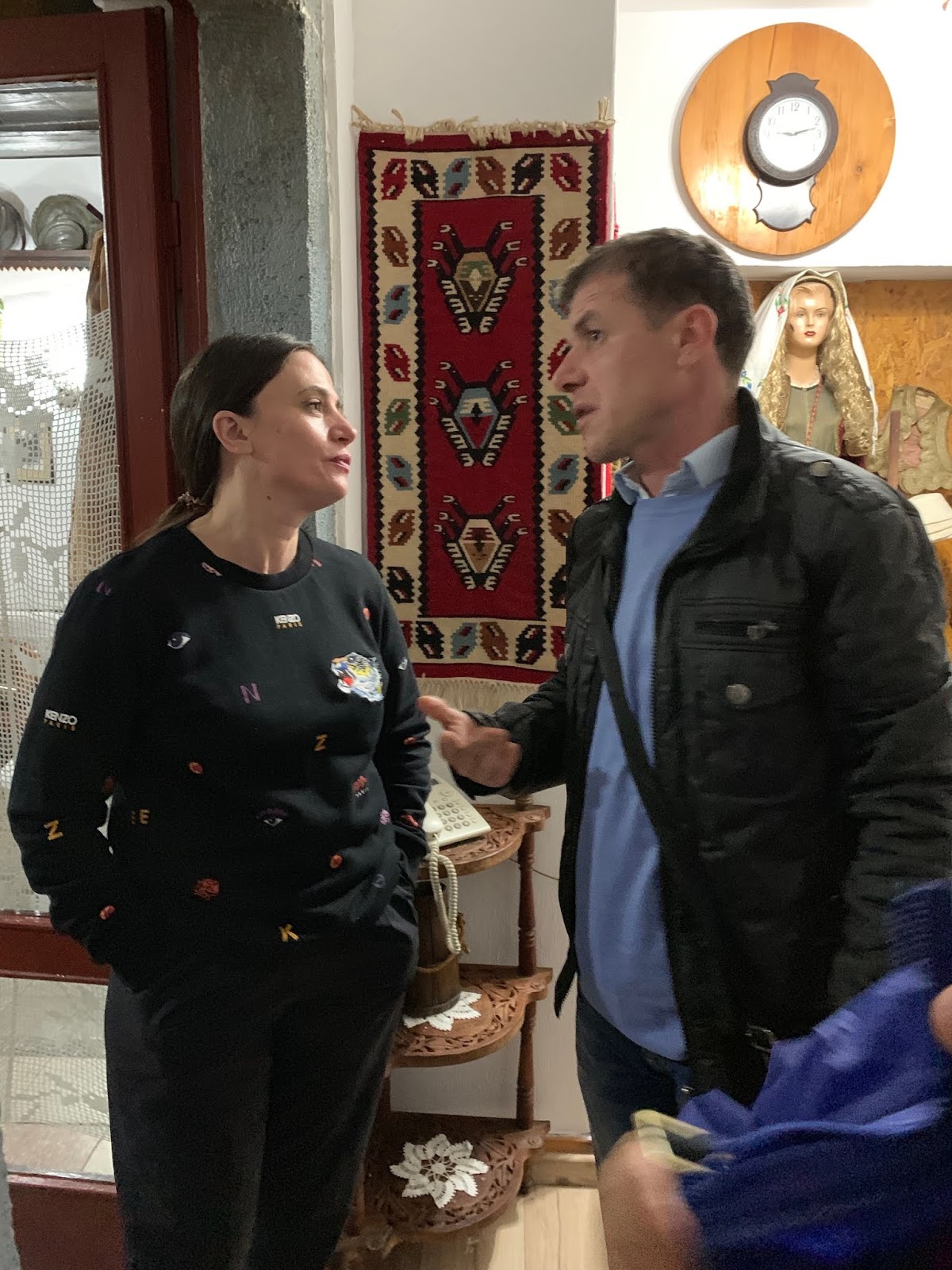
Klodi at right, with owner of a restaurant where we ate.
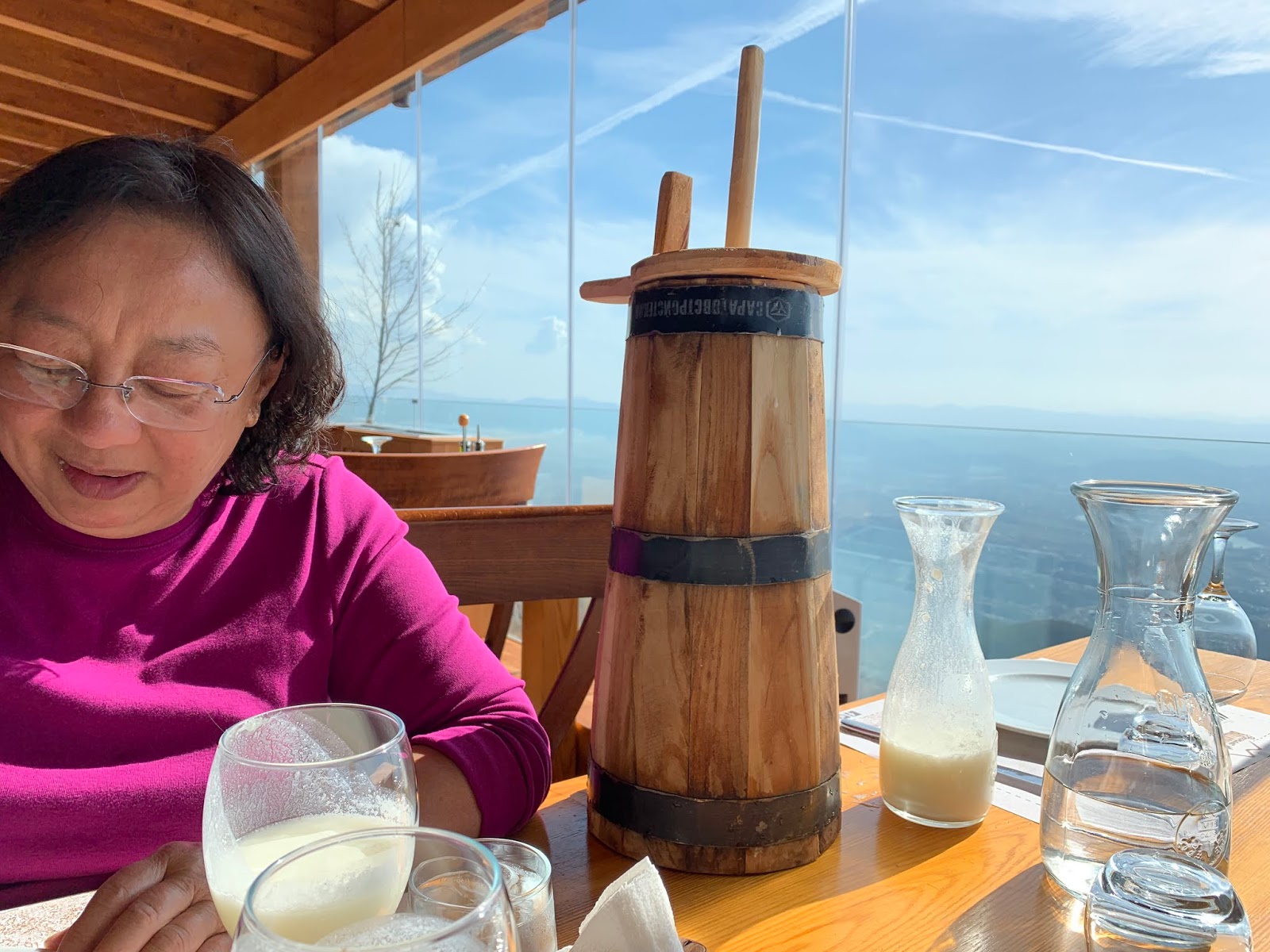
My co-traveler Nora at the mountaintop restaurant overlooking Tirans; next to her
is a churn in which our drink of fermented milk was made.


Corruption 


A daily paper, and in English!


Two days before our arrival there had been an anti-government protest in Tirana, and there was another protest two days afterward.  The first was met by water cannons, but the second was peaceful.  Although our hotel was only two blocks away, daily life appeared to continue normally. The current president, a powerless figurehead compared with the prime minister whose resignation was the protestors' goal, offered to resign after the second protest.  The reaction to this was a collective shrug.

Klodi pointed out a tall building (it was hard to miss) just off the main square that looked as if it was under construction, complete with building crane.  It has looked exactly like this, he said, for fifteen years, crane and all. Construction projects like this are allowed to break ground without guaranteed financing.  So what stopped it?  Financing that fell through?  A shrug.  Maybe a bribe not paid.  Who knows?  Buildings are not taxed until they are completed. Hence the half-built, half-collapsed, often abandoned structures that litter the landscape. Yet there is money somewhere. Expressions of wealth abound in fanciful structures unconstrained by a lack of imagination. Expensive cars crowd the streets.  Outside of town shepherds stand around watching sheep. Why not just fence them in?  Why should a guy spend his time watching sheep? we wondered. Because someone would steal them, Klodi responded.  It is a poor country.  An average monthly salary, said Klodi, is about USD280.


The hero on horseback is Skanderbeg (Lord Alexander) who fought against the Ottomans in the 15th century. The building at the left has remained unfinished for 15 years.


Klodi told us a story about another building in Tirana, an odd-shaped concrete building with a roof that looks like a rippled skirt (a reference, maybe, to the traditional men’s costume– the "fustanella," meaning “put it all inside”– of both Greece and Albania).  It was envisioned as a marble monument to the late Stalinist dictator Hoxha (more on this later) and designed by his daughter, an architect. In the post-Hoxha years the monument idea never came to fruition. This was hardly surprising, given the antipathies he engendered among Albanians who survived his rule.  The building began to deteriorate. Perhaps, thought one governmental ruling party, it could become an arts center.  Good idea.  Scaffolding was erected.  Then there was a regime change.  The scaffolding came down, but, sadly, there had been no restoration.  Another regime change occurred, and this time it was decided the building would be destroyed.  But before that could happen, the regime changed once more. Scaffolding went up.  After a time the scaffolding was removed.  The building had not been restored.  But all the marble was gone.


Not much is lacking in design elements. Along the road there were shops specializing in selling columns.

Another unfinished residence

Location, location...

A Ridiculously Abridged History Leading to Hoxha 


Long ago in Albania there were the Illyrian and Greek tribes. Then the Romans arrived (mostly a good thing for infrastructure building and so forth), until Goths and the Huns put an end to the Romans.  Before you knew it it was the Middle Ages, a time when clans dominated the land, literally and figuratively (remnants of their domination can be seen as crumbling castles on mountaintops), followed by a sort of Venetian-Serbian Empire that then became part of the Ottoman Empire.  In 1912 Albania declared its independence, and after a few historical bumps, became a monarchy under a self-declared king known as King Zog.

King Zog, like other self-made leaders, did a few good things to start with, but spent a good amount of time and money working on his royalness. (He had Europe scoured for a lady of actual royal blood to wed and so enhance his own kingship.) Zog's downfall came along with World War II (he had sided with Mussolini) and the occupation of Albania first by the Nazis, then the Italian Fascists (no longer friends with Zog who fled), after which a promising Communist named Enver Hoxha was installed as leader. Unlike Communist Tito of the new Yugoslavia, Hoxha’s model was not so much Marx as Stalin, although perhaps Hitler could have served him as a model equally well. The years of Hoxha’s reign were a downhill slide into oppression. Albania became the North Korea of its time.  This is the Albania I remember reading about with amazement. Klodi pointed out the section of Tirana where Hoxha and his closest associates lived in fortified splendor, enjoying the luxuries of the west that were denied to everyone else. The country became a prison for its own people. He ordered concentration camps and death for those in opposition or for causing other annoyances. The national museum has a photo of Hoxha’s closest friend and minister, killed by two bullets to the heart, heedlessly dubbed a suicide.  Hoxha’s paranoia about invasion grew large–by this time he had alienated his only allies,Yugoslavia (Tito), Russia (Stalin), and China (Mao)–and, fearing invasion from somewhere or other, was moved to build bunkers all over the country. The bunkers were intended to protect soldiers, and were not for ordinary citizens. Hoxha died a natural death in 1985.


No, not Peter Sellers, but King Zog. The source of those many medals is unclear.

One of Hoxha's many, many bunkers, this one in the middle of downtown Tirana

Out in the Country


Has all this been too negative?  I should mention that Albania seems to be a tolerant society.  Muslims and Catholics and Orthodox and various sub-sects all get along, said Klodi.  The tone for this may have been set in the early days of Ottoman rule when Christians were taxed more than Muslims.  The choice for Christians was obvious: become Muslim.  About 75% of the population today is Muslim, 20% Christian Orthodox, the rest Catholic, and miscellaneous. Klodi himself is Muslim, somewhat of a passive Muslim, his wife Catholic.  Mosques and churches often sit side by side. Throughout the Balkans, including Albania, Islam is practiced in a relatively relaxed style.  


A lavish mosque on a hilltop within Tirana belonging to an Islamic sect related in some way to Dervishes.


We visited the mountains, but did not penetrate very deeply into them.  I've read that two new long distance hiking trails exist that stretch from Slovenia south through the Balkans, but they appear to come to an end in Albania.  The Albanian mountains still hide some of this country's most ancient traditions and practices.  One of these practices that continues to this day is the blood feud between families that passes on through generations. If it happens that all the men in one feuding family have been killed by another feuding family, it is the duty of the oldest sister to become a "man" to continue the feud on behalf of her family.  This feuding is hard on children, especially the boys, all of whom must remained locked in the house all day and night if they are to live.  The government is too weak to put an end to such feuds.  Klodi said he recently saw a documentary on Albanian TV about these "men," and these feuds.  Although they once happened throughout Albania and now occur mainly in the northern mountains, this practice has an effect, he said, on the whole of society.


Rugged mountains rise steeply immediately west of Tirana. This photo was taken from a cable car to the restaurant up top.


A couple of hours from Tirana is an old castle atop which Hoxha's daughter designed a museum addition


The path to the old castle. There were not many tourists.

The crumbling remains of another, probably medieval, castle.


The Old Ways


A lovely old house that likely once belonged to a well-to-do family. Animals were kept below. There also were wine-making, weaving, and blacksmith quarters incorporated within the house below the family rooms.


The beautifully decorated doorways are low so that one must enter a room humbly.

A UNESCO heritage site of 17th century houses in Berat


New Ways


The town of Fushe-Kruje salutes George Bush!  Yes, really.  A statue of former president Bush, adorns the center of this town where Bush visited in 2007. He was the first US president to visit Albania.  Opposite the statue is a café named after him, and, in fact, the town very nearly changed its name to Bush. It's not a bad likeness.


Unfortunately too many quasi-urban roads looked like this: no site planning or zoning, and plenty of trash on the roadside.  Yes, there are laws prohibiting the tossing of trash, but, like many government laws, they are not enforced.  Perhaps there is no will to enforce them, or to abide by them.  Maybe tossing trash feels like a form of freedom.
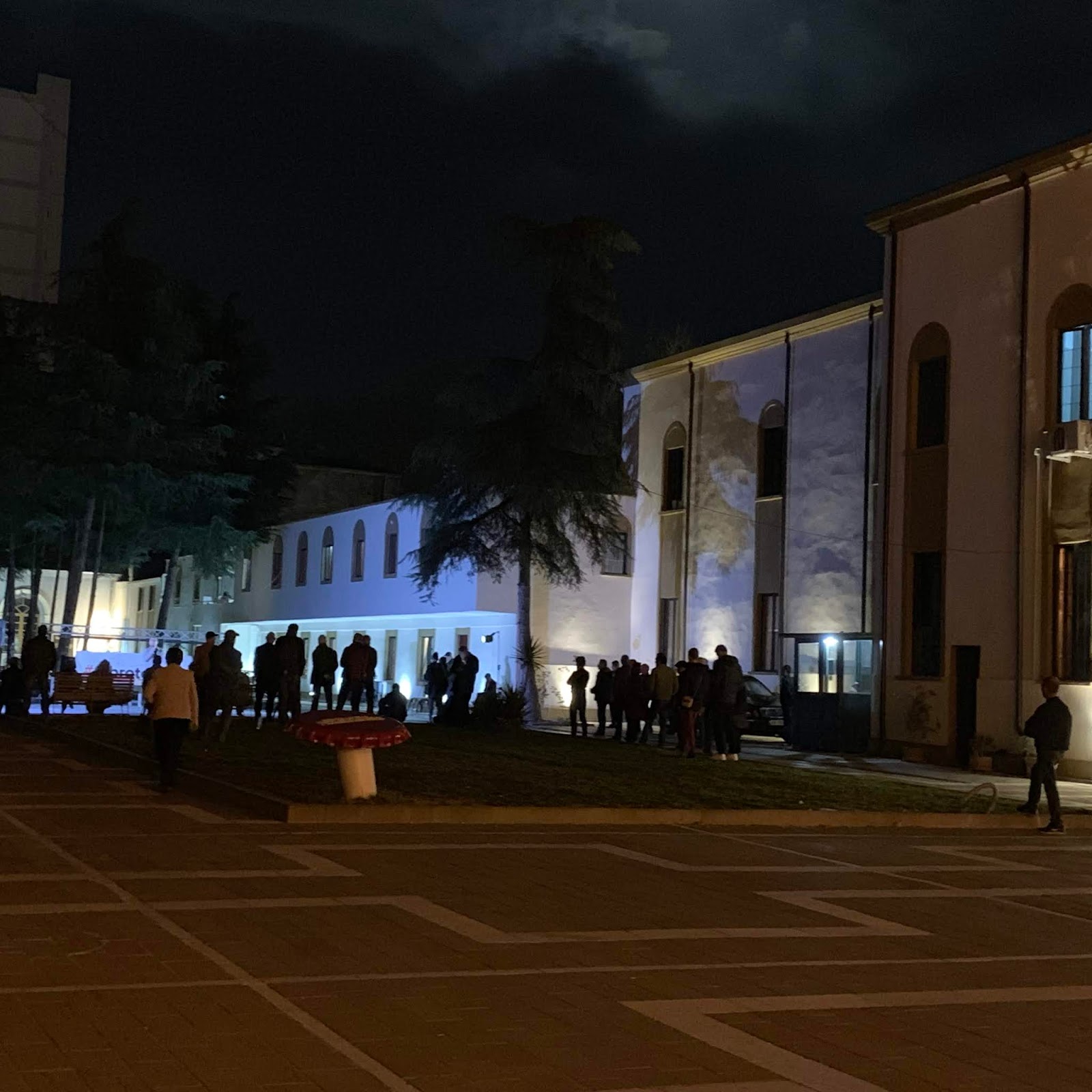


A small protest in Tirana in support of restoring a decaying theater.  Will it have an effect?


When we arrived at the border crossing with Montenegro there was already a bus parked there awaiting inspection.  The bus was headed for Germany, a long ride away.  It looked as if it had been parked there for a while.  Everyone had disembarked, and all the luggage had been taken off for inspection by a drug sniffing dog.  Luggage compartment, inside of the bus, and the passengers themselves were all sniffed.  By the time we made it through the border the passengers were still waiting to reboard.

Bus passengers waiting to cross into Montenegro, en route to Germany
The bus passengers may end up among the Albanian diaspora, joining the many who have left Albania in recent years to seek better lives elsewhere.  Last week, in the Boston airport lounge, while I was waiting for my flight, the bartender, waiter, and receptionist all were from Albania. At our turn to cross into Montenegro our passenger car's VIN was checked, carefully.

Friday, March 8, 2019

TOWN MEETING: Our Democracy at Work


From the Front Lines: Voices From the Countryside


I read today that town meetings in our smaller towns are better attended than in larger towns.  I get that.  It’s the feeling that you could have an effect on things in small settings that spurs attendance. And you are more likely to know the people running things. This year was different in one way because the usual big ticket item–translation: expenditure–was not on the agenda because of school consolidation and was dealt with separately.  It left us with much less to argue about. Almost nothing, really. (Imagine!)

Just like in the high school assemblies I remember–in this case a gym doing double duty as an auditorium, or maybe it’s an auditorium doing double duty as a gym–hardly anyone choses to sit up front.  The further back, the more of us there are.  This way we have a view of who’s who and who’s saying what. In the last row, especially, the row I’m in, we feel free to whisper about the proceedings or snicker without annoying anyone.

It begins.

A lady of 90 who has done a lot for the town is lauded. The Town Report is dedicated to her. She served on many committees and restored (single-handedly?) the town cemetery. She loved to mow, and kept the cemetery grounds mowed.  The person next to me tells me this lady mowed herlawn.  This honoree is, however, not in attendance.  (“Why isn’t she here? Is she dead?” I ask my neighbor. No, I don’t think so, she replies.)  In any case, we applaud her.

The primary business of the meeting goes quickly enough.  Although everyone speaking has a tendency to wander a bit.  After all, what’s the rush?  This is how things are done here.  No one is in a rush, almost never anyway.  There’s always time to catch up about the state of affairs, the weather, what other folks are doing, and maybe around to the weather, again. 

After a few opening remarks (our local legislators give brief reports. Our State Representative (Rep.) mumbles (I couldn’t hear most of what he was saying, mic or no), and then our State Senator (Dem.) gives an update of various environmental legislation (clear voice this time),we whip right through articles one and two.  No questions, no debate.  I was (almost) disappointed.  This is too easy.

But wait.  There is a question from the floor regarding articles three and four that concern (3) “creating” a Conservation Commission, and (4) ratifying actions taken while under its previous designation as the Conservation Committee. Both articles are apparently the result of some sort of bureaucratic oversight, causing the Committee status to have reverted to Committee status. (This sounds like an odd oversight, but everyone involved is a volunteer, after all, and, well, things are kind of low key here. A Library Trustee incumbent, for example, forgot to file her papers on time and is asking for votes as a write-in candidate.)  

The question is being asked by a man wearing a MAGA hat, suggesting an agenda perhaps at odds with anything conservation-ish.  “What does a Conservation Commission do?” he asks mildly. He might as well add “anyway” to the end of that question, as he also wonders what such a Commission does, as in “who needs this?”  Alas, the committee member responding seems to miss the import of the question (that being the intimation that the Commission aka Committee is yet another grab for power by us elites).  He responds at some length about all that the group tries to do, like weighing in on solar array issues (a red flag for some local Trumpers, vehemently anti-solar), inviting speakers about protecting wildlife and such (odds are good that the MAGA guy is a hunter), and further that the Commission would really like to do more, have morepower if it could, although it does try to be more powerful, and, yes, could be funded by grants, instead of the town(No! No, don’t say that! many of us are muttering), but this would be daunting, and so forth.  With a budget of only $500, of course, most of the rest of us can be pretty comfortable about any kind of conservation power grab.  Remaining unsaid was how conservation groups help monitor and protect the beauty of our town for us and for the future. Alas, indeed.

I am anticipating some action from our local bête noire, a Trumper and all around thorn-in -the -side* who, having failed to win an assistant judgeship for which he had somewhat unethically campaigned (his signs read asked you to vote for asst.JUDGE TXXX, so unless you put your eyes within inches of the sign you would assume he was a judge), was running this time for Town Treasurer and not just one, but two positions on the Selectboard.  (Spoiler: He lost the county-wide asst.JUDGE position, coming in last, and came in last for all three in this vote.) A surprise! His brief candidate speech is low key, almost as if he senses, somehow, that he will lose.

A question from the floor spikes our attention: “There is automatic rifle fire every Sunday morning in church. I think something should be done about that.”  (Not an exact quote.)This is a waker-upper. We have visions of people running around shooting wildly on the town green.  (Who? Where? What?)  Well, it turns out there is a shooting range in town, one used by none other than our State Police, who are apparently fond of shooting on Sunday mornings.  Whew. After some discussion–what to do? It is the State Police, after all–a voice from the floor suggests maybe someone could ask the State Police to refrain on Sunday mornings? Problem solved!

Onward to public works. I am beginning to drift as are the rest of us in our back row.  Our roads-and-stuff guy likes to explore the topics thoroughly when he talks about his duties and his department and doesn’t like to leave a stone unturned when he answers a question.  So we are fully informed about the need for a new tandem truck** and the maintenance costs for the old tandem truck, and the rust, and the reliability, and the wear and the tear of the old tandem truck, and the need for a new tandem truck because of the rust and the reliability, and the wear and the tear, and the culverts and the drainage, and the

I miss the rest of the roads-and-stuff explanation as it sounded likely to continue for a good while.  A couple of us in the back row (that’s why we were in a back row, right?) made our quiet exits.  Democracy works!


(I should mention that there are many more articles, i.e., expenditures, to vote on, most of them small and for charities, local good works and the like.  They all passed when we voted the following day.)


  *Refer to an earlier post: “Road Stories,” 5/18/18
**Truck with a double axel in the rear; a dump truck.

Sunday, January 20, 2019

EIGHTY MILES AN HOUR


Time compresses. It's all a blur!


Here I am, speeding along at 80 miles an hour.  Olin says, you need to be going 88 mph to get back to the future. That was the speed that worked in the movie.  But I'm not sure I want to go back.  Returning to where you've already been has its up sides, certainly, but when you look more closely there are plenty of down sides.  And which time would you choose, anyway?

I’m not really sure how how fast 80 is, I'm just finding out.  Just starting to accelerate, as it were.

Time is a flexible thing.  A relative thing.  Most of us sense when time is speeding by and when it drags.  We learned relativity from Einstein, of course, but it’s right here in everyone's ordinary experience.  We are aware of it in sometimes odd ways.  If you’ve had a fall, or been in an accident, or jumped into the water from a very high place and you think back about the experience, the motion of it, and try to visualize it: didn’t the time it took to happen feel elastic?  As if it happened in slow motion?  When in fact it took only a nanosecond.

As I said, eighty is a number of great import.  It's heavy.  I think about it, and I weigh it.  It contains two forties, four twenties.  Those are numbers of entire lives.  Now take forty, for example.  Forty is a nice number, a neither here-nor-there number, so you can have it both ways, if you know what I mean.  But it's an underappreciated number, believe me.


Metaphors.  So you don't actually have to talk about age.

So:  Aging is diminishing.  It's a highway to nowhere. We get smaller, skin begins to look like old fruit, limbs don't work as they did, files get jumbled, and so on and so on.  And on.  People acknowledge all that, but they don't know it.  You should feel smarter than you ever were (after all, there are miles of information in that mental filing system) but it's harder to sound that way. When you manage some simple thing––maybe something not everybody going at the same speed as you can do–is that good?  Is it really amazing? Amazing is scary.  Does it mean you're just testing the speed limit?  Pushing the envelope? Are you going to get stopped?  When, exactly?

It’s all very tiresome. So I’ve decided to forget it all.  Which is harder than you might think. I suppose this is evidence that I'm not forgetting.


Some moments can be lived fully.  (The same scene, seen more clearly.)  Living with nature makes all the difference.


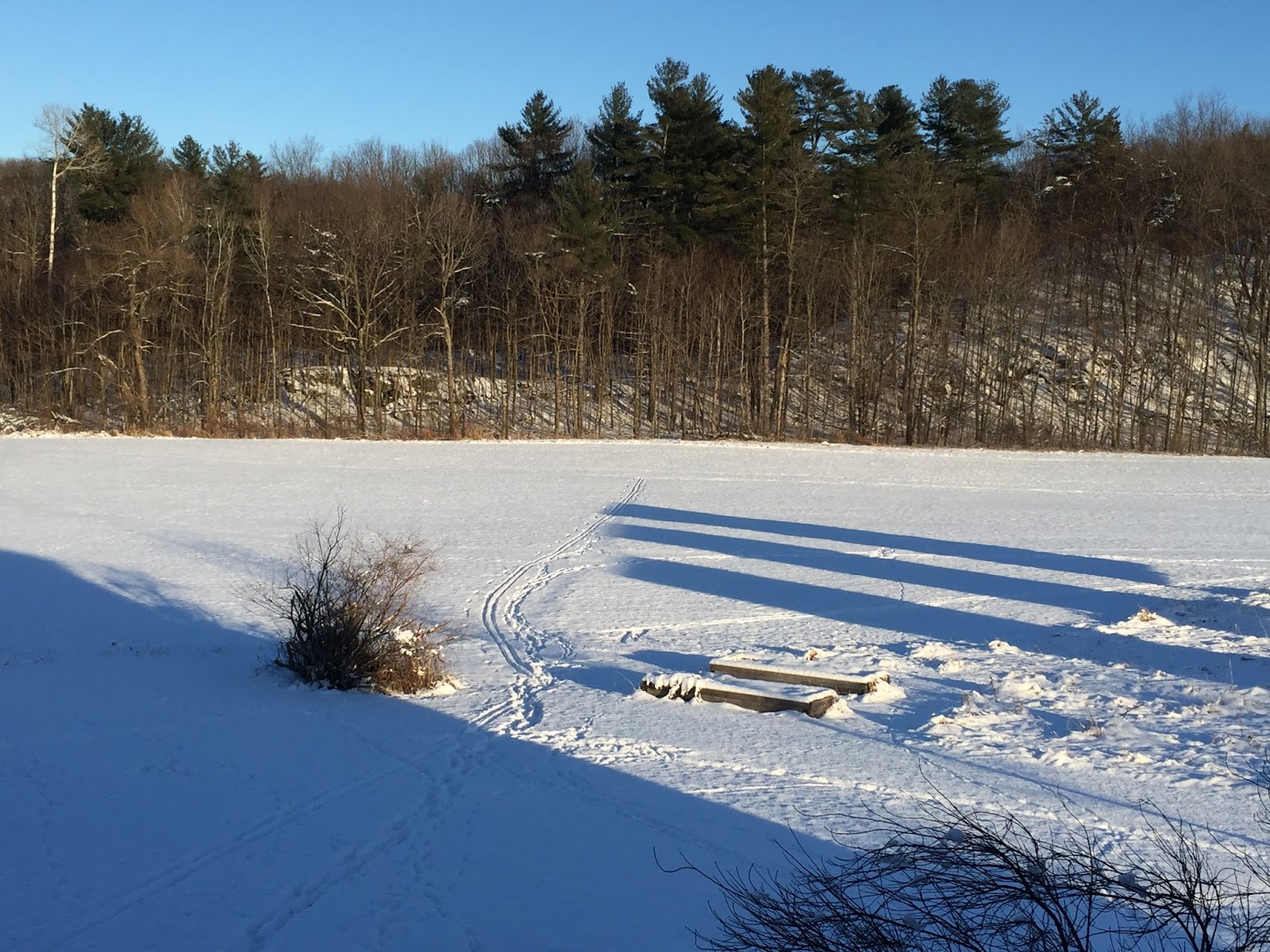
This morning Skyler got me up at his usual seven o’clock and I came downstairs in bathrobe and slippers, fed him, let him out, made coffee, made a fire (it was minus 6 outside), let him in, went back upstairs and got dressed, let him out, went outside and hauled wood to the back porch, made an apple crisp for everyone tonight, let him in, had lunch, took him out for a walk in the woods which involves a thorough inspection of the night’s wildlife traffic, went for a brief ski in the same territory, had a shower, let him out, let him in etc. (Skyler's actions are highly repetitive), got ready to go to an afternoon party in town, started to write this bit, and expect later to bring my apple dish next door for tonight’s dinner.  A busy day.  All this took about 15 minutes, total.


You may ask Y? or Why?
[Trails made by muskrats who know their letters.]

I exaggerate.

But–seriously–a week can pass in the space of a day.  The quicker you move along...  Wait.  To be honest, the more years you add, the closer you get to the end of that road.  There it is.  That's what eight-zero is really about.

But maybe we're all going too fast.


Tuesday, October 30, 2018

FALL DOWN AND CHANGE


Signs at a fervently Republican household. Their Trump signs stayed up for months in 2016. The display felt too hostile, so I took the photo from my car.


Jarring, those political signs in the landscape. It’s the best time of year right now, so that’s why they startle. I admit that when spring comes I say that’s the best time of year, especially if the winter has been a tough one (that is, lots of snow) or a boring one (no snow, just dreary weather). Yet it’s fall that is the most ephemeral. And all the more precious for it. Fall can't be contained. You can’t know exactly when the colors will peak, or how red the reds will be, how orange the oranges, or when the wind will suddenly blow all the color away, and when the frost will put an end to it all. 


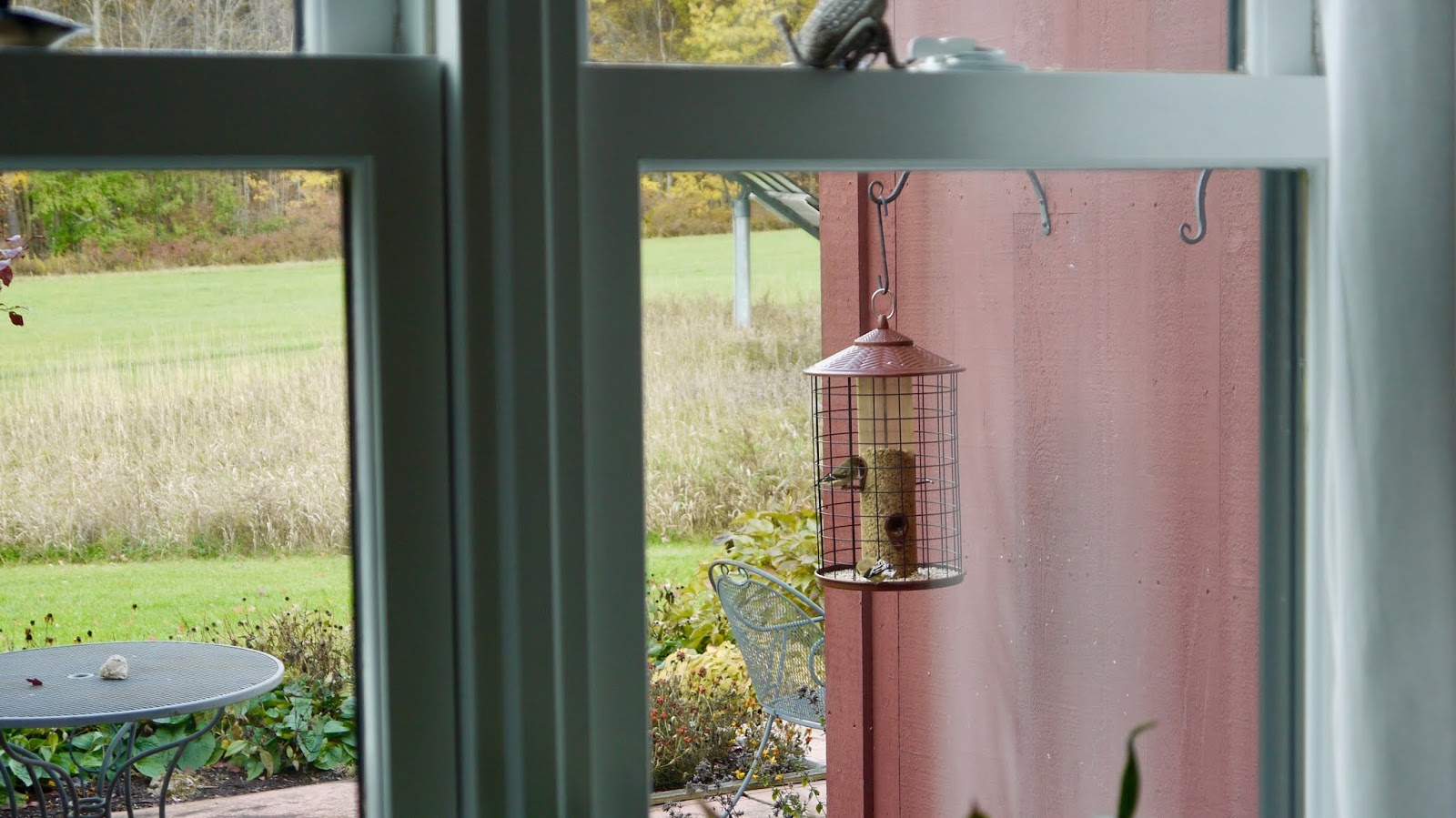
Only a week or two has passed since I wrote this,­ and the flaming trees and shrubs have already begun to fade. I can tell time is moving on by the new visitors to the bird feeder, freshly filled, the birds I'll see in winter: nuthatches, titmice, chickadees, purple finches, woodpeckers. The feeder is in its winter location now, near the rear windows so birds can be watched from inside. Ken’s favorite chair is in prime position to see them. Our bird book is still nearby.


The view from what I still regard as Ken's chair.


Time.  It moves on, doesn’t it.  

It was two short years ago that Ken died. Two years ago when Ken left Vermont. When Ken left behind all that he loved. Odd things of his show up now and then. Digging in a basket of random items that managed to sit untouched in the mud room since 2016, I found an altimeter, a nail clipper, a tiny lens snug in its leather case (for examining lichen and other small objects), a camping cup, an outdoor knife (all-purpose I guess, for cutting rope or gutting fish), two pocket knives, a comb, a compass, two tire pressure gauges (given that I have one in my car, this makes three), a whistle (if in need of help while hiking), BB pellets, clip-on shades, and pair of work gloves. I could tell a tale about each of these, because every item has a direct tie to something Ken enjoyed doing. They ended up in this basket because they were so random ("Where does this go, anyway?") and infrequently used. Maybe even forgotten. Neither of us might have used the camping cup again, or have need of a knife, or BB's or even a compass, or a whistle. The lens, the work gloves–yes, probably.


Although these things were close at hand, not many had been used in a while. Except the gloves.


Our needs change. Time changes us, as it changes the world around us. Has changed the world around us. Hugely, in only two years.


Ken voted just a few weeks before he died. He didn't learn the result. 

He could never have imagined that everything he represented and so much of what he believed in–the beauty and logic of science is one small example–would be seen by our current leaders (leaders? is that even the right word?) as just so much rubbish. He couldn’t have known that now lies are presented as facts, that science is mocked and scorned, that preservation of the natural environment is subservient to private interests, that our society is poisoned by anger, racism, and hate. That our president incites and encourages these basest elements of our nature while pretending to do the opposite, accusing others of the very things he does himself. 

I cannot imagine how Ken would have dealt with all this, had he been able.


Wednesday, October 3, 2018

ICELAND: BRAVE NEW WORLD

An iconic photo:  Tiny houses lend scale to a gigantic landscape


Land of the Future?


A film I saw recently was a thriller filmed in Iceland. Most of the scenes took place in dark stormy winter with howling winds and blowing snow. Scenes that took place in doorways–and there were a number of them–showed the actors chatting right there, the door wide open. No one seemed to mind. Obviously, I figured, this was for filming purposes because people don’t do that in winter. No one leaves a front door open. Not even for a minute. But who cares if the open door lets in a little cold air when you have infinite heat?  Not to mention hot water, really hot water, in endless amounts.

Iceland is 100% energy independent, generating the cleanest energy from renewable sources (geothermal and some hydro), an ideal sought by many countries and achieved to date by––hmm, none, actually.  Admittedly it’s a tall order for countries that don’t have Iceland’s unique conditions: only 350,000 people, a location atop a volcanic hot spot (with tectonic plates moving apart 2.5 centimeters per year, by the way), extensive water power, a well-educated population, and a mindset that favors innovation.

When you can cook bread by putting a raw loaf in the ground, you don’t have a heating problem.


Cooking a type of brown bread, local recipe. It takes about a day to bake.  


Steam, not smoke, comes out of the earth in this valley.


A schematic of Iceland's thermal fields; to the west is the American tectonic plate, to the east the Eurasian plate. The white splotches are glaciers.

Jarðböðinn thermal spa, one of many, the most famous of which is the Blue Lagoon. Thermal spas are a delightful extra that comes with volcanos.


Ahead of the curve socially as well, Iceland sees itself as having total gender equality, as well as an openness and embracing of everyone declaring themselves LGBT or Q.  Iceland is, in fact, our guide explained, a matriarchal society. Women are fully empowered–totally equal, and have been for ages. The current prime minister is a woman, although the president is a man. Female power is often cited in the sagas, where women are frequently described as powerful and as ready to wield a weapon as any Viking hero. There were hints here and there that this equality may not be quite so thorough (example: at the Ocean Cluster organization all the “suits” were males, and it was a female who served as receptionist and guide even though she held advanced degrees. Could just be chance, right?) Immigration is favored too, but with Iceland still notably homogeneous, this may yet have to be tested.

Viking hero, Lief Ericsson, son of Eric the Red, Viking hero


A show of power:  This is Go∂afoss

Besides being ranked as one of the countries with the most educated population overall, Iceland has an almost non-existent level of unemployment.  Farming, according to our guide, is often farmed out (so to speak) to outsiders, as are lower level jobs in the service fields (restaurants, hotels, shops, tourism in general). Farming, not in the least resembling farming in Vermont, seems to consist mostly of having sheep and Icelandic horses graze the fields.  (The genes of both horse and sheep are ancient; no sheep, horses or other animals are allowed into the country.)  Even hay baling looks surprisingly enlightened, what with pink plastic bales supporting breast cancer, blue in support of bladder cancer, and green, black or white plastic covers existing as local color choices. Many farmers have turned to hosting tourists to fill empty barns while they live elsewhere. Greenhouse owners run their "farms" remotely; they are almost completely automated to the point where those owners may live in Spain if they like and check on their crops via the internet.  There is no agriculture as we know it.  Despite the Gulf Stream keeping the climate just short of Arctic, there is not enough warmth or sun year round to support crops of fruits or vegetables. 


A huge greenhouse growing tomatoes for Iceland and, cleverly, including a cafe that offers tomato soup.


Only horses are missing from this farm photo.  Mostly green hay bales employed here.


Land of the Past


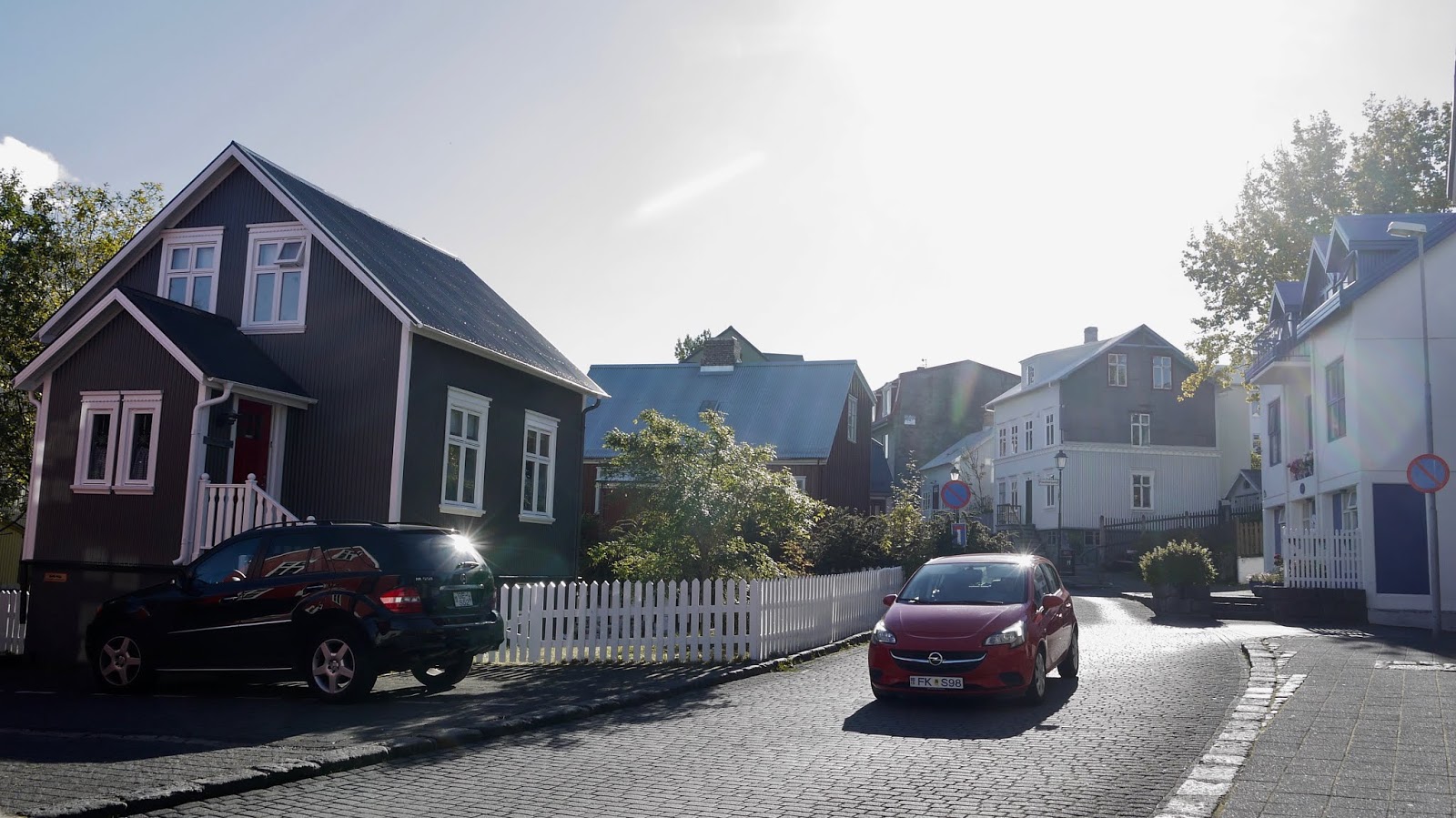
Tin framed (hence "old") buildings in Reykjavik's center; the Hotel Centrum where we stayed for 3 days
A neighborhood in old Reykjavik. Newer areas looks like ordinary suburbs.


Except for buildings that date from the 1920’s or so, everything looks new. Is new. (Even the trees are new; major efforts at reforestation began only 30 years ago.)  There are no 14th or 15th century homes, ruins or monuments.  Vikings, the first settlers, arrived in the 870’s. They chopped down the existing birch forests and built with wood, stone and turf.  When the forests were gone, wood came from Norway.  It wasn’t until the 1870’s that tin was introduced and swiftly became the material of choice for outer walls and roofs.  Color arrived, too.  The oldest houses in town centers (notably Reykjavik) date from the 1920’s with a handful from the late 1800’s.  Then came concrete.  The architectural shape of choice seems to be the square and the rectangle.  Sometimes this works really well. Often, though, the lack of exterior decoration and the endless boxy-ness has a soulless quality. It’s mostly the older houses that look inviting.


A Viking history buff build this reconstruction of a sod dwelling.  It is surprisingly roomy inside, if dark.


A photograph of the sort of housing most settlers had before the arrival of new materials.
The crude kitchen area of one of those old houses. The housewife looks pretty grim.

After the Viking period there were dark days.  Danish rule lasted from 1262 until 1944, the day of independence.  But there were many dark periods. The plague swept through Iceland twice in the 1300’s and again in the 1400’s killing nearly half the population, the volcano Laki erupted in 1783 and killed a quarter of the population, and there were several unusually cold winters, plus the Spanish flu that arrived early in the 20th century. Life here was often hard. Not to mention the dangers faced daily by fishermen.


This interior had wooden walls, but life was generally still pretty difficult, even in the 1920's.


How to account for all the churches.  Their numbers are a thing of mystery. Nearly every farm has its own church, generally a small building resembling a chapel, made out of wood.  And then there are the town churches.  Every town has a church or two and at least one of them in nearly every case is likely to be a striking––as in you-can’t-look-away­­––modern building of avant-garde design, in concrete.  The old farm churches may have been built by farmers because their homes were so isolated they were unable to make their way to a town in order to go to church.  It may also have been simply something one did if one could afford it (wood, after all, had to be imported)––a way of displaying one’s faith. Or was it built ias a talisman against the hope that lava wouldn't eat you up?  At any rate, in these modern times church attendance is said to be very low, with only 10% of the population reporting that they go to church occasionally, and 50% saying they never go at all.  (Marriage too may be fading, with only about 1/3 of babies born in 2014 born to married parents––unless, of course, they married afterwards.)  I watched a film on the plane that took place in Iceland. The husband in the story was always leaving for choir practice.  I’m guessing he went to a church for that.  Still, the church mystery endures.


Old church above the town of Vik (Vik means harbor).  The town below is very near the glacier and volcano (unseen behind the hills).  If and when it erupts, they may only have 15 minutes to evacuate.

Per caption above, volcano Katla, one of Iceland's largest, lives right under the ice cap behind Vik.  

In the small town of Stykkisholmur the church dominates the hill at right. It may not be the most extreme design.

Another spectacular waterfall.  This one is Gullfoss.


The Dark Side. Or Isn't There One?


Winters are long and hard and, no doubt, depressing.  (I admit I am writing this on a dreary rainy day in Vermont in October when the sun is already setting as early as 6:30.)  What do people do during such long winters?  Well, they are either reading books or writing them.  Or perhaps knitting. Here’s a statistic:  More books are published per capita in Iceland than in any other country. There would have to be 328 million books published in this country in order to come up with a similar statement. (An actual book count for the US is closer to under half of one million.)  

The English language section with its dark titles. The larger towns have excellent bookstores.

You don’t have to read much Icelandic fiction before you start imagining the country suffers from (a) a drinking or drug problem (see Arnoldur Indrio∂ason, for example, for tales of a divorced detective with a drug user daughter); and (b) depression.  I thought the drug problem would be severe. Not so.  But it used to be.  The whole country seems to have pulled together recently to draw teens away from drugs and get them involved in activities.  It worked. (“How Iceland Got Teens to Say No to Drugs,” The Atlantic, January 19, 2017.) As for depression, according to the Organization for Economic Cooperation and Development (OECD has 36 member countries, including the US) “Iceland is the most depressed of all European Countries.”  I always wonder what the questions are in surveys like this.  In any event, the OECD is responsible for a few other interesting pieces of data, like the fact that more women are depressed than men, and Icelanders use more anti-anxiety drugs, sleeping pills and so on than the other member countries.  Well, I guess there has to be something of a downside.

Yet another beauty:  Skógafoss

But did I mention that Iceland has no army, the police aren’t armed, the crime rate is practically non-existent (there are currently 26 people in jail in the whole country), and, although lots of people own guns, they are reserved exclusively for hunting? 

Speaking of hunting, what, exactly does one hunt in a place almost entirely without any wild animals?  Although there are some 500,000 or so sheep, plenty of horses, and swans everywhere, only the arctic fox (the fur of which I saw adorning numerous clothing items for sale in some shops), is a native wild animal. (I heard about reindeer imported many years ago existing somewhere in the country although I didn’t see any.)  Do people hunt foxes?  (They're pretty cute, I have to say. )  Birds, maybe?  Puffins? Puffins??  Puffins are kind of a mascot of the country, cherished by children who help them on their migratory routes when they are misled by the lights of a town, and yet you will find them on menus here and there. Somebody must be hunting them. Whale meat is also on some menus. Reykjavik’s three-ship whaling industry, with heavy irony, uses the same dock as the local whale watch fleet. Our guide said only tourists eat whale meat. I suppose some people get a thrill from eating something exotic. Wait a minute. I once ate a witchetty grub in the Australian outback and was kind of proud of that. Witchetty grubs don't come with ecological histories attached, but still...


On the right, Greenland shark (yes, really). These sharks are the unfortunate bycatch of trawling. This company takes them and allows the shark meat to ferment so that it will lose its toxic level of ammonia, and then hangs it for several months until it is deemed ready to eat.  An acquired taste in the extreme sense of the phrase. I tasted it, and found it pretty horrible, even when followed up with a shot of Icelandic schnapps (at left) called Brennavin.  Greenland shark is a national dish and regarded as a special treat. Other northern isles (the Hebrides, for example) have a similar culinary history of fermenting meat and fish.


Our guide, Kolfinna Baldvinsdottir, holding a sheep head, another holiday treat. There is plenty to eat in the head, including (yikes!) the eyes. In supermarkets the meat section is wholly composed of about a thousand cuts and treaments of lamb.


Then there is the downside of Iceland's dangers. You could:

(a) fall down a waterfall,
(b) stumble into a fumarole,
(c) get lost in a lava field,
(d) drown in the ocean,
(e) fall off a cliff,
(f) freeze to death in wind and rain,
(g) whoops! wrong temperature thermal pool,
(h) drive your undersized Kia into a river and be swept away,
(i) be swept away by meltwater from a glacier caused by
(j) an erupting volcano and be rained on by ash and rocks,
(k) get trampled by a herd of sheep,
(l) get lost and taken by a troll, or
(m) eat too much Greenland shark and die.

But there are voluntary rescue squads stationed all over Iceland ready to save you.  

You could drown:  waves and wind came up suddenly, about a half hour after this photo was taken, during a whale watching trip, and seas were growing seriously enough to seek a harbor ASAP.  (All passengers had been required to wear survival suits.)

You could fall off a cliff.  Basalt columns and other formations on the Snaefellsnes peninsula


You could get lost in a lava field, or fall into a hole.  The lava is covered with lichen, the first colonizers of rock.


You could fall into a fumarole.  This place reminds me of Yellowstone.


You could get lost. (This photo is very confusing.)  And be taken by a troll.

Ah, but if I lived in Iceland I would miss the chipmunks, the squirrels, the racoons, the snakes, the bears, the deer, the coyotes, the robins, the hawks, the rodents––all of them.  And the forests.  The country I live in is a different place in so many ways.  We are too big, too heterogeneous to have a future that is like Iceland's present.

But we could take a leaf from their book.


Friday, August 3, 2018

AND A WATER GARDEN TOO


I hadn’t thought much about having a water garden.  But with a natural pool, you get one.

Last August the plants around the new pool consisted of about 90% reeds or sedges and some pickerel weed, all striving to help filter the water in the swim part of the pool.  They were too young then to do much filtration, and water clarity was fragile. It was a brand new ecosystem.  Without the weekly addition of algae-eating bacteria the water would have gotten a greenish cast and there could be surface gunk too. It was necessary to add algae-eating bacteria to help control nutrients in the pond water, thereby depriving the algae of food.  The bacteria also act to transform some of the dissolved nitrogen compounds that could become algae food into nitrogen gas that diffuses into the air.  A weekly cup or two of added bacteria did the trick.  (None of the chemicals used to clarify normal swimming pools can be used in a natural pool.)


August, right after completion


The sedges and reeds were nice, but not particularly exciting.  Then in midsummer pool builder Tim Lindemyer added some robust plants to fill empty spots: water lilies, irises and dwarf cattails to replace or add to the pickerel weed that was growing far too meekly.  With the echinacea in full bloom by this time and the grasses now mature, both serving as backdrop to the water plants, an attractive layered harmony has emerged. 


August 2018. Skimmer and algae grabber in the foreground.


A modest (or maybe not so modest) variety of creatures live here, but not fish.  Fish would only complicate the already dynamic ecology, adding nutrients instead of removing them, especially if they were to multiply. But there are newts, some tadpoles, the usual pond bugs, and frogs.  They found their own way here.  A garter snake was spotted one day last month, swimming!  In July we often found the larval shells of dragonflies. The dragonflies may have been born from eggs laid in the water.  Probably some of the frogs, too..


There hasn’t been a glimmer of surface algae growth this summer, nor the slightest greenish cast to the swim water.  None of that. However.  This summer’s bane has been hairy algae, a completely different type of algae, one that likes to cling to the bottom of the pool, attaching itself to stones.  It is amazing stuff.  Completely benign, happily, it has the capacity to double in volume in a short time, unhappily.  This entails nearly daily scooping of the stuff.  I pull out what I can (some portion inevitably refuses to give up its grip and prepares to regrow in the same place) and toss it in the field. I leave much of it as-is in the plant area because frogs seem to enjoy sitting in the midst of it.  Besides serving as cover for frogs, It should be good for something.  But what?  Could its presence have discouraged the other form of algae, that surface stuff?  Could the two varieties have been vying for favor?


A blue of hairy algae covering some stones 8 feet underwater

A sample of hairy algae out of the water. "Hairy" is not a misnomer.


There are many ways to get rid of hairy algae.  One suggestion I came across advised encouraging your children to pull it out.  Fun.  I can see that, kids tossing the stuff around, putting it on somebody's hair, etc.  Seriously, though, pulling it out with a stick is pretty effective. I have a telescoping pole with a paint roller holder attached to the end.  Even better, though, is donning my mask and snorkel and getting to work on it with my hands.  The best solution may simply be not filling the pool with hard water.  Hairy algae, as anyone with a fish tank and has fought the stuff can tell you, loves a high pH. And, boy, do I have hard water.  Filled now by unsoftened well water, the pond's pH sits around 7.8, the cliff edge of okay.  I plan to fix this by rerouting a hose connection through the water softener.

Lily and lily pads in the raindrops


Will this weigh the balance in another direction?  It will be interesting to see how this little ecosystem will develop in another year or so. This fall I will trim the sedges and cattails in the plant area.  I will move the water lilies (rooted in pots) to the shallow part of the swim area to overwinter.   The filter pump will be shut down and stored. Ice will eventually cover it all.  Then I will wait.  I will forget about it.  When the pond awakens in the spring, I wonder, will it be in balance?  Will it tip this way or that?  What will be the next dynamic in this little water world?