Wednesday, July 6, 2011

Not-So-Idle Days, Idyll Evenings


The view from Snake Mountain, the lake in the background
Much of our time has been spent doing chores of one kind and another.  Well, for me, two kinds, mostly:  painting, and weeding.  The painting that relates to the porch is now pretty much done. The weeding, I’ll admit, will never be complete.  In the long garden it’s a battle against staggering odds.  A hike up Snake Mountain, the mountain we see from our porch to the southwest, was a break from all this.  It was hot, but Harry, thirteen now, managed quite well.

Harry admiring the view


The days have been warm and warmer, interrupted somewhat regularly by thunderstorms, and the nights, soft and balmy.  A picnic supper and swim with the Huston gang at Kingsland Bay on Lake Champlain marked the official beginning of summer as far as I was concerned.  The night of the fourth of July (well, actually it was Sunday, the 3rd) was one of those summer days.  After a dinnertime downpour (which downpoured inside the screened porch as well as outside, thanks to a long-awaited but still-not-completed roof covering, and the rain had Ken scurrying to keep the kebabs on the grill, and himself, from getting soaked) the fireworks went off under a cloudless sky. A good display for a small town, with the same kind of starbursts I oohed and aahed about in the Boston version.  A brass band–the one that plays in the gazebo on the Vergennes Green from time to time–played every piece of march music known to man, ending at last with “The Stars and Stripes Forever” while the rockets got fired up.  It felt very intimate; there were acres of space available for laying out blankets or setting up chairs, not a single thing to block anybody’s view, everything happening directly in front and overhead, and the wind blowing all the smoke in the opposite direction.  In other words, it was just right.

The night before had been just about right too.  A night of music (rocking blues) on a sweet summer’s night.  The event was indoors, though, at the Vergennes Opera House.  Headliners were a couple of musicians from New Orleans (including a blind keyboard player who looked like Stevie Wonder; we have been very into the music of New Orleans after watching a season of Treme on HBO).  Leading off was Panton Flats, a local five-man group that got the place jumping.  It was easy to get moving to this music.  The place was sold out, but there weren’t enough chairs for everyone (most of us were sitting around tables that took up a lot of space), so about a third of the audience was standing, making it that much easier to dance or just move to the beat.  Besides the 30-somethings and 40-somethings I figured would be there, we saw plenty of children, old people (that’s us, I guess), and very old people.  Dancing, too.  A local bar was selling everything from cokes to whiskey.

Nights are beautiful.  Last week I woke around 3AM for no particular reason.  At that moment it occurred to me that I didn’t really know this place at night.   So I got out of bed and wandered downstairs without turning on any lights.  I realized I know the house well enough now to navigate it in the near dark, my way lit by the myriad green and blue and red equipment gear–the TV, stove, smoke alarms, clocks, etc.  (Is any house ever completely dark anymore?)  Outdoors there was a kind of monitoring light too, the meager shine from a slit of moon, the distant glare of a farmyard light, and among the grasses:  fireflies.  Looking at this through the screen door wasn’t good enough, so I got myself a glass of wine (at 3 AM!), went onto the front porch and sat in one of the Adirondack chairs.  I listened to the tree frogs and the bullfrogs and other unidentifiable sounds.  But for these, all was still.  This was just right.


Thursday, June 16, 2011

Doings in Gardens


The frogs have quieted down, settling in, I liked to think, with their chosen mates.  Not.  That may have been true the other day.  Now they're restless again.  I’m beginning to realize frog sounds have something to do with the weather. 

The grass isn’t growing an inch a day any more, so we’re no longer raking up haystacks of clippings.  But in the meadow the grasses are as tall as a person, nearly hiding the old hay bales. 

The sugar house is almost hidden behind grass.  Fortunately Ken cut trails through the meadow in several directions.
The hay bales are actually a problem, because the farmer who usually mows the field will have a devil of a time mowing with old hay bales in the way.  He wasn’t the one who left them there in the first place.  A Department of Agriculture guy we talked with downtown in Middlebury a month ago, when we were still trying to figure how who did what, was pretty certain the bales hadn’t been left by that farmer.  “Not good mowing practice.  He wouldn’t have done that, I don’t think.”  Last week the farmer told me he hurt his leg last fall and had this other guy from a shoddy-looking farm up the road do it in his place.  That guy did it all wrong, mowing too late in the season, leaving the cut hay to get rained on, mowing the whole thing all at one time, and then abandoning the bales because by then the ground was too wet to pick them up.  I think this is the same person the previous owners told us hit the well head besides.  Bales mowed the way these were, and left out all year, aren’t good for feed any longer, just for bedding.


 My plantings are settling in and sending up new shoots.  They were planted in clay, clay being the basic soil of Addison County, leavened somewhat by compost, but 99% clay nevertheless.  I keep on being amazed that delicate roots can find their way through this stuff, but apparently they do, quite happily too.  They had a rough start. First it was so wet they were nearly flooded (and with clay the water just sits there for days), then they got blasted by heat, then beaten by wind, followed on by cold.  Maybe it makes them tougher. 

There wasn’t anything much here in the way of perennials other than the black-eye susans that  re-announced themselves recently, only the stubborn remains of about fifteen giant sunflowers.  In the location I figured an herb garden should be, or maybe once was, I planted the usual assortment of herbs (parsley, sage, rosemary, thyme, mint, coriander, tarragon, basil, chives, little onions), and further on some perennials (lavender, euphorbia, reed grass, coneflowers, monarda, an aster variety, alium , yarrow,  peonies, Joe Pye weed, daisies, false sunflower, salvia, day lilies), sowed some giant sunflowers, and started a couple of vegetables (tomatoes of various kinds, cucumbers, jalapenos, ancho chilis, eggplant, squash), all of this in one fell swoop.  The season was marching on.  I had to get stuff in the ground

Last Sunday I realized everything I’d done in the garden so far was merely a beginning.  It was raw, unformed, definitely minor league.  Lesley and I went on a Middlebury area garden tour that set a standard few could reach.  Granted, having several hundred acres, a couple of huge ponds and lots of money wouldn’t hurt.  So much to be done.  But it was inspirational.

On the garden tour: this house is only the potting shed.


Another garden, and Lesley.   Yes, it was raining yet again.


Tuesday, May 31, 2011

Memorial Day, With Frogs


Senator Bernie Sanders, just before I shook his hand
Vergennes has a grand parade on Memorial Day.  For a small town (excuse me, "city") this is a big parade.  Just a bit smaller, maybe, than Lexington's Patriot's Day parade.  It's significant enough that the governor of Vermont marches (Peter Shumlin, Democrat and good guy, by the way) and a Senator, our favorite socialist, Bernie Sanders.  I called Vergennes a city, and it really is a city, with a mayor and city council.  True, there are only 2,670 people in Vergennes, but it was chartered in 1788 as a city, not a town.  There were high hopes for its economy at the time, what with Otter Creek Falls for power, access to shipping via Lake Champlain, and the largest ironworks in the country nearby, an industry that supplied iron fittings for the fleet that would defeat the British on the Lake Champlain in the war of 1812.  


There were the fire engines, the old cars, horses, the madcap Shriners, high school marching bands, veterans and military trucks, lovely teens ("Miss Teenage Vermont"), and a few paraders that told you this was Vermont, not Lexington, Massachusetts.  One such was the parade of old tractors.


**
Each night for a week or more we have been hearing frogs carrying on from the pond area.  

It’s a nightly concert, every frog joining in at random and seeming to want to out-sing every other frog.  Trills, croaks, snorts, whistles, beeps.  What a cacophony.  I’ve tracked it down, and the source of the noisiest and most dominant sound is the grey tree frog.  It has a resonating–and I mean resonating–trill, lower in pitch than the spring peeper.  Louder too, by far.  

I don’t know that I’ve ever seen a grey tree frog.  Not surprising, as it’s tiny, only between an inch or two, and may be green or grey, depending on the color of whatever it’s sitting on.  We hear other frog voices that try to be heard over the din of the grey tree frogs.  I’m sure we’re hearing some northern leopard frogs as they are widespread and, what’s more, are the official state amphibian of Vermont.  I like the description of its call.  It’s likened to “the twang of a loose banjo string.”  Others we could be hearing are the mink frog that has an almost electronic-sounding croak.  It’s called a mink frog, by the way, because it reportedly smells like mink.  “To those unfamiliar with mink” (i.e., most of us), Wikipedia tells us, the odor is “more akin to rotting onions.”  Chances are I will never get close enough to check this out.  

We may also be hearing the green frog that sounds pretty much like a bullfrog, including the “loose banjo string” call description. There may also be pickerel frogs (they like pickerel weed and we might have some) with a call that sounds like “a short snore.” I think I heard that.  It’s probably too late in the season for the Vermont wood frog (electronic-sounding croaks) and the peepers (high-pitched trills), but, goodness knows, they could be singing too in the background.   


In the daytime, Harry often walks the perimeter of the pond, frogs leaping away from him right and left.  This doesn’t seem to stir any predatory instinct, for he doesn’t snap at them or do much except keep walking, or sit and stare. I like to think he is taken with the wonder of it.

Monday, May 16, 2011

Earth, Weeds, and Rain


 Another wet week.   I can almost hear things growing.

The Weeds: Bag of weeds #3, but lots more to go


The garden was rototilled and composted today. I didn’t do it. I didn’t think of trying.  Our land is amazingly fertile (our grass grows like the grass on Scotts Grass Seed ads), but it is thoroughly clay.  Clay, when dry, turns into hardpack or lumps so hard that if you tossed one at someone, they’d think you hit them with a rock.  When wet, well, anyone who has molded pottery knows what it’s like.  The other day, a day remarkable for blue sky and warm sunlight (no rain!), Audrey made a sculpture out of some of our clay. For several days the result sat there looking ready to be popped into a kiln. 

Audrey's mud kitten


This morning our landscaper dug holes for the huge plastic sonotubes that will be filled with concrete to support the porch.  He dug down about six feet with his bucket loader and hit not one single stone.  Not even a pebble.  Solid clay, all the way to infinity.  If you can get plants into this stuff they will be quite 

Sonotubes in, shrubs, tree, gone.  Looks worse before it can look better.

content.  Getting them in there, and getting the weeds out, that’s the challenge.  (A horticultural note:  you need to mix the top level of clay with some mulching compost to lighten it.  Hard work nevertheless.)  

We have a garden strip along the south edge of the lawn in which the previous owners apparently grew some corn, pumpkins and sunflowers.  I think it’s a mile and a half long.  That’s how long I figured it was after I spent a morning yanking the most blatant weeds.  The typical dandelion had a root about ten inches long and a spread of about twelve.  You see what I’m up against.

We established (“we” meaning me=ideas, landscaper=the work) another planting bed on the opposite side of the pond.  My thought is to have it ultimately look less like a golf course hazard, less fine, more like a natural pond.  Which it is, technically.  A natural stream,  widened and shaped.  Shrubs had to be moved from the front of the house to make room for the porch, so they are now looking at the house instead of looking out from it.  A river birch will soon be added to the mix.  


Some shrubs newly placed on the far side of the pond.
An evergreen that was moved from a location too near the porch-to-be is now the first occupant of an area south of the front of the driveway where it will soon be joined by six more, an attempt to break up the emptiness of the field and, we hope, help keep the road clear of snowdrifts.


When the rain stops (rumor has it it could be a while) I can start planting.  For the first time ever I’ll be able to have plants that require full sun.  In fact, there will scads of sun.  No more hostas for me!  (Gardeners, you know what I mean.)   So far I have put in three peonies in the patio garden.  (Peonies! Giant, lush, bulbous flowers!)  There was no place for peonies in Lexington.  No room for giant sunflowers or pumpkins or other big things, wide things, tall things.  I’ve got to think big.


Monday, May 2, 2011

The Social Network


The size of the social world here is smaller, of course, than in Lexington, Massachusetts, but I feel that the network of connections is more intense.  Early on we heard about connections.  A carpenter who had a Westie too (“White Dog Cabinetry”) said he knew someone Ken’s son Bill knows over in Starksboro, some fifteen miles from here.  That was only a start.

Our contractor’s son-in-law happens to be a landscaper.  As our porch plan demands includes some shrubs, plus we want the garden roto-tilled, and a group of trees planted near the driveway, it was obvious how we found the person to do it.  When we decided to have some help cleaning this enormous place we got a name from the very savvy woman who dispenses advice at the Middlebury paint and decorating store.  The person she recommended turned out to be a cousin of the above landscaper.  The landscaper who, by the way, knows Ken’s son Bill.  The guy who came to fix our phone got here within ten minutes of my calling the local Telecomm service, as he lives two miles up the road.  When we sold our old stove on Craigslist last week (by which means it was snapped up as quickly as it might have been in Boston, quicker maybe) the buyer turned out to have once lived up the street at the sheep farm.  (More on the sheep farm later.)

That reminds me.  Nearly every workman who has been here, from our contractor to the local furnace/propane guy, has time to tell stories.  At first they don’t seem to have to say very much, but a comment or two gets them going.  Pretty soon we’re hearing stories, stories about animals they’ve had (pets), animals they’ve hunted, or stories of who did what when.  No one seems in a big hurry to get on with it.  You have to get used to the pace.  No need to rush around, right?

We arrived here with a leg up, socially, thanks to Lesley and Chris.  They had to get to know everyone without any foreknowledge when they moved here, although having kids helped, of course.  We all agreed that an Open House seemed like a good way to meet our neighbors.  So Ken and I were able to put together a proper guest list, taking our cues from the above locals. 

Almost everyone showed up.  And what an interesting mixture it was.  Our nearest next door neighbor had shown up the day before, with a cake, as she wouldn’t be able to come on Sunday.  She might have been a mom from, say, Wellesley or Weston.  She hadn’t the faintest idea who mows our meadows, hers and ours.  Living along with two children, she mentioned how isolated she felt after the huge snows this winter, having to snowshoe to get to the end of her driveway, and no one available to plow.  (We exchanged phone numbers.) Oh, and she knows a friend of the aforementioned Bill. 

The guests came from a wide range of experiences: the wife of farmer Don Hallock who once owned all this land (our eponymous road) and lived in the farmhouse further up the hill that is now in the hands of a family that is letting it decay; the matriarch of another many-generation farm family, mother of several local farmers (her sons) who own much of the area lands; one of those sons and his wife; a guy who runs marathons all over the world and just flew in from yet another; a horticulturist; a metal sculptor who has an upcoming exhibit somewhere; an executive for some company or other who makes maple syrup big time just for fun and brought us a half gallon; a young family with both parents working in Burlington; a few retired couples who’ve lived here for years; a biologist who wrote a book about Lake Champlain; the couple across the road and our nearest neighbors: she was a policeman, he works for a feed company; an elderly couple who, along with son and daughter-in-law, run the sheep farm, Treleven, up the road, and were in Bill McKibben’s book “Wandering Home.”  This weekend we all, especially children, are invited there to a “Lamb Frolic,” an annual event that features ice cream and cupcakes, and, of course, plenty of newborn lambs.


Playing around the pond after the party


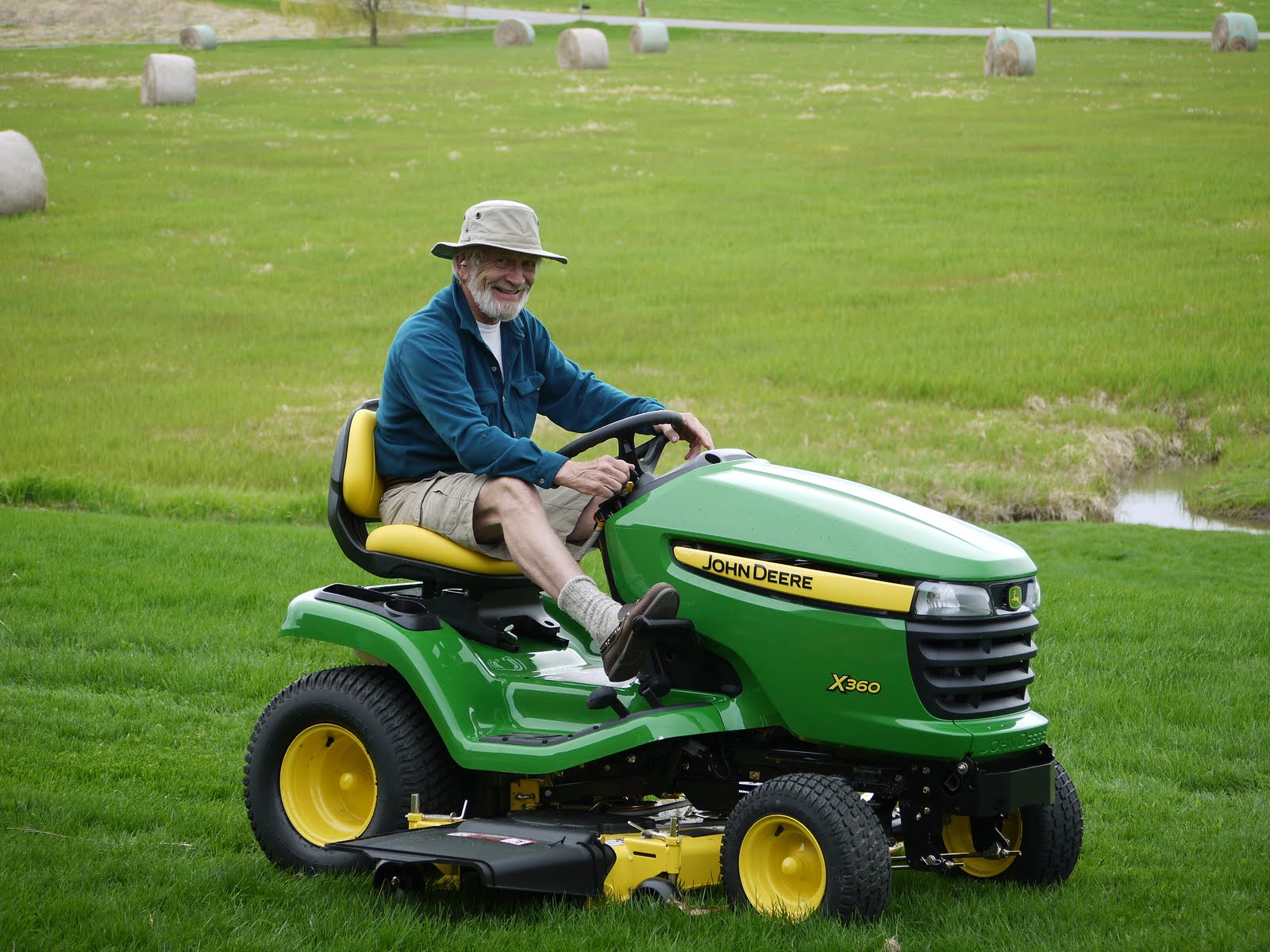
Today we went a step further in country living.  That is to say, we bought a tractor.  Not a huge tractor, mind you, but the kind of garden tractor that can deal with a really large area.  It can be equipped with a snowblower in the winter, in case our plow guy doesn’t get there when we need it.  Reassuring, that.  The person we bought it from at our local John Deere store (could you guess?) is the son-in-law of our neighbors, the Hallocks.  

Mowing is really fun with this (honestly!)

Friday, April 22, 2011

Hay, Rain, and Lambs


One noble-looking ewe
***

The hay bales are still lying scattered across the fields.  They wouldn’t be, of course, unless they were old, cut at the end of last summer.  People who’ve been here a long time and know about farm practices don’t think much about someone cutting all that hay and then letting it sit through the winter (so we’ve been told).  A waste.  Much of it is salvageable more than likely, but there’s still waste.  Hay bales have their uses, though, especially for Carly, Audrey and Ben.  (And Hans and Olin when they were here.)

The pyramid from top: Carly, Ben, Hans, Audrey, Olin
on the first day of hay bale games


 We learned some about mowing after following up a lead from the man who farms at the corner of our road and route 17.  He said there’s a conservation program that helps people who want to hold off mowing in order to encourage ground nesting species, many of which are endangered, something we’ve been thinking about doing.  After following this up we ended up talking with two genial agriculture guys at the Middlebury USDA office.  As with most transactions here, they took their time with us, as if there was no one else they’d rather be dealing with. There’s a small subsidy available if you don’t cut the hay until after nesting time, around the end of July.  You can’t avoid mowing entirely, or unwanted species will start to grow and that’s the end of your perfect meadow.  As it is, mowing only once opens the field to invasive plants.  We have yet to meet the farmer who presumably did our mowing, see how he wants to handle this.  At any rate, he can’t easily pick up the old bales now, because the ground is still too wet.  And probably will be for a while, given all the rain we’ve been having.

The hay bales and meadows during a bit of sunshine after the rain


Lake Champlain is still at flood stage (or at flood stage again) according to the weather service.  That doesn’t mean much for most people, only those living at the water’s edge in low-lying areas.  Still there were notices like this:  “If you live or travel near streams and rivers...seek higher ground.”  Otter Creek, which we can almost see from our house, is muddy and flowing fast.  The nearby waterfalls are powerful with water.  Our little creek (can we dub it “Bear Skull Creek” in honor of the dead bear?) now has a noisy waterfall.

Yesterday through heavy rain we spotted a pair of wood ducks on our pond.  Once again, I think they are just visiting.  I heard quacking later the same day but couldn’t see any ducks. Today there are no ducks.  There were a few other interesting sightings, though.  While eating dinner at our dining room table we saw a lone deer run across our neighbor’s field.  On our way to Vergennes to pick up the newspaper we saw a moose sauntering across someone’s lawn, heading toward Otter Creek.  Otter Creek, no mean creek by the way, runs through Middlebury and Vergennes, and cascades over dams in both towns, as well as another dam in between at Weybridge, before it empties into Lake Champlain.
Wood ducks visiting, in the rain


It’s nearly Easter, a holiday I would hardly have given much thought to except for the fact that Easter and lambs go together.  Lambing is happening right now up our road at the Mitchell’s place and we were invited to see the babies.  Audrey and Ben were here one (rare) sunny morning so we all went to see them.  I’m glad there’s no lamb on the menu this weekend.


Wednesday, April 13, 2011

Water, In Several of Its Forms


The waterfall in Vergennes, in spring flood

Sugaring is over.  The total for both us and the Hustons is about 2-plus gallons.  Not bad for a first try. Each mason jar is differently colored, from dark amber to light amber (official color descriptions, by the way).  That done, it’s time for garden planning.  Thoughts of which are overwhelming at the moment.  I’ll think I'll put that off until next week.

On Monday morning I was listening to NP.  It was raining, and there was some distant thunder.  Suddenly, “Blaaark!  Blaaark!” the emergency radio network came on.   “Heavy thunderstorms accompanied by hail,” it said, “in East Middlebury, Salisbury, and Leicester.  If you are in these areas, get under cover!  Blaark!  Blaark!”  None of that “This is only a test!” stuff.  I had never heard anything–ever–broadcast on the emergency network. Lesley told me later that she’d never heard emergency network messages until they moved here ten years ago.  Since then, not so unusual.  And what happened here?  It lightened, it thundered, and our lights went out, but that was it.  No hail, and not much reported from East Middlebury, Salisbury or Leicester either, as it turned out.  Thanks to all that Monday rain, the ground is soggy again in places.  It’s raining again today. 

Hepatica, in the woods at Kingsland Bay

When it wasn’t raining, it was warm, very warm, and sunny.  Frogs in our pond have begun singing their croaky songs, especially down at the marshy end.  I love hearing them at night. Frog are not alone in deeming the water inviting.  A pair of ducks that hung around the pond last year (we saw them sometimes as we drove by) may, or may not, have returned.  On several mornings in a row the pair flew in, stayed for about an hour, and left.  Harry has been getting into the habit of drinking from the pond, but he has tended to skirt the edges on his way to sniffing around in the meadow which is much preferred.  But the other day, either because he fell in, or because he thought to reach the other side by the most direct route, he swam across.  Ben and Audrey (7 and 9, respectively) also either fell in or didn’t quite make the leap at the narrow end, or–and this is the most likely– a combination of both, emerging after dousing number ten or so, wet and muddy from head to bare foot.

A wet and muddy Audrey and Ben.  Behind them, right,
a photo of their mother and aunt Leah in a mud puddle circa 1978. 


Having seen the ice disappear a while ago from our pond we expected the ice would be long gone in Lake Champlain.  Not so.  We hiked around a peninsula at Kingsland Bay where there is a favorite swimming and picnicking spot in the summertime.  Lake Champlain has a lot in common with, say, Lake Erie.  The beat of the waves on shore on a windy day lets you know there is a very big body of water behind.  Rocky cliffs along the shore bring to mind the ocean-swept rocks of Maine.  There are sea gulls and osprey.  I half-expect to think in terms of tides.  


On still-icy Lake Champlain, Harry and Ken.  Our diving dock is under water.