Sunday, September 30, 2012

AMAZON, NOT-DOT.COM

A passenger ferryboat on the Amazon.  For overnight trips there are hammocks.


Our ship, the "Aqua," underway.  And luxury comfort.


Three degrees south of the equator, in Peru.  Really far from Vermont.  In many ways.

It’s the largest city in the world that has no roads leading in or out.  The only ways to get here are by plane flights from Lima, mostly, or travel by riverboat.  When you consider that Iquitos is on the western Pacific side of South America, it is intriguing to think that you can arrive by boat from the Atlantic Ocean, sailing some 2,300 miles from the 200-mile wide mouth of the Amazon all the way to Iquitos, Peru. The Amazon begins at Iquitos, technically speaking, because it is here that the Marañon and Ucayali, major rivers themselves, meet to form what from this point on is named on maps as the Rio Amazonas.  And it is here the Amazon makes its unfaltering right-hand turn to the east.  These are all facts I had been blithely unaware of.


After the Marañon and Ucayali rivers join, the Amazon, technically speaking, begins

It’s impossible to avoid talking of numbers when describing the Amazon:  it’s the largest drainage basin in the world (some 40% of South America), with tributaries pouring in from Venezuela, Ecuador, Peru, Bolivia, Colombia, and Brazil.  It is as much as 30 miles wide in places at high water from approximately November to June, and nearly a mile wide in Iquitos.  Yet for all its length it drops only about one inch per mile for some 4,000 miles. The water is thick and opaque with clay sediment, unlike the “black water” feeder rivers, clearer, yet darkened with tannin.  A cone of sediment some 200 miles or so long coats the ocean at its outlet.  A nightmare of navigation after dark, the river is replete with floating logs and branches that occasionally stick up like the remains of a rotting pier, and constantly shifting sandbanks.  The entire river used to flow directly past Iquitos but shifted course a few years ago, and Iquitos now lies along the Rio Italaya.  A goodly portion of the land through which the rivers flow is floodplain.

Along the Rio Itaya in the Belén sector of Iquitos, houses set to float on balsa logs line the banks.


During the wet season the water rises some 20 or more feet around Iquitos, but last year was freakish, and in March the water kept on rising and rising, flooding all the lower ground of Iquitos except for those houses built on balsa rafts.   Making matters worse, last year also brought Iquitos a dengue fever epidemic. One of our ship guides, Victor, told us how the floodwaters were so extensive a swimming anaconda grabbed a 9-year-old girl in her own flooded house.  Fortunately her screams caught the attention of her father who paddled to the house in his canoe and with a blow of his machete cut off the snake's head.  This flood was in weird contrast to the equally freakish drought of the year before.  Climate change, our guides felt, was affecting water levels, the amounts and timing of the rain, and was bringing increasingly high temperatures. 

The poorer people and new arrivals who populate the Belén sector of Iquitos saw their stilt houses flooded last March.


Our hotel in Iquitos, more than likely on terra firma.


Iquitos is bustling, heterogeneous, grubby, rakish.  In short, interesting.  Since there are no roads that lead anywhere. with the single exception of a 70 mile-long road that took 30 years to build and connects the town of Nauta, population15,000, to Iquitos, nearly everyone gets around by motocarro, a kind of covered rickshaw propelled by motorcycle, the engines of which provide a constant background roar.  Iquitos is growing wildly, already having over a population of over 600,000, fed by people from the jungle lured by possibilities of having different or better lives.  All of our guides––Cesar, Daniel, Victor, Roland––had been born in remote parts of the jungle and still have family there.  Victor’s father, for example, who lives a day’s boat trip away down the Pacaya River, still catches fish with a spear.  Near where Victor’s family lives but further away from the river where one still finds “traditional” tribes lives a group known as “cat people” because of sticks thrust through their noses that look like whiskers.  The way Iquitos is developing, its size could one day rival Manaus, the famous Brazilian frontier town in the heart of Amazonia.  But no matter how large Iquitos gets it’s likely to remain a city of two- or at most three-story buildings.  A couple of years ago some shortsighted person built a ten-story building that almost immediately started to lean as it settled into Iquitos’ soft sedimentary clay.  Instead of taking it down, the government bought it and popped several antennas on top, and it remains a decaying fungus-spotted blue eyesore.

A street in Iquitos, with the too-tall blue building in the background


On our elegant ship, where we spent a week exploring the Amazon and several other rivers, memorably the Pacaya in the pristine Pacaya-Samiria Reserve, we were coddled with nightly tasting menus of imaginatively prepared local and Peruvian food, wine, and Pisco Sours, Peru’s national cocktail.  (Peruvian food overall, including Lima, is the most interesting and delicious amalgam of flavors from the Andes, the ocean, the tropics–fruit for example–and the Amazon.)  Cocooned in our air-conditioned staterooms we could watch the insects plaster themselves on the outside on our windows after dark.  But from our short hikes we returned drenched with sweat, even though our expeditions were completed before 11 in the morning or no earlier than 4 in the afternoon.  We wore long sleeves despite the heat because of insects or the chance, say, of leaning against "punishment trees," where biting ants crawl up and down the trunks or up and down whatever is touching the trunks, hats to protect ourselves from the sun, and rubber boots because of snakes.  We knew, too, as we coasted in small launches along the rivers that the lovely welcoming riverbanks were not really as welcoming as they looked, even though malaria-carrying mosquitos were not in this area according to our ship’s guides, proof of which was that the little owl monkeys we saw can’t live in malarial areas. 


Owl monkeys, normally nocturnal, but interested in us standing below.


We would not have wanted to be abandoned for a night without shelter.  We had seen snakes on our walks, frogs, bats, and spiders, and the light-reflecting red eyes of the cayman lined both banks of the river at night.


  A "Goliath" spider


The poison dart frog

Me, gingerly holding a small cayman


Me and a three-toed sloth.  This was a visit to a friend of our guide's place, so I'm not togged up head to toe.
Holding a sloth isn't terribly smart as parasites and ants live in their fur in symbiosis with the sloth.
Fortunately, I had no open wounds.

Holding this (baby) anaconda was an entirely different thing.  It was heavy, but–honestly–felt benign.


The piraña I caught; Ken caught one of the same size.

Early explorers of the region emerged from the jungle skinny, unkempt and often unhinged.  Many of them starved:  In “The Lost City of  Z,” David Grann describes several expeditions undertaken in the 1920’s by the legendary explorer Percy Fawcett who was as famous for vanishing without a trace as for his discoveries:  “Scrounging for food, Fawcett and his men could make out only buttressed tree trunks and cascades of vines.  Chemical –laced fungi and billions of termites and ants had stripped bare much of the jungle floor.  Fawcett had been taught to scavenge for dead animals, but there were none to be found:  every corpse was instantly recycled back into the living.  Trees drained even more nutrients from a soil already leached by rain and floods.”  


Still life:  a carnivorous butterfly, feasting on a dead catfish.


They encountered sweat bees (drawn to sweat, of which there was surely an abundance, and called–horribly–“eye lickers” in Brazil), vampire bats that transmitted lethal protozoa, malarial mosquitos, maggots that infected open wounds, electric eels that sizzled the horses and dogs they had with them, fire ants, pirañas, poisonous vipers, poisonous ants, termites, caymans, trees with poisonous sap (the curare tree, for one) poisonous frogs (the poison dart frog) and leg-eating mud-holes.  In “The River of Doubt,” the tale of Teddy Roosevelt’s Amazon expedition, author Candace Millard adds:  “The rain forest was not a garden of easy abundance, but precisely the opposite:  Its quiet, shaded halls of leafy opulence were not a sanctuary, but rather the greatest natural battlefield anywhere on the planet, hosting an unremitting and remorseless fight for survival that occupied every single one of its in habitants, every minute of every day.”  Whew.


Ken, modern day explorer

It took two of us to pull me out of the mud.

Most of the people who live along the rivers are subsistence farmers, growing small patches of corn, yucca, papaya, melons, and sometimes rice.  Most of their protein comes from fish.  In the markets we found wild boar meat, turtle meat and turtle eggs, and innumerable kinds of Amazonian fish from small catfish to paiche, the largest known freshwater fish.  New conservation practices discourage the traditional eating of manatees that are now finding protection.  Illnesses that befell explorers don’t seem to trouble the local people who use the many natural medicines of the jungle.  The local people swim and wash in the black water rivers, and many swim in the Amazon, with immunities we undoubtedly don't have.  I would be wary:  lurking in the murky water, along with the graceful gray and pink river dolphins, are pirañas and various kinds of parasites, the most notorious of which is the candiru, well known by watchers of exotic animal programs who may know why–ugly story!–you should not pee in the Amazon.


Ken feeds a young manatee at the manatee rescue center near Iquitos.  River manatees need to take mother's milk until they are a year and a half old.  This special substitute milk is supplied by the Dallas Aquarium.

We visited a school where kindergarten was crowded with beautiful cheerful faces.  But the higher the grade, the fewer students, especially girls, there were in class. An upper level secondary class (where they were learning English) held only three boys.  From everyone we met we felt warmth and hospitality, and there were always waves and smiles.  This caused us to feel almost uncomfortable, as we were invading their houses just by looking, or photographing:  living quarters, belongings and all, are vulnerable, completely open to the air, each family on a platform with few walls or coverings for them to hide behind.  What do they think about where we come from, or who we are?  If they were to leave Iquitos in any way other than by boat, where would they choose to go?  I cannot imagine how Lima would affect their senses.  None of our guides had ever seen snow.  One guide, I'm pretty sure, had been to Lima, but I don't think the others had ever left Iquitos except to travel in the jungle.


A young mother, age 25, in her home, with two of her children.  Each sibling takes care of the younger one, and they often wander on their own.  Young boys play with machetes, and I watched one four or five year old pull the tail of an anaconda.


This father is repairing his outboard motor; below and at rear is their floating kitchen.


A man fishing from his dugout canoe.


The launch from our larger boat, at right, explores a small river.
And then there were the river dolphins, gray ones and pink, and many, many birds.  By category I can name kingfishers, wading birds, vultures, hawks and kites, ibis, herons and egrets, flycatchers, swallows and swifts, tanagers and honeycreepers, orioles and blackbirds, parrots, macaws and parakeets, trogons and hummingbirds, nighthawks and nightjars, toucans and barbets, woodpeckers and woodcreepers.  I must also admit I didn’t see many of these birds very well, but when I heard our guide call out “There’s a black-fronted nunbird,” I really tried to find it.  My favorite was the "Horned Screamer."


Dark comes quickly, and early.  Those who live here wake with the sun, and go to bed with the dark.


Wednesday, August 29, 2012

STRUGGLES


Our valley, from Buck Mountain


On some days, well, many days really, everywhere here looks perfect.  It’s not just the lake with the blue-green Adirondack peaks behind, but the bright green valleys and gentle hills, the neat alternating rectangles of meadow and corn, the winding river, and the hidden places, the swimming holes, the beguiling roads that disappear and reappear behind trees and curves, and the narrow ones that lead to who-knows-where.   

Like most places, lovely or unlovely, it contains a lot more than scenic calendar material.  There are reasons, after all, that the local police blotters (Vergennes, Middlebury, Bristol) in the bi-weekly newspaper, the Addison Independent (Addison being our county), shows that about 75% of their weekly calls have to do with drugs or drinking, or both, not infrequently with driving thrown in.  In urban areas I suppose you can do the drugs and the drinking and stay indoors enough of the time to escape official notice.  But here you’re likely to have to drive someplace to get what you want or to meet someone, and then you’ve got to get back home somehow.  You’re exposed.

There are more than addiction problems.  In cities we read about the homeless, and we can often see people who are homeless.  They’re right there, on the street.  Maybe even bothering you, asking you for something.  Obviously, where it’s more densely populated, there are bound to be more homeless people.  But in Vermont, well, I hadn’t considered it.  Poor, yes, but not homeless.  Homeless people here don’t live on the street.  What street could support you?  Homeless people here are more likely to hole up in a camper, or maybe in a car, or squeeze in with relatives, more likely than not in substandard housing.  If you look more closely you can figure out where these places might be, but still, the homeless here are not really visible. 


The John Graham Shelter, Vergennes


Vergennes is unusual because it's such a small town and yet, since 1980, it has had a homeless shelter, a pleasant looking yellow clapboard house on a corner on Main Street.  Freshly painted and repaired, in fact, but with an ominously high wall newly erected by its next door neighbors.  In Vermont overall there are 31 homeless shelters (according to HomelessShelterDirectory.org), and, remarkably, the one in Vergennes is included among the top six, the other five located in the state’s largest towns (Burlington, Brattleboro, etc.).  The Graham Shelter is not a big place, yet it manages to house up to 25 people at one time.  It’s usually full.  Except for the kitchen, recently enlarged, the rooms are small, claustrophobic.  But there is a small play area outside for children, a picnic table, and a small pleasant garden.  It’s Vermont, after all.  Lucky residents who have found jobs and seem capable of getting their lives together are often able to move into transitional housing, a couple of nearby apartments.  I haven’t seen any of those, but I hear they’re nice.  However there aren’t nearly enough of them.

The odds of being poor in rural areas are between about 1 to 2 times higher than for people in metropolitan areas.*  And, as has been heard and written about elsewhere, the percentage of people in state of poverty is growing.  Rural poverty isn’t mentioned as often.  In 2005, 15 percent of rural Americans were living in poverty compared with 12 percent of non-rural Americans, rural homelessness being the most pronounced in agricultural regions, areas whose economies are based on declining industries such as mining (not an issue here, but see my February 10, 2012 “Of Meat and Mines,” about New York across the lake), timber or fishing, and regions experiencing the kind of economic growth that attracts more workers than there are jobs, or that attracts higher income residents, thereby driving up taxes and living expenses.   Some of all these factors probably play a role. There’s clearly not a lot of industry here.  

The major employer in Vergennes––located as to be almost invisible to Main Street––the Goodrich plant with some 800 employees, houses environmental test laboratories and presumably hires primarily the technologically skilled, although even that company will have some low-level jobs that at least a few of the unskilled will fill.  It happens that Vergennes also has Northlands, a Job Corps site administered by the US Department of Labor offering no-cost vocational education to underserved youth; it occupies that from 1874 on housed the Weeks School or “Vermont Industrial School” that served as orphanage and juvenile delinquent home––both simultaneously, sad to say––until the late 1970’s, and also played a role supplying human data to the unsavory eugenics research of the 1920’s.**  

Part of Northlands Job Corps center

As for housing, costs are lower in rural areas, but then so are incomes, with the result that a disproportionate share of low earners’ incomes often ends up being spent on rent.  Then there’s the geographical distance between low cost housing and job opportunities, the dearth of transportation, and so on and on.  There are plenty of trailers (read low-cost housing) around on sites where land is cheaper, some of these low-lying and susceptible to flooding.  Health care costs and mental health factors in here, too, somewhere or everywhere.  When you lose your job you lose much more than your job.  If you don’t have much to start with, where do you go from there?

Some low-cost housing; actually this trailer is one of several unoccupied homes
in Vergennes' only–and now defunct–trailer park.


I’ve been impressed by the local support system for the very poor and homeless.  At least what I have been able to see.  The people who run the shelter are enormously caring and thoughtful.  Others who work in service organizations like CVOEO (a fun acronym if you say it quickly; stands for Champlain Valley Office of Economic Opportunity) seem open-hearted albeit business-like.  Maybe this is because they’re not pressed as hard, not as jaded, as people who work in urban centers.  In general, people are softer here.  Anyway, the food pantry has less on the shelves than they should (note to self:  buy more than you need at the supermarket and put it in the food pantry box by the door!) and, I was told, they carry less than in past years.  Their non-paying customers are accompanied past the shelves of canned goods, the boxes of fresh produce, and gently told “You can take one of these, you can pick two of those,” and so on.  There are a lot of canned peas.  This being Vermont, and summer, there are also a lot of fresh-looking vegetables. You can sift through a pile of used clothing and take anything you find for free.  There’s not much to choose from. 

This can’t help but bring to mind our current Vice Presidential candidate Paul Ryan’s comment, quoted in the New York Times, “We don’t want to turn the safety net into a hammock that lulls able-bodied people into lives of dependency and complacency, that drains them of their will and their incentive to make the most of their lives.”  Some hammock.  Don’t get me started.


***

First bite:  the toad and the garter snake


There are struggles and struggles.  We witnessed one in the natural world last week.  We were surprised to see a common garter snake, genus thamnophis sirtalis,  a small one at that, lying almost fully extended in the open next to the shrubs by the front porch, its mouth firmly attached to the left rear leg of a large toad.   I have never heard a toad make sounds before, but this toad was, in toad language, screaming.  The sound was one you might think was made by a bird.  There was nothing to be done.  The toad was doomed.  It took at least five hours, into the early evening, for the snake to completely engorge the toad.  For at least the first hour, maybe longer, the toad was alive.  When we last looked just before dark, the snake had only the tip of its head to go.   In the morning it looked as if nothing had happened.  The snake was gone.

Midway through, the toad either dead or in shock.


Apparently garter snakes are capable of eating any creature they can overpower.  That can include slugs, earthworms, leeches, lizards, ants, frog eggs, rodents and toads.


***
  
*This statement and much of what follows, mostly paraphrased, is taken from the National Coalition for the Homeless, August, 2007, by way of the Graham Shelter Mentor Training book, 2012. Thank you!

**A brief but interesting explanation of this can be found at http://www.uvm.edu/~eugenics/vis.html

Wednesday, August 8, 2012

SALT WATER


Salt-water rock mountains 

When you have driven to the White Mountains or Maine from south to north since forever it is slightly disorienting to come sideways into familiar sights from the west-to-east can’t-get-there-from-here angle.  (We always went “up to New Hampshire” and “up to Maine.”)  The mountains, the towns, the roads, look at once familiar and strange.  Like arriving in Maine for the first time from our home in Vermont.  One vacation spot to another, really.  The mountains or the sea?  But why choose?

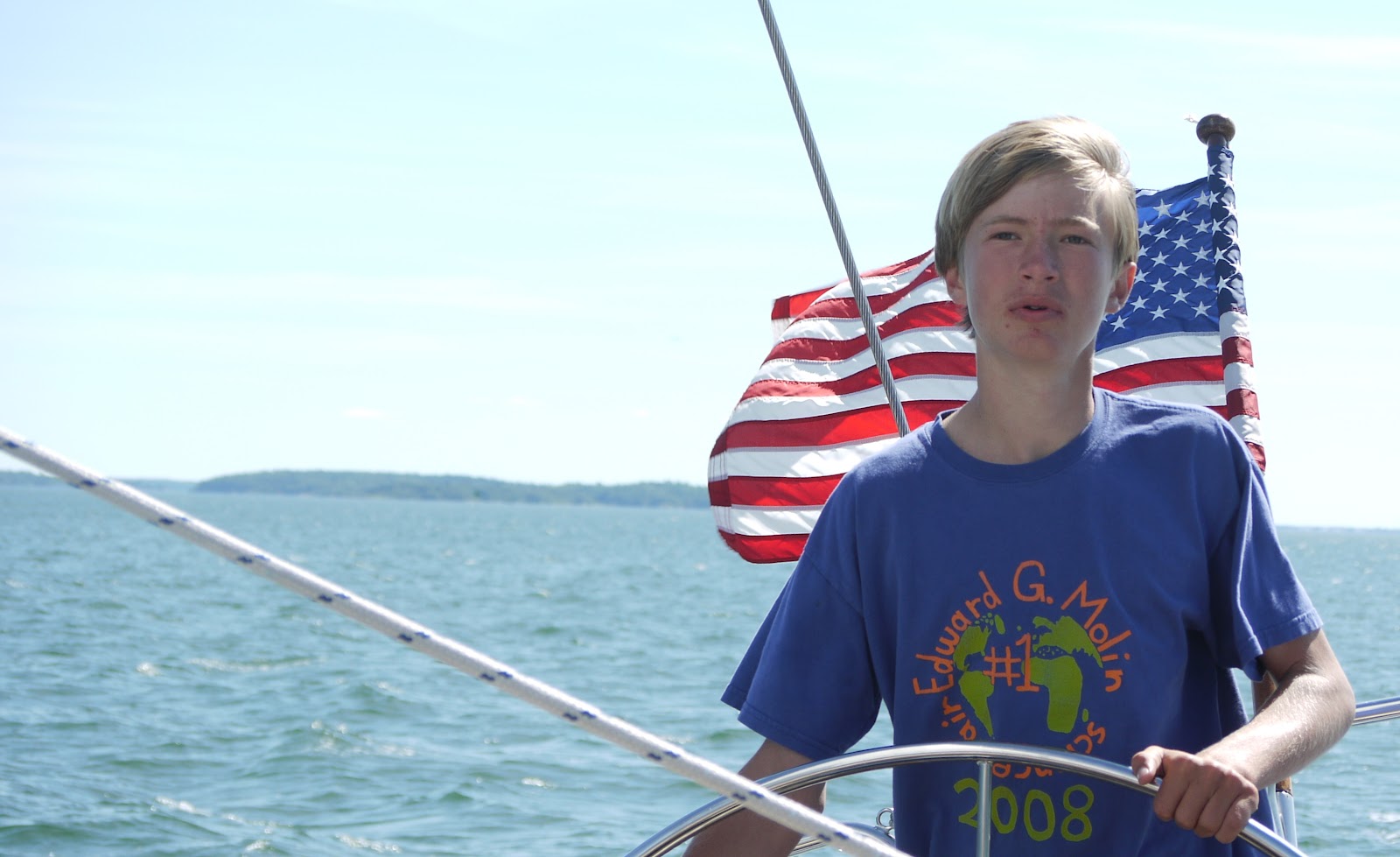
Olin and Hans taking one of the sailboats out

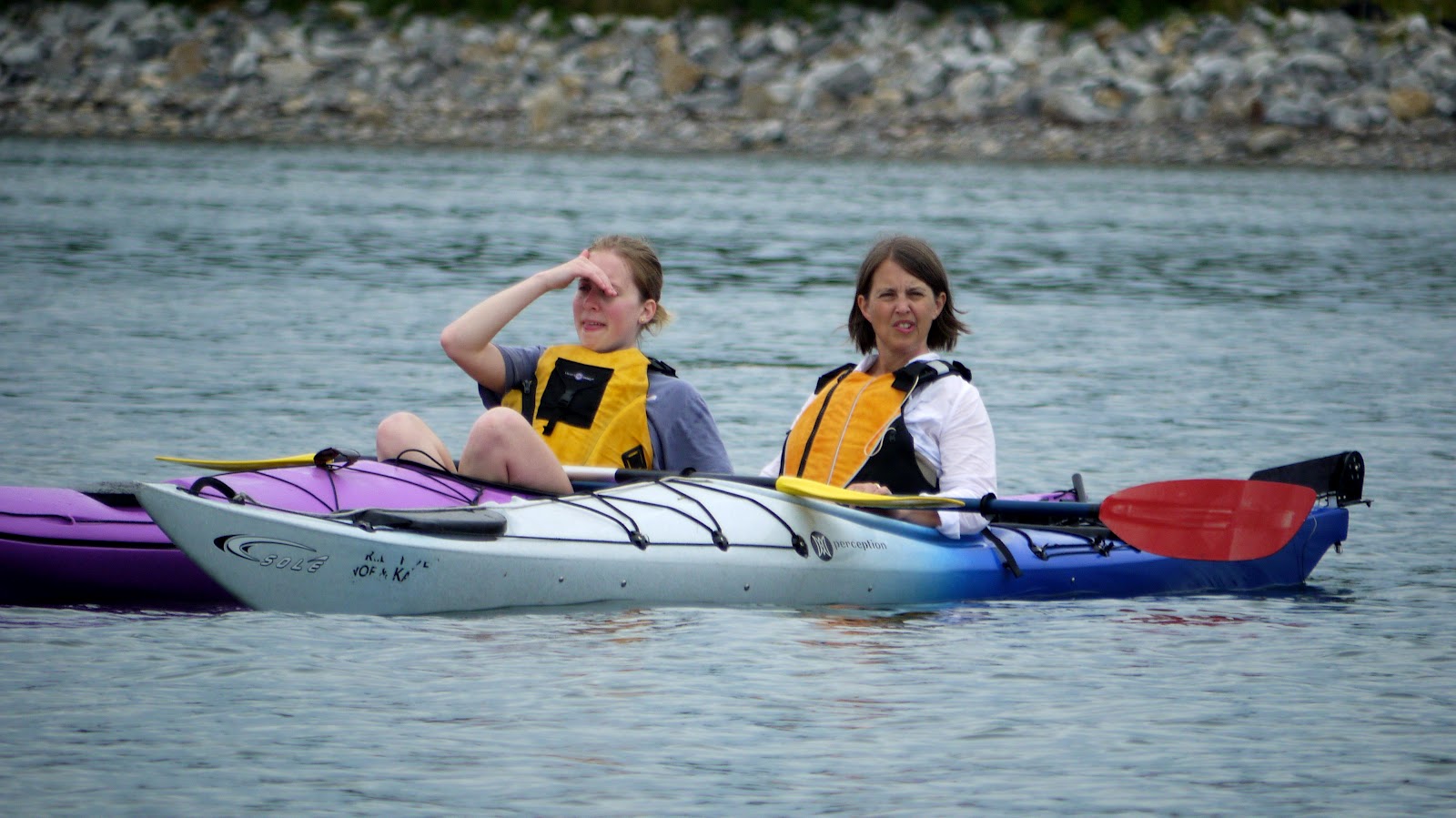
Me, Ken, in borrowed kayaks
Hans sailing his Laser near the Zube


Messing about in boats is mostly what we all do at Bailey, kayaking, rowing, sailing.  Besides reading, walking, swimming, puzzle-solving, eating and drinking.  I love kayaking, but when it comes to sailing I’m most useful as ballast.  I still can’t keep straight what a cunningham does or what a shroud is.  I kind of know the functions, but not necessarily what they’re called, which isn’t much help when Cap'n Cliff calls “bear off,” or “slack the jib.”  (But I can look things up!  A cunningham is a line on the boom that you pull to tighten or flatten the sail, and a shroud is a set of cables stretched from the masthead to the sides of the boat to support the mast.)


The boys (l to r, Olin, friend Harrison, Hans) getting the Zube ready

Thinking about this reminded me of when we were in Punta Arenas, ‘way south in the Patagonia area of Chile a couple of years ago, and visited their Naval Maritime Museum where we happened to see a film about the last clipper ship to round Cape Horn entirely by sail.  The grainy film was made early in the 1900’s by an American who signed on as a member of the crew and added the narration some years afterward.  (Credit for the film, to our surprise, was given to Mystic Seaport.) The ship was German, as was the captain, so our sailor had to learn not only the functions of the more than 300 ropes, but had to know what they were called in German.  The captain would call a drill at odd times for the new sailors by calling out the name of a rope and having them race to see who would be the first to locate it.  Each time the captain did this, he sent his dog charging off after them as a sort of encouragement to speed, as the dog liked to bite the rear of the slowest man at the end of the line.  


If we're talking about today, that slowest man could be me.

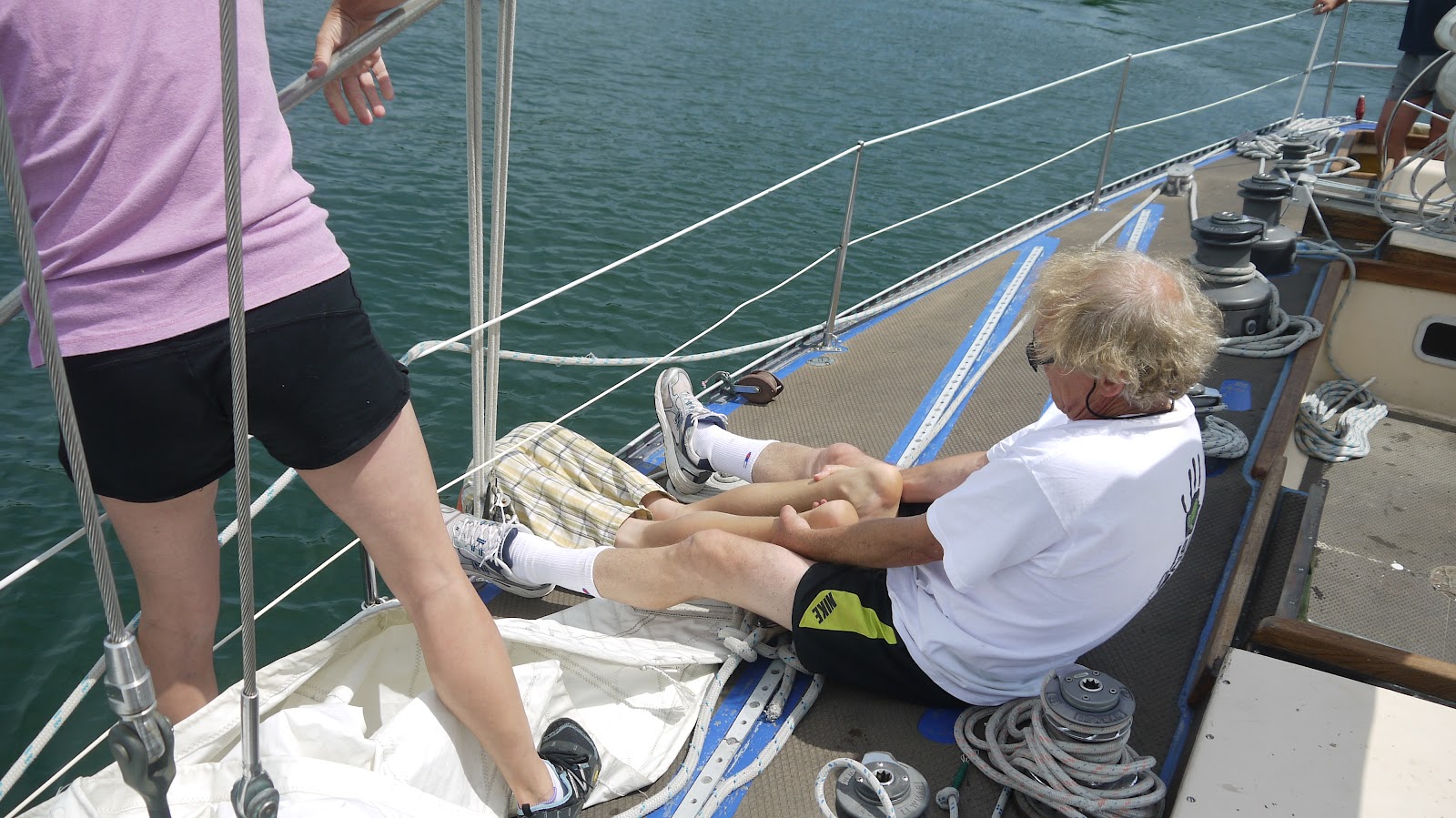
Olin winching away while we take it easy on the windward side

One sunny afternoon the wind was blowing nicely, making for a good sail day.  We often sail to an island in Casco Bay or head north somewhere or nowhere.  This time the wind was good enough to have a gusty sail south as far as Portland harbor.  Ken and I made our contributions switching back and forth on every tack to the high side of the deck.  Which was probably also our major contribution to the sail race the ‘Zube’ (short for Zubenelgenubi, a double star in the constellation Libra, viewable through binoculars) entered two days later.   It seems we won it, but maybe we were actually second because we were given a huge handicap due to the Zube’s size and speed.  We gave ourselves a pretty nice handicap anyway, snagging not just one but three lobster traps and starting a minute late.

Uh-oh,  headed for Portland harbor's "NO" ZONE 

Hans and Olin are experienced enough now to be seriously helpful crew.  (Hans did some useful work hanging over the side to try and unsnag the lobster rope before the race.  Ken was useful too, by supplying a sharp knife at the critical moment.)  Much of Hans' and Olin's experience has come from piloting small sailboats, especially Hans’ sailing a Frostie through a couple of winters. This summer he got his own Laser sailboat and he's already handling it beautifully.  

Hans at the helm on the return from Portland


L to R: Hans, Harrison, Claudia on longboard, Olin, and the Zube on the right


Sailing was not a part of my childhood, but was more like something that occurred on a distant planet.  I remember my mother saying that she would never get on a sailboat because they could tip over.  (Until we took her into our canoe when she was in her late 80's she'd never been in a canoe.  Talk about tippy.)  I stored away that thought, puzzling idly why people sailed these things if they knew they were going to be tipped.


Holding onto Hans as he tries to free the Zube from a lobster buoy
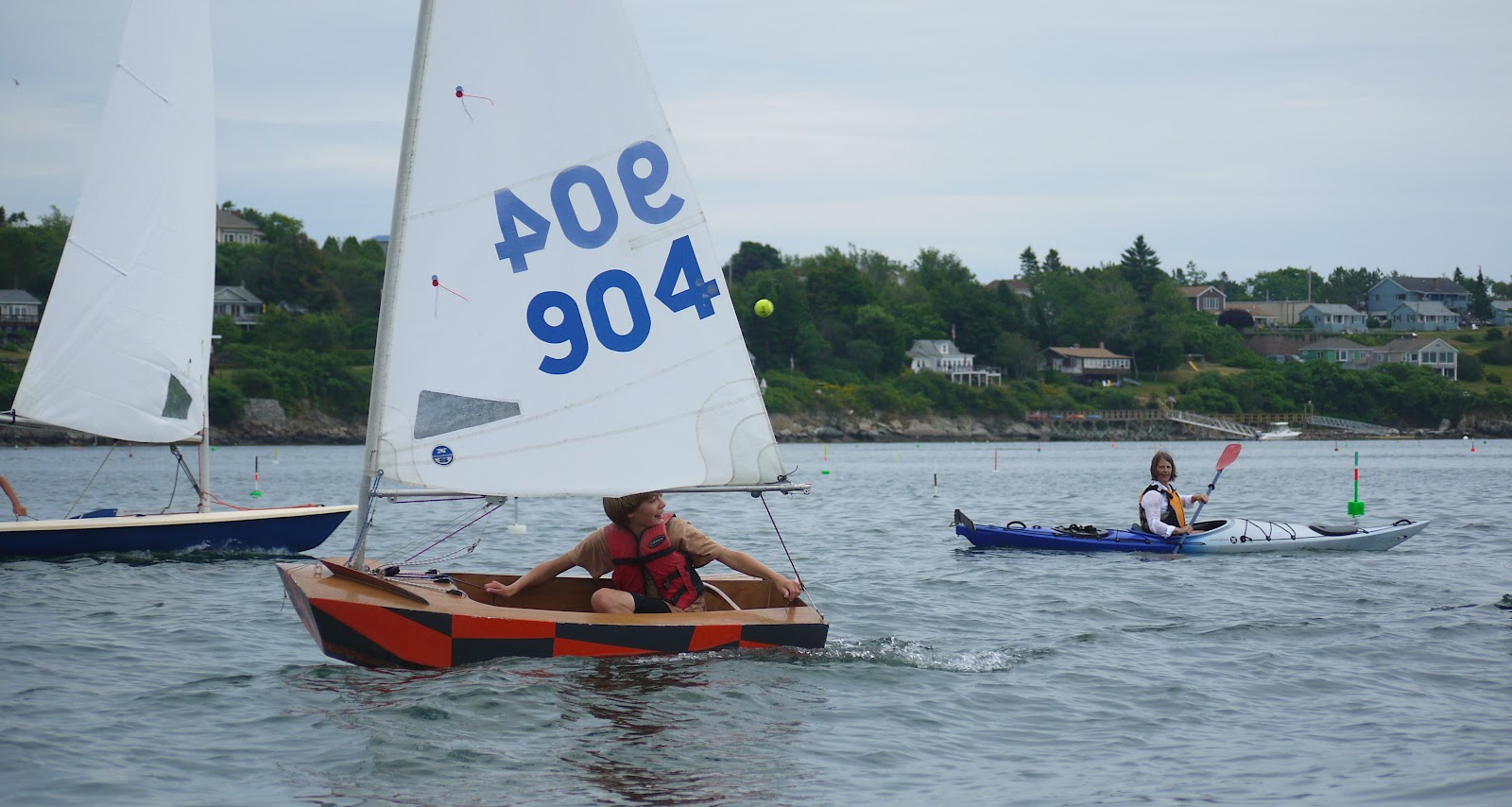
Ken and I and a couple of Leah and Cliff’s guests (Dave and Deborah Davies and daughter Izzy) were sailing and kayaking in different parts of the bay one afternoon while Hans, Olin and his friend Harrison were sailing, each in his own boat.  The kayaks moved toward the sailboats, Leah and Cliff hopped into the punt, and pretty soon everyone was in the same area.  A couple of tennis balls materialized and soon there was a game of tennis tag.  Sailboats are more fun to be in than kayaks for catching and lobbing tennis balls.  Somehow all the sailors–not the kayakers–ended up in different boats than they started with.   Hmm, idea for a game: musical boats, one boat less than the number of people...

Cliff and Olin race to grab the ball
Dave, uh, pushing Deborah away from the ball?
I see it!  I got it!
(Ball is to the right of the Olin's 904 sail)

What happened to that ball,  anyway?


Jacquish Island, off the tip of Bailey, is an isle encircled by water-sculpted rock, a source of many of Leah’s collection of rock photos. (See them at McGavernDesign.)  We hiked the perimeter.  Much of the rock looks so much like wood you need to touch it to assure yourself it’s really rock.  


Olin hoards his snacks on the way back from Jacquish (background right of flag)

***


BACK HOME in our saltwater-less environment it’s time to deal with our over-abundance of tomatoes, squash and beets.  I almost dread finding more of everything because I will have to do something to preserve them almost immediately if I can't find enough interesting recipes.  The tally on beets is about 15-20 so far, cucumbers maybe 30 or so, tomatoes–I don't even want to go there.  Soon to come:  about a thousand eggplants.  No, not really, maybe only 20 or so.


And August signals the start of the annual Addison County Field Days, our local fair, the main attractions of which–barring the midway of rides and thrills–center around agriculture, farming, and cattle.  One of the sweetest events was the Favorite Pet contest.  This year's contestants:  Two miniature alpacas, one rabbit, one turkey-necked chicken, two baby ducks, and two sheep.  Everyone won.