|
| The Tilley hat, the binoculars, hearing aids just visible, the almost-grin: Ken! |
Ken died on October 30th. Still almost a month later, it’s hard
to write or say that sentence. I
console myself with the thought that if he were alive, would it be the Ken of
his last days? Of the month of
September? Why not wish for the
Ken of a year ago, or two, or three?
It’s then that I realize I may as well hope to be whisked back ten
years. Why not? It makes no sense. Still…it’s just as hard to write or
say that sentence.
The weekend
after Thanksgiving there was a celebration of Ken’s life at Middlebury’s
Waybury Inn.
 |
| This was the place, but on a sunny summer's day, not in gloomy November. |
Several of
us spoke. This is what I said:
The world is already a different one than
Ken knew. I can’t really believe
that time has passed since October 30, the day of his death. The election happened. That was
enormous. I went to Washington for a weekend and I wanted to tell him about
it. I bought a dress he hasn’t
seen. The leaves fell. It snowed. The outdoors looks different too.
I’ve been
gathering and reading all his notebooks.
He didn’t like me poking around when he was alive. They remind me of things I already
knew.
Ken was
always an explorer of the natural world. He was filled with curiosity.
He was an observer. He wanted to
understand the universe.
He wanted
to understand the behavior of an insect.
He loved to quantify things.
Ken was intense about every pursuit.
And he was always modest about it.
He never boasted.
 |
| In typical winter gear |
***
We had
adventures together. Many trips we
took were more than just visits to places. They were explorations, they were adventures, sometimes they
were really adventures. We collaborated on planning them. Our last big trip to the Galapagos
happened only a year ago. That one was his idea.
His
interests all through throughout his life spanned an amazing range. I loved the fact that he was always up
for something, something new. The
sports he tried out included technical climbing, hang gliding (only briefly, thank
God), rollerblading, scuba diving.
Some he stuck with for years:
fly fishing, cross-country skiing, snowshoeing, downhill skiing (even
last winter), running, bicycling, hiking.
He took long walks as recently as September.
***
I’ve been
reading through all his notebooks. There are a lot of them. Most of them are half-filled. When he had something he wanted to make
notes about he grabbed the nearest one.
When he was in a shop that sold small notebooks he picked up more of them.
 |
| Ken 's notebooks |
A lot of the
things he took notes on were about science. He wrote:
“For thirty
years I worked as a physical chemist, but I don’t consider myself a
scientist. I am a fan of science,
an amateur in the original sense of “amateur” ––a lover of science. Much of the science I love is not
chemistry. Had I been better at math, I might have been an astronomer or a physicist. Chemistry seemed to sit in the middle
of all this. The child in me was
delighted by the smells and colors:
the marvel of electricity generated by chemical batteries, and the
explosions and pyrotechnics.”
But he
really was a scientist at heart. He wrote:
“It’s the
sense of discovery, the rhythm of theories and ideas which enlarge,
encompassing one another. A cycle
of new insights, overturning earlier insights, only to encompass them.”
On walks he
would have a magnifying glass so he could examine a bug, a mushroom, animal
scat, or a lichen.
He was a
scientist too when he was cooking, always trying the same dish in different
ways, never satisfied merely to repeat it, even if I told him it was perfect
just the way it was.
And then
there was art, and opera, music, and the theater––until his hearing got so bad
even headphones didn’t help.
 |
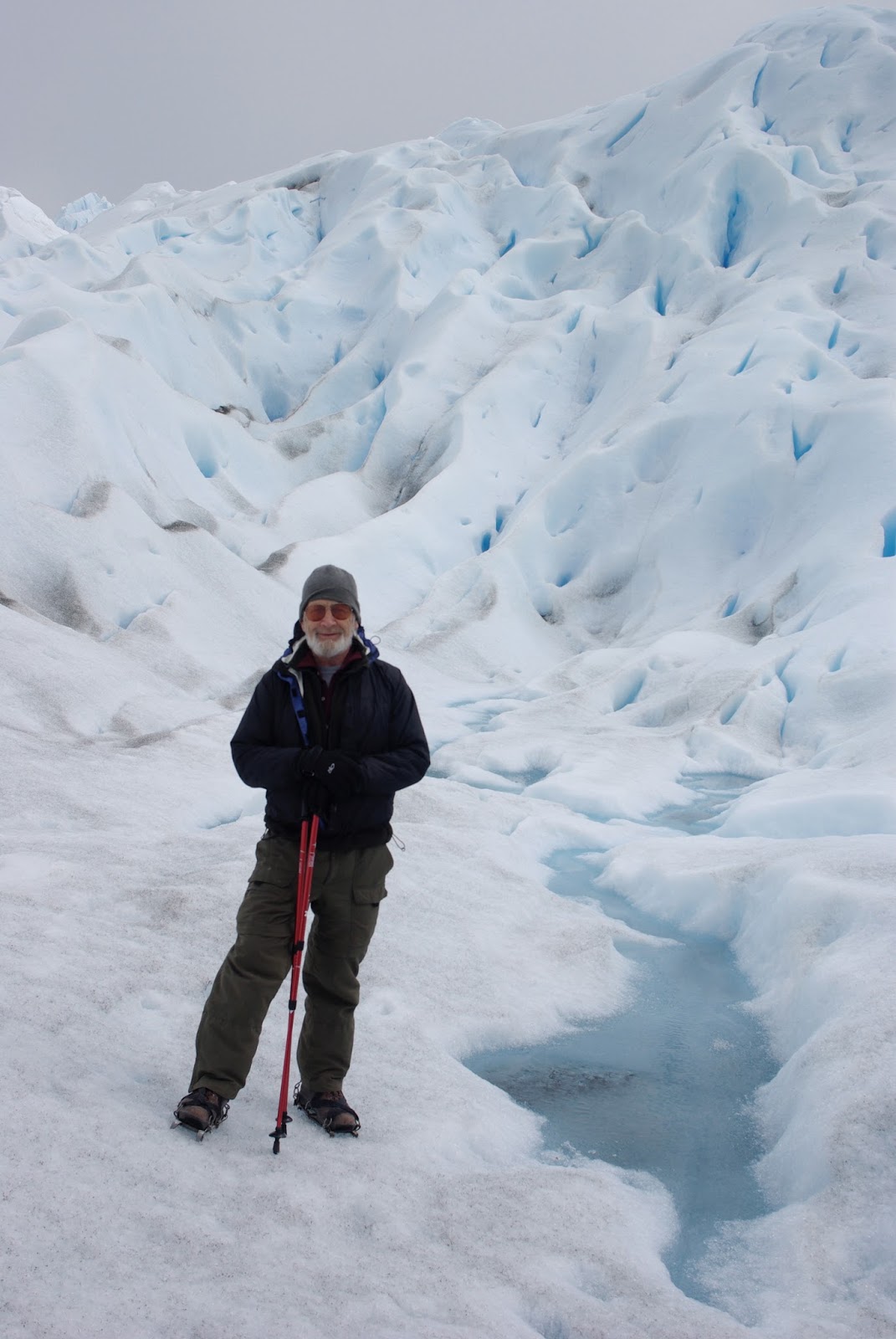
| In Patagonia |
***
The
notebooks are full of lists–shopping lists, to-do lists, lists of interests to
follow up on, lists of phenomena he wanted to understand, lists of animal or
plants he observed, lists of behaviors he wanted to improve upon. There are short essays on a huge range
of topics, and there are travel notes.
Some of his lists are interrupted by recipes.
***
More than
ten years ago, after he was retired, he took a writing class in Cambridge
(taught by a person some of you may know, with the wonderful name of Mopsey
Strange Kennedy) and he began to write often, mostly about his early life. After that he took a poetry class. Both these classes helped him look back
on his life, especially his early life.
There was a reason for that.
As some of
you may know, he was haunted––scarred even––by the death of his birth
mother. After she died, an aunt
moved in to take care of him and his brother, but after a while she moved away
to live her own life. His dad, who
by now had begun drinking more heavily, sent both boys to live with their
maternal grandparents who lived nearby.
It wasn’t long before his grandmother died, and not long after the
grandfather he’d begun to care deeply about also died. Ken wrote about these losses again and
again. Here is an excerpt from his
notebooks:
“I was
young, three and a half years old, when my mother died in childbirth. Seventy-five years later I can remember
the time. My brother was brought
home from the hospital, and I have the image of a few women carrying him
upstairs at our house. I can see
myself as a small figure behind them, as if I were on the ceiling looking down
at that small boy climbing behind the group. That image, and a powerful sense of loneliness and
abandonment, was compelling.
“In middle
age I met a neighbor from that time.
She remembered me, and my telling her that my mother had gone to
heaven. I recalled fantasizing as
a child that I could climb a tree and go to heaven to see her. She recalled how
I told her I was going to go up into the sky where she was, and that I had
looked like a little old man. I remember seeing a movie about a tree in front
of a house where climbing the tree was linked to a grandfather and death. I have always liked the view of great
spreading trees with lower climbable branches.”
His actual
mother was never mentioned in his childhood household. It was as if she’d never existed. That was only part of his story.
 |
| Christopher, Ken, Christine (above), Bill, Luke (below) |
***
He was often
pessimistic, sometimes depressed.
But he also wrote this. He
titled it “Me, Myself and I.”
“I want to
tell you about myself. It’s
complicated because along with myself and me, there’s also my mind which has a
mind of its own, so that’s four of us.
That as far as I know.
There could be more lurking back there.
Myself
doesn’t talk much, although he wants to.
It can be hard to drag anything out of him. He’s ambivalent and sulks a lot. He’s not that happy a person mostly, but when he is, it’s a
rush for me. I feel like dancing
then. And laughing.
“I’m pretty
gregarious. I like people, I like
the out of doors. I like
parties. I like to fish and ski. I liked my job when I had one, and I
like not having one now. There’s
not a lot I don’t like or can’t tolerate.
I don’t like mean people. I
don’t like being pushed around.
Mostly I enjoy my life.” [He wrote that in
2004]
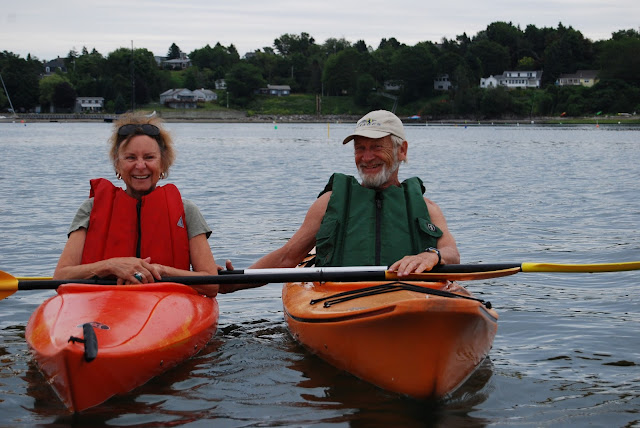 |
| Summer in Maine, three years ago |
***
In his
notebooks, the notes, and the lists, drawings and the essays, are a window into
his mind. They tell me how
hard he was working to corral his wide-ranging interests as his brain was
changing.
One to-do
list reads as follows:
1: Gather firestarter wood
2:
Draw birds
3:
Clean trash bin
4:
Saturday night Norma’s birthday dinner
5:
Check re Bill for lunch
6:
Higgs boson
7:
Is there anything special at the center of the universe, galaxies,
nebulae? All flying away from the
Big Bang?
He made
notes about what he was reading to help him remember. There are notes on the plots of books, and other things,
like:
o “How much dark matter is there?
o The five pillars of Islam
o Temple Grandin’s “Animals in Translation”
o The poetry of T.S. Eliot ” (and comments on Eliot’s metaphors of
loneliness)
He thought a lot about what was going on in his mind:
“I am remembering a series of sketches at an
Alzheimers [art] exhibition.
First there was the initial drawing. The initial drawing begins to
change. Face fragments and gaps
appear, then distortion in a series of images, and a shattered visage at the last. Captured is a slow loss of faculties,
of interests, especially by the gaps in the image where what was, is gone,
irretrievably. Humanity is lost in
the void.”
Elsewhere he
wrote:
“Instead of the flotsam (ideas) following
the current of my thought, they are trapped in the whirlpools on the surface;
circulating, not following the train of thinking. Part of brain that enables sequential steps is impaired.” [2013]
“What goes on in cognitive impairment causes
a loss of initiative, prevents movement on complicated tasks. Same reason I can’t dance well.”
On the next
page he wrote: “Learn to dance.”
Then this,
on a page by itself in 2005 he wrote:
My
soul’s wings are clipped and
A
devilish cat approaches in the night.
***
Everyone who
knew Ken, those who knew him well and all those who came to know him, from
Vermont to Australia, knew he was a man of “sweet strength and kindness.”
(That phrase isn’t mine; it comes from
a sympathy note.)
As he grew older
he had compassion for every living thing.
He liked sad stories less and less.
 |
| Ken with Harry who was by then about 15 or 16. |
The first
thing I ever noticed about Ken was his laugh. It was infectious.
It was filled with joy. I
can still hear it.
There are
lines from an Irish ballad that have been haunting me:
Many the mile with thee
I’ve traveled,
Many
the hour, love, with thee I’ve spent
I
dreamed you were my love forever
But
now I know, love, you were only lent.
That was all
I said. There could have been so
much more. I forgot to mention
what he did for me, how much richer and fuller my life was because of him. How much more fun. Until the last few months.
****
There
were many words other than mine spoken on November 26th. Not all were written but happily Chris
Huston’s were:
It
seems appropriate to begin by recognizing Norma’s significant efforts to care
for Ken over the last several years and more specifically in the last few
months. Yes, sure we have all seen
Norma get a little short with Ken when he would be “forgetful,” she really had
the best intentions of keeping him on point, for as long as possible. His passing was as perfect as one could
wish for- in the comforts of his own home, surrounded by his family. Norma made sure of that.
I
have known Ken for the last 20 plus years as his son-in-law
Through
the years and more so recently, I could always engage Ken in a conversation
about fly fishing. The technique
of the cast, the selection of the fly, and the sound of the river - Ken taught
me how to fly fish, I just wish he taught me how to catch fish. He was always content having spent time
on the river and perhaps getting a strike or two, maybe losing a few flies in
the process.
 |
| Not with his usual fly fishing friends, a guide instead this time. |
Ken
was a man of process. He loved
the process of cooking a fine meal, perhaps taking all day to prepare it. While he enjoyed wood working, it was
really about the process of looking at the wood, studying the grain under his
pocket magnifying glass after he sliced through it. Process, not always focused on the end product, process was
paramount. Even stacking his cord
wood, the process of drying, and of course the process of lighting and
maintaining the perfect fire in the wood stove, were all quintessential Ken
characteristics. Sometimes it
would drive Cliff and me crazy. We
would have a project that typically had a sense of urgency. Ken was perfectly happy to STUDY the
issue, maybe even experiment with several options, taking days to find just the right solution.
He
embodied the scientific mind. He
exuded SCIENCE in everything he
did. Some of my most fond memories
that I know my kids will carry with them through their lives will be of Ken
showing them insects or minerals or plants under the microscope. Deeply engaged in scientific literature,
he was often so immersed in his book that everything else was background. Perhaps that was the one occasion where
his hearing impairment was an asset, just for that moment.
Les
and I were so pleased and quite surprised when Ken and Norma announced they
were moving to VT, to our street…NEXT door in fact! Ken’s happiness with his decision to move to be closer to us
and Bill and Bob, was expressed nearly every time I saw him. He would marvel at the beautiful
landscape, content with watching the changing seasons, the incredible sky
drama, or the stunning sunsets that seem to be the norm here.
 |
| On the left, holding Harry |
One
of Ken’s most memorable roles was that of the crazy Mr. Tickle Monster. Often Mr. Tickle Monster would arrive
on the scene at the most inappropriate and unwanted times…such as our kid’s bed
time. He would, without warning,
begin with a low growl, then roar with impressive volume sending the kids
shrieking in fearful delight at their impending doom, and thus delaying their
bedtime routine. Thanks, Ken, for
that.
You
know how some people just get more mean and grumpy as they age? Ken just became more kind and gentle. He could not hurt a thing. He was a beautiful caring man who was
such a wonderful grandfather to our kids.
We are all the beneficiaries of Ken having touched our lives. We love you Ken and will miss you very
much.