Wednesday, April 24, 2019

INTO THE LAND OF THE BALKAN WAR


On the road 


Prologue:  Montenegro


Only a few miles over the southern border of Montenegro all is serene.


Leaving Albania, after a careful examination of our car’s VIN number at the border (did they think it was stolen?), we entered a bucolic section of Montenegro before we actually hit the coast.  We were driving to Dubrovnik (“we” being my co-traveler Nora and Klodi, our Albanian guide), taking what was likely the busier and more fashionable coastal route.  I knew virtually nothing about Montenegro (besides having read that it was the Montenegrin President whom President Trump elbowed aside at a NATO summit in 2017).  I figured the government had a good shot at being as corrupt as Albania's, given that in 2015 an international organization of journalists named the President (different guy than above) “Person of the Year in Organized Crime.” It  made me wonder who won this year.

Montenegro is very small. We were in one side and out the other in no time.  The visit to Kotor (pictured below) was made from Dubrovnik, just a half hour and one border away.  


Did I mention that Albanian currency is the Lek, while the Montenegrins have the Mark, Croatians the Kuna, Bosnians the Bam, and Slovenians the Euro? Fortunately I didn’t visit Serbia, or I’d have had the Dinar as well. 


Parts of Kotor, Montenegro, on an inlet of the Adriatic, date to the 12th and 13th centuries.
Ancient protective walls circle the mountain high behind the town. I hiked to the chapel (the tower halfway up).

 
Being in Kotor, Montenegro, was like being in Italy.  Camera distortion makes the buildings lean in; some of them actually did in a 1800's earthquake.


Many Russians own property along the Adriatic in Montenegro. Connections that date to tsarist times, as well as the frequent use of Cyrillic script in Montenegro, may help make Russians feel at home. 

We heard jokes about how laziness is part of the Montenegrins' nature.  Even our local guide in Kotor told a few of them.  Examples:  "Man was born tired, and he lives to rest."  "If by chance you wish to work, sit, wait, and you will see, it will pass."  And so on.  This attribute of the national character was even mentioned by Rebecca West in 1941 in "Black Lamb and Grey Falcon."  It was attributed to Montenegrins' long history of fighting to preserve their independence, a standard of heroism that allowed no failure, hence no desire to take on tasks at which one might fail.  Freely given foreign subsidies in the 19th and 20th centuries, especially from Russia, may also have contributed.  As if to prove this true, there was recently a TV program broadcast from Montenegro called "Good Morning," or something like that, but to much snickering it came on around noontime.   


Sadly, many of the roadsides gave evidence of thoughtless trash disposal.  Much of the junk looked as if it has been hung up on branches or lying around for years.


North to Dubrovnik, Croatia


Dubrovnik, a jewel of the Adriatic


It's hardly surprising that Dubrovik's old walled city looks like Italy (as did Kotor, in Montenegro) given that it was once part of the Venetian Empire.  The first thing a visitor to Dubrovnik's old walled city is likely to see on entering the old city gates is a reminder of the Balkan war of the 1980's and 90's.


The red squares denote buildings burned, the black dots are direct hits to buildings, the triangles are damaged roofs. The bombing continued for eight months. "Grad" means city.

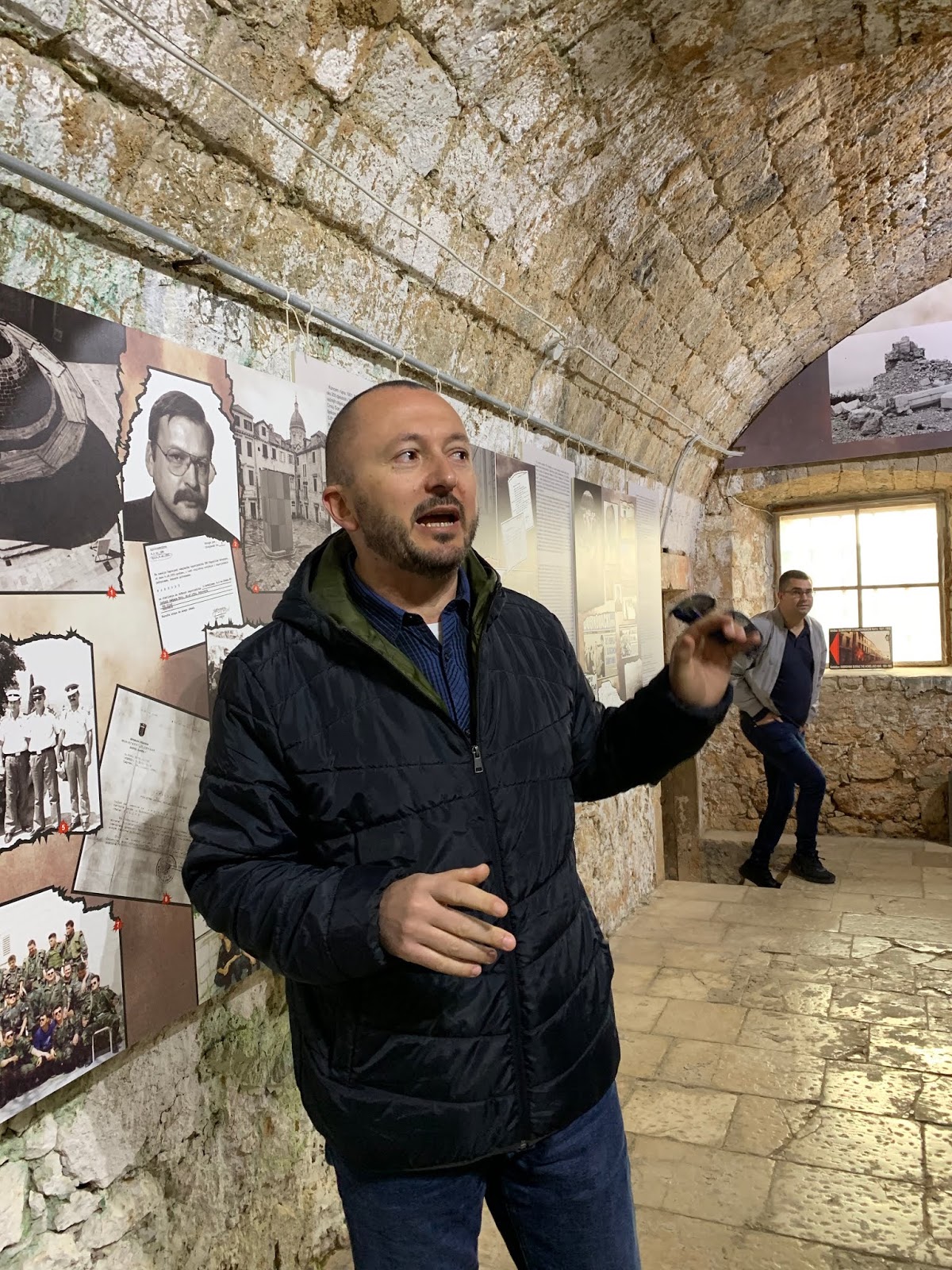
Above the town is a fort built by Napoleon. It was used by defenders of Dubrovnik, one of whom
(above) described his experiences in the war.  The fort is now a museum of Dubrovnik in wartime.

A major street in old Dubrovnik during the war.  It was bombed by Montenegrins
who had sided with the Serbs.


In Dubrovnik today: this street angles left to the one pictured above. Only new roof tiles hint at repairs of war damage. 

"Game of Thrones" filmed King's Landing scenes in Dubrovnik


Mountains...
...and more mountains, en route from the coast to Mostar and Sarajevo


It's time to talk about history.  (A warning: very ridiculously abridged.)


A Ridiculously Abridged History of Yugoslavia


It is hard to imagine a past in which the place where you were born, where you live, where your traditions and customs originate, was ruled for centuries by two warring empires, each affecting and shaping your traditions, customs, and even architecture. Each of these empires left its mark: The Ottomans from the 14th century onward, and the Austro-Hungarians from the 16th. Then, after WWI, there was no empire at all.  

The nation of Yugoslavia was created out of territories lost with the breakup of the Austro-Hungarian Empire after WWI. What the territories' people had in common was that they were, more or less, all southern Slavs.  Nevertheless, the country was never an organic union. What, after all did it have as its political model?  Only monarchs, dictators, occupiers, power brokers. Not surprising then, that this new entity, Yugoslavia, had a rocky political history up until and throughout WWII when it was occupied by Nazis and Italian Fascists. 
A unifier entered the scene:  Josep Broz Tito led a group called the Partisans that joined with Allied forces to fight against the Axis powers during WWII.  He also ended up fighting against Serb nationalists and Croat collaborationist forces each of which had its own agenda. Tito's forces ultimately triumphed, and he became the leader of a communist Yugoslavia by the war's end.  A different sort of communist, not a Stalinist like Hoxha in Albania, he positioned Yugoslavia in the world community as a non-aligned state during the Cold War.  This lent him a degree of international renown.  He built a powerful army and ruled Yugoslavia with a strong hand until his death in 1980. It was a dictatorship, but many thought it a benevolent dictatorship.  Especially in retrospect.

The death of a strongman/dictator often leaves behind a weakened central government. Even worse in this case, there was no one to replicate Tito or replace him.  Tensions related to the events of WWII–memories of Serb nationalism and Croat collaboration with the Nazis and earlier grudges as well–that had gone underground during the Tito's rule arose once more.  Serbian nationalism in particular.


Tito's birthplace, the house and barn, near Zagreb, Croatia. On Tito's first visit to the house as head of Yugoslavia he found his minions had torn down the barn because it looked "too humble" to belong to such an important person.  He demanded it be rebuilt immediately. The above barn is, of course, that reproduction.


Think what it must have been like to live in a country that was falling apart, that was a country no longer.  Our guide, Vladka, who lives in Ishia on the northern Dalmatian coast, has a brother who had been called up to serve in the Yugoslav army in 1991 when it was clear that the country was coming apart, with many areas of the country already deeply involved in war.  As he went off to Belgrade to report to duty (service had long been compulsory) his family was aware that he was about to serve in the wrong army.  His father secretly went to Belgrade in an attempt to bring him home, but it turned out to be too risky.  Some time later though, enlisting the help of a friend, Vladka’s brother escaped from the Yugoslav army and made his way back to Ishia. 


Soldiers: Stored casts for statues at sculptor Antun Augustinčić's museum near Zagreb, Croatia. There were also casts here of statues of Tito, Ethiopia's "emperor" Haile Salassie, and more. One of his sculptures resides at the UN in New York.


Bosnia and Herzegovina


To us westerners, the Balkan troubles began shockingly soon after the 1984 Olympics in Sarajevo.  One moment Sarajevo, Yugoslavia, was the enviable international center of sport and excitement, and then suddenly, inexplicably, the whole region and the nation itself disappeared into the fog of a war most of us had trouble understanding. The city of Sarajevo became a symbol yet again:  It was here that the stage had been set for WWI, when a Serbian nationalist assassinated the heir to the throne of the Austro-Hungarian Empire as the carriage carrying the Archduke Ferdinand and his wife Sophie crossed this very ordinary, unremarkable bridge.


Above:  The assassination in 1914 of Archduke Ferdinand and his wife Sophie, at left above; the same bridge today, above at right.  Below, a cable car in the building now housing a brand new cable lift, and at right, an "Olympics" artwork at the museum of the massacre of the inhabitants of Srebreneca; with heavy irony, it is now a town in the all-Serb Srpska Republic.


Symbols.  Mostar became a symbol of the war too.  Its rightly famous beautiful 13th century bridge built during the Ottoman era was destroyed by Croats.  It has been faithfully rebuilt.  I should say, “faithfully” to my eyes anyway, because the cobblestones forming the walkway over the bridge seemed authentic; they were steep, and made slippery with the feet of centuries. 


The bridge at Mostar, from a different angle than the most iconic photos. 


Menu
We had lunch here in Mostar


In today’s Mostar, the Muslims live on the east side of the river, the Christians on the west side. They attend school separately, at alternate times.  Only the university is unsegregated.  This was not the case before the war. (See The New York Times, November 20, 2018 article with the ominous title “In Bosnia, Entrenched Ethnic Divisions Are a Warning to the World.”) 


Former Olympic sites are shown at upper left and upper right. The siege of Sarajevo lasted nearly four years.

What many inhabitants in Sarajevo most feared during the long siege, more even than mortars fired from heights above the city, was snipers shooting from inside.  Our Sarajevo guide told us of a young girl who, like many others in the city, was on her way to get water for her family (there were only two places in this city of over 400,000 to get water during the siege) and was shot by a sniper who, it turned out, was her math teacher.  Everyone in the city older than, say, 35 or so has memories of the war.


Sarajevo, a view from the cable car.  The old Ottoman section is in the  center; to the far left are tall modern buildings.Tito's concrete apartment complexes dot the landscape just beyond the old center.


Walking on from the old Ottoman section you enter the Hapsburg part of town.  If you kept walking you would be in modern times.  Changes of architecture. Note the museum sign on the left, a "Museum of Crimes Against Humanity and Genocide." 


The narrow streets of the old part of Sarajevo are full of people, restaurants, cafés, shops.  The crowd waiting in line is not shopping, however, but queuing for free food.


Many small shops line the narrow streets of the oldest part of Sarajevo. The long-handled metal pots are for Turkish–no! here it's called Bosnian–coffee. 


Everything that was evil in the Balkan war and wrong in the peace agreement is evident in Bosnia-Herzegovina.  First of all, ethnic cleansing––for which Serb leaders were tried in the Hague for genocide––was essentially successful.  Secondly, the Dayton Peace Accords, more a cease fire agreement than a peace treaty, nevertheless formed the basis for the Bosnia-Herzegovina constitution, thereby setting in stone a separation of people that had not existed before the war. 


A house bears scars of war.


Where Muslims and Christians, Serbs and Croats lived side by side in Bosnia and often intermarried, there is now a Bosnia divided into three sectors:  the Federation of Bosnia and Herzegovina, Srpska, and the district of Brčko.  Srpska is an area for Bosnian Serbs and is primarily, or perhaps thoroughly, Orthodox Christian; Brčko, a miniscule district, actually a small city, has a remarkable mixture of people; the Federation of Bosnia-Herzegovina has Bosniaks (meaning ethnically Bosnian, not simply living in Bosnia), ordinary Bosnians and Croats, and is almost entirely Muslim.  Each sector has its own president and parliament; the three presidents rotating every eight months between Bosniak, Croat, and Serb. The Bosnian Federation consists of eleven governments and parliaments.  (I am not exaggerating.)  Below the level of the parliaments there are cantons, yet another political entity. 

This is a staggering amount of government. So much so that it is hard to imagine how anything can get done.  Given the current economic situation, very little indeed is getting done.  A standard Bosnian quip says “50% of the people are unemployed, and the other 50% work for the government!”  (The unemployment rate is no joke.  It is currently running at a whopping 57%.)  In order to work for the government a family must be 100% of whatever ethnic sector one plans to represent.  Merely living in Bosnia is not a qualification.  People in ethnically “mixed” marriages cannot be part of the government.  Since there are many mixed families, this disenfranchises much of the population.  A family we joined for dinner is one of those mixed families. Our Sarajevo guide's family is another.


Houses like this in Bosnia and Croatia were not left to decay by choice; the people who lived there were ordered out during the war.  Looters took or destroyed what was left.


This plant spewed toxic plumes for miles, covering the town of Zenica and well beyond.  We held our breath as long as we could as we passed through.

It is hard to be optimistic about the future of a place that carries so heavy a burden:  the weight of the past, plus the weight of a complex political settlement that leaves no one content.  A speaker we heard in Sarajevo talked about the impact of these double burdens on the young. What is there to hope for?  What kind of future is there for them in their own land?  The current situation appears to be untenable. It makes no sense economically or politically.  How long can it last?  

Many Albanians have left their country to find a better life elsewhere.  Many Bosnians are doing the same.  As we wound our way back into Croatia, this time to a farming area near the Hungarian border, we found the situation sadly much the same–the younger generation was emigrating to other, richer countries in Europe.  


A town in the Srpska area.  Serbs are Christian Orthodox, as is the church in the background.  Although these houses look neat, the amount of roadside trash reached a peak in Srpska; piles of junk were dumped into streams, ditches–anywhere–as if the land was held in some kind of deliberate contempt.


And yet…there were places that seemed healthy, that held promise.  When we re-entered Croatia for maybe the third or fourth time, heading north to the Hungarian border, the roadsides were clean.  And they stayed that way.


Note:  Apologies for any font irregularities. I simply got tired of dealing with the defaults.

Tuesday, April 16, 2019

MEANWHILE, IN ALBANIA...


The huge main square in Tirana. In the background a Stalinist-age mural adorns the national museum.


I was in Tirana.  Except for one vowel, the word could have been tyranny. Tyranny was about all I had known of Albania in the past.  A country with a nasty history, ruled by tyrants, without a beneficent government–ever. My first impressions were much brighter:  I noticed the liveliness of the streets, people filling tables at outdoor cafés, numerous restaurants, and newish apartment buildings here and there.  And the weather was the best of spring. The city felt benign, welcoming.  The current fashion of younger men with their punky haircuts, grizzled faces and tight leather jackets gave them a kind of dangerous look. If you saw someone looking like that in Vermont, you might step back. But this wasn’t Vermont.  


This was the first leg of a trip through what was once Yugoslavia: Montenegro, Croatia, Bosnia-Herzegovina, and Slovenia.

The older men don't look stylishly punky at all, unlike the younger guys; they look unemployed.

 Our Guide to Tirana


It was only me and Nora, a Chinese lady from San Francisco, and our guide Klodi in Albania. Klodi’s story reveals a lot about Albania, although I didn’t learn all this until we’d spent a couple of days with him.

He told me he had trained as a veterinarian in a college in Tirana, one of the colleges that actually expects students to work at learning, as opposed to the other college for those who only want to buy a degree.  But Klodi said he never practiced as a vet for two reasons: the first was that Albanians don’t really care about animals; the second was that his professor owns all the veterinary clinics in the country, thereby eliminating the possibility of Klodi opening a practice of his own.  One could question this explanation, as to why study veterinary science in the first place, and so on, but we did not.

Klodi is married, his wife an elementary school teacher, and they have two children, one of which, only a few months old, was born with cystic fibrosis.  There is a single doctor in all of Albania who is able to treat this disease.  Klodi would like to move to Germany for the baby’s health, but at present this is only a hope.

He talked a lot about corruption in Albania–it was unavoidable as the physical results of it are everywhere–but shrugged his shoulders at possibilities of reform and change.  It goes so deep and has existed for so long.  When Klodi was a teenager in the late 1980’and early 90’s after the 1985 death of dictator Enver Hoxha and the years of unrest that followed he had a gun to protect his family. We didn’t ask if he ever used it.  We liked Klodi.  We didn't want to give him a hard time.

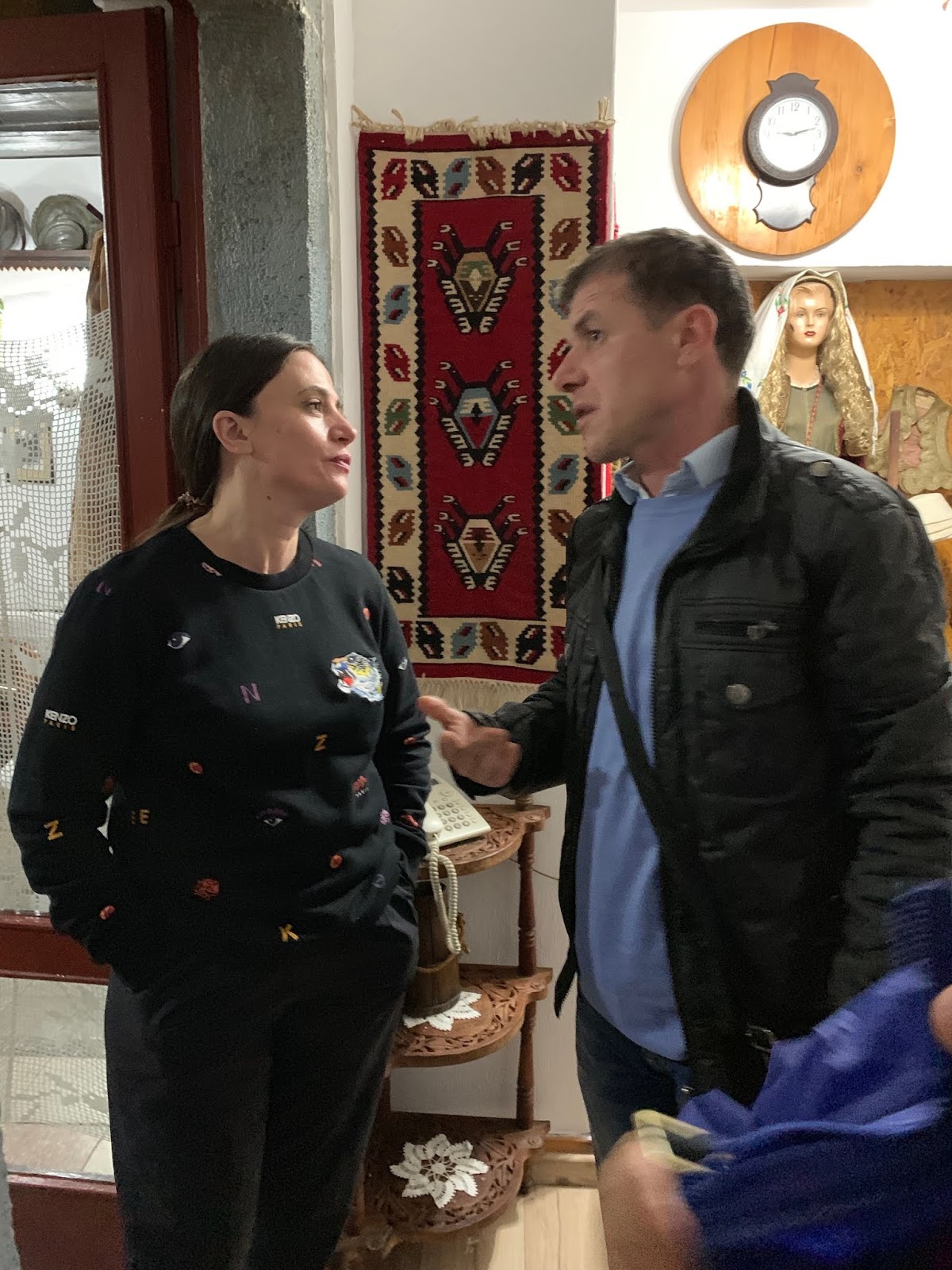
Klodi at right, with owner of a restaurant where we ate.
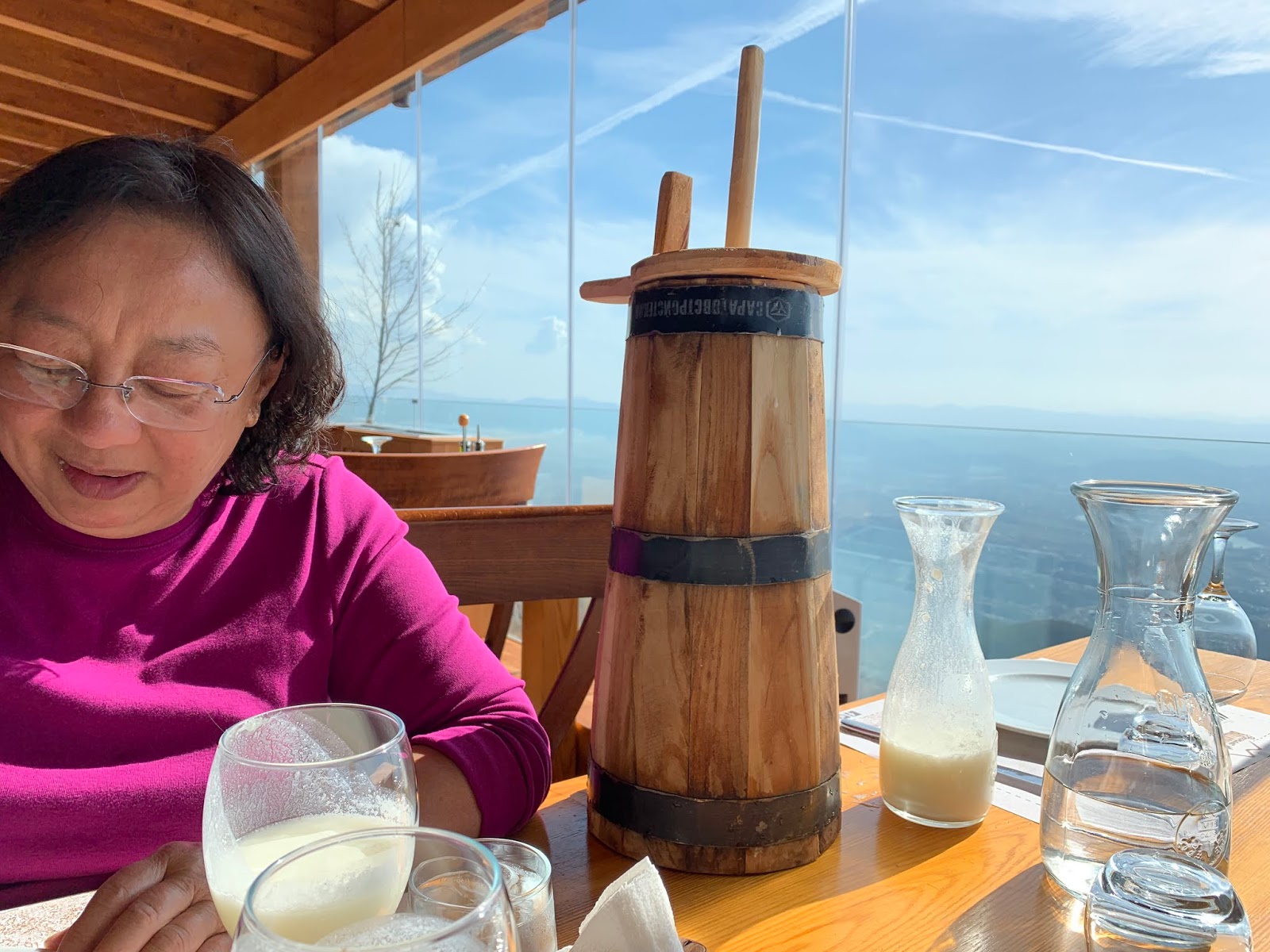
My co-traveler Nora at the mountaintop restaurant overlooking Tirans; next to her
is a churn in which our drink of fermented milk was made.


Corruption 


A daily paper, and in English!


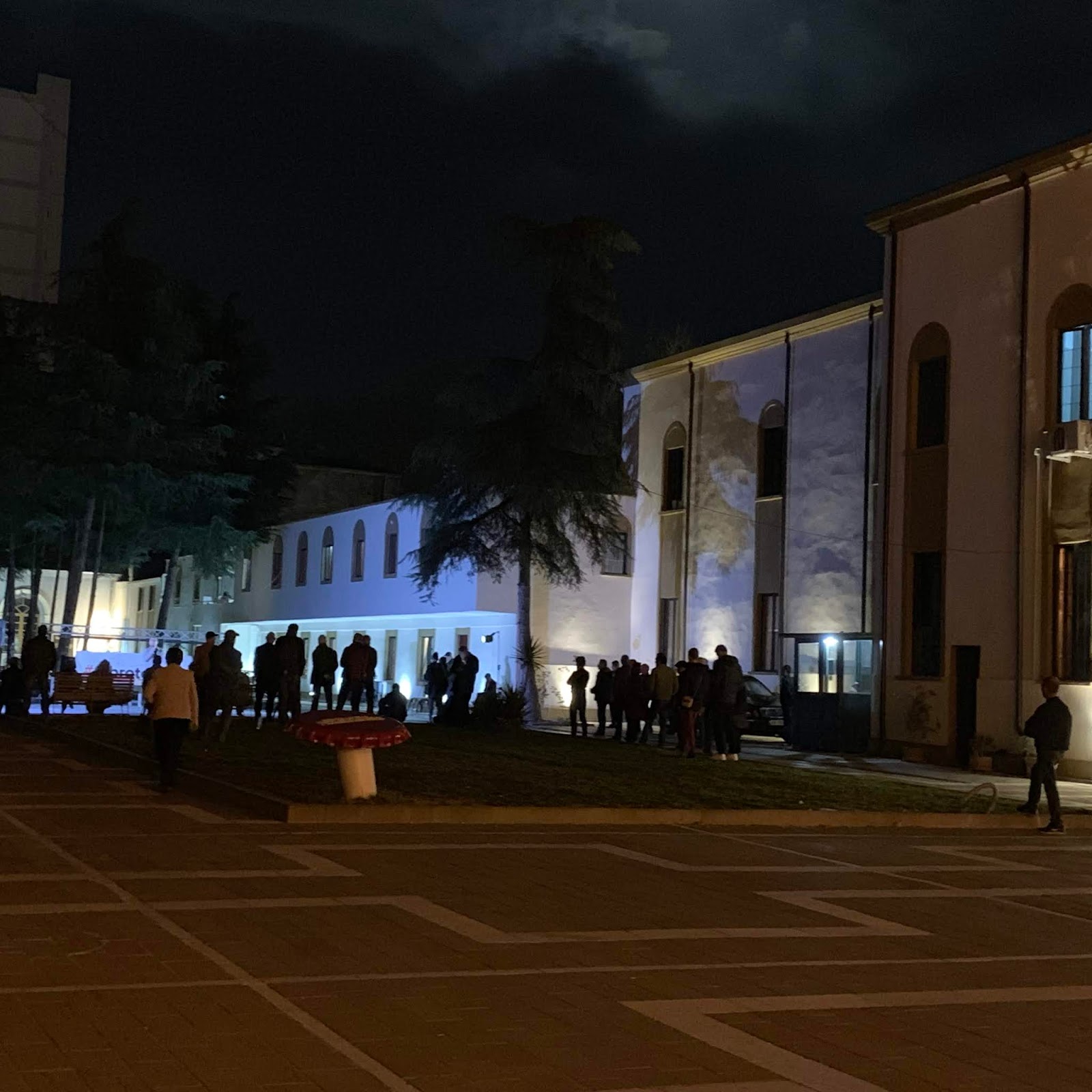
Two days before our arrival there had been an anti-government protest in Tirana, and there was another protest two days afterward.  The first was met by water cannons, but the second was peaceful.  Although our hotel was only two blocks away, daily life appeared to continue normally. The current president, a powerless figurehead compared with the prime minister whose resignation was the protestors' goal, offered to resign after the second protest.  The reaction to this was a collective shrug.

Klodi pointed out a tall building (it was hard to miss) just off the main square that looked as if it was under construction, complete with building crane.  It has looked exactly like this, he said, for fifteen years, crane and all. Construction projects like this are allowed to break ground without guaranteed financing.  So what stopped it?  Financing that fell through?  A shrug.  Maybe a bribe not paid.  Who knows?  Buildings are not taxed until they are completed. Hence the half-built, half-collapsed, often abandoned structures that litter the landscape. Yet there is money somewhere. Expressions of wealth abound in fanciful structures unconstrained by a lack of imagination. Expensive cars crowd the streets.  Outside of town shepherds stand around watching sheep. Why not just fence them in?  Why should a guy spend his time watching sheep? we wondered. Because someone would steal them, Klodi responded.  It is a poor country.  An average monthly salary, said Klodi, is about USD280.


The hero on horseback is Skanderbeg (Lord Alexander) who fought against the Ottomans in the 15th century. The building at the left has remained unfinished for 15 years.


Klodi told us a story about another building in Tirana, an odd-shaped concrete building with a roof that looks like a rippled skirt (a reference, maybe, to the traditional men’s costume– the "fustanella," meaning “put it all inside”– of both Greece and Albania).  It was envisioned as a marble monument to the late Stalinist dictator Hoxha (more on this later) and designed by his daughter, an architect. In the post-Hoxha years the monument idea never came to fruition. This was hardly surprising, given the antipathies he engendered among Albanians who survived his rule.  The building began to deteriorate. Perhaps, thought one governmental ruling party, it could become an arts center.  Good idea.  Scaffolding was erected.  Then there was a regime change.  The scaffolding came down, but, sadly, there had been no restoration.  Another regime change occurred, and this time it was decided the building would be destroyed.  But before that could happen, the regime changed once more. Scaffolding went up.  After a time the scaffolding was removed.  The building had not been restored.  But all the marble was gone.


Not much is lacking in design elements. Along the road there were shops specializing in selling columns.

Another unfinished residence

Location, location...

A Ridiculously Abridged History Leading to Hoxha 


Long ago in Albania there were the Illyrian and Greek tribes. Then the Romans arrived (mostly a good thing for infrastructure building and so forth), until Goths and the Huns put an end to the Romans.  Before you knew it it was the Middle Ages, a time when clans dominated the land, literally and figuratively (remnants of their domination can be seen as crumbling castles on mountaintops), followed by a sort of Venetian-Serbian Empire that then became part of the Ottoman Empire.  In 1912 Albania declared its independence, and after a few historical bumps, became a monarchy under a self-declared king known as King Zog.

King Zog, like other self-made leaders, did a few good things to start with, but spent a good amount of time and money working on his royalness. (He had Europe scoured for a lady of actual royal blood to wed and so enhance his own kingship.) Zog's downfall came along with World War II (he had sided with Mussolini) and the occupation of Albania first by the Nazis, then the Italian Fascists (no longer friends with Zog who fled), after which a promising Communist named Enver Hoxha was installed as leader. Unlike Communist Tito of the new Yugoslavia, Hoxha’s model was not so much Marx as Stalin, although perhaps Hitler could have served him as a model equally well. The years of Hoxha’s reign were a downhill slide into oppression. Albania became the North Korea of its time.  This is the Albania I remember reading about with amazement. Klodi pointed out the section of Tirana where Hoxha and his closest associates lived in fortified splendor, enjoying the luxuries of the west that were denied to everyone else. The country became a prison for its own people. He ordered concentration camps and death for those in opposition or for causing other annoyances. The national museum has a photo of Hoxha’s closest friend and minister, killed by two bullets to the heart, heedlessly dubbed a suicide.  Hoxha’s paranoia about invasion grew large–by this time he had alienated his only allies,Yugoslavia (Tito), Russia (Stalin), and China (Mao)–and, fearing invasion from somewhere or other, was moved to build bunkers all over the country. The bunkers were intended to protect soldiers, and were not for ordinary citizens. Hoxha died a natural death in 1985.


No, not Peter Sellers, but King Zog. The source of those many medals is unclear.

One of Hoxha's many, many bunkers, this one in the middle of downtown Tirana

Out in the Country


Has all this been too negative?  I should mention that Albania seems to be a tolerant society.  Muslims and Catholics and Orthodox and various sub-sects all get along, said Klodi.  The tone for this may have been set in the early days of Ottoman rule when Christians were taxed more than Muslims.  The choice for Christians was obvious: become Muslim.  About 75% of the population today is Muslim, 20% Christian Orthodox, the rest Catholic, and miscellaneous. Klodi himself is Muslim, somewhat of a passive Muslim, his wife Catholic.  Mosques and churches often sit side by side. Throughout the Balkans, including Albania, Islam is practiced in a relatively relaxed style.  


A lavish mosque on a hilltop within Tirana belonging to an Islamic sect related in some way to Dervishes.


We visited the mountains, but did not penetrate very deeply into them.  I've read that two new long distance hiking trails exist that stretch from Slovenia south through the Balkans, but they appear to come to an end in Albania.  The Albanian mountains still hide some of this country's most ancient traditions and practices.  One of these practices that continues to this day is the blood feud between families that passes on through generations. If it happens that all the men in one feuding family have been killed by another feuding family, it is the duty of the oldest sister to become a "man" to continue the feud on behalf of her family.  This feuding is hard on children, especially the boys, all of whom must remained locked in the house all day and night if they are to live.  The government is too weak to put an end to such feuds.  Klodi said he recently saw a documentary on Albanian TV about these "men," and these feuds.  Although they once happened throughout Albania and now occur mainly in the northern mountains, this practice has an effect, he said, on the whole of society.


Rugged mountains rise steeply immediately west of Tirana. This photo was taken from a cable car to the restaurant up top.


A couple of hours from Tirana is an old castle atop which Hoxha's daughter designed a museum addition


The path to the old castle. There were not many tourists.

The crumbling remains of another, probably medieval, castle.


The Old Ways


A lovely old house that likely once belonged to a well-to-do family. Animals were kept below. There also were wine-making, weaving, and blacksmith quarters incorporated within the house below the family rooms.


The beautifully decorated doorways are low so that one must enter a room humbly.

A UNESCO heritage site of 17th century houses in Berat


New Ways


The town of Fushe-Kruje salutes George Bush!  Yes, really.  A statue of former president Bush, adorns the center of this town where Bush visited in 2007. He was the first US president to visit Albania.  Opposite the statue is a café named after him, and, in fact, the town very nearly changed its name to Bush. It's not a bad likeness.


Unfortunately too many quasi-urban roads looked like this: no site planning or zoning, and plenty of trash on the roadside.  Yes, there are laws prohibiting the tossing of trash, but, like many government laws, they are not enforced.  Perhaps there is no will to enforce them, or to abide by them.  Maybe tossing trash feels like a form of freedom.


A small protest in Tirana in support of restoring a decaying theater.  Will it have an effect?


When we arrived at the border crossing with Montenegro there was already a bus parked there awaiting inspection.  The bus was headed for Germany, a long ride away.  It looked as if it had been parked there for a while.  Everyone had disembarked, and all the luggage had been taken off for inspection by a drug sniffing dog.  Luggage compartment, inside of the bus, and the passengers themselves were all sniffed.  By the time we made it through the border the passengers were still waiting to reboard.

Bus passengers waiting to cross into Montenegro, en route to Germany
The bus passengers may end up among the Albanian diaspora, joining the many who have left Albania in recent years to seek better lives elsewhere.  Last week, in the Boston airport lounge, while I was waiting for my flight, the bartender, waiter, and receptionist all were from Albania. At our turn to cross into Montenegro our passenger car's VIN was checked, carefully.