Friday, July 12, 2019

VERMONT UPDATE, for Ken, if you were here


It's been a while.  Since you've been gone I've been in Arkansas, California, Iceland, the Balkans (almost all of them), Maine, and Boston.  Lots of times, in the case of the last two places.  But best of all is being right here.  I can't imagine ever leaving.  It's not just home, but a place to watch the changing light of a day, the only place I've lived where I could be so aware of the seasons.  Right now it's the best time of all, June, when everything is fresh and in bloom and the air smells sweet.

Many things are happening just as they did before.  It's that circle of life cliché.

Swallows returned again and made their nests in the exact same places on the front porch as they did last year.  They had to make fresh nests this time because I removed them when I cleaned up their poop at the end of last summer.  One set of would-be parents gave me a hard time, though.  There were plenty of sheltered rafters on which to build a nest, but they wanted a niche directly above the front door.  We let them have it one year, but it meant angry flutterings everytime the door was opened, not to mentioned spashes of mud on the door and splatterings of bird poop to walk under or over.  The next year you hung some newspaper pages along the ledges and it worked; no swallows even tried that spot.  But this spring a pair of potential swallow parents thought a nest above the front door would be just the thing.  I tried putting up strips of paper that I figured would blow in the wind and chase them away.  It looked kind of odd, but interesting.  I figured it was working until I saw a swallow squeeze in between the paper strips and attempt build a nest right there.  I resorted to what you did:  I taped whole pages of newspaper across every potential nesting ledge.  At that, they gave up.


Fledglings, in their old spot.


I've made paths in the field again, using the same tracks you began mowing eight years ago.  I've kept them all mowed for several years now.  But I gave up a while back on the long track you made that went as far at the road and circled around the edge of the field, the one that often had standing water in a wet spring in the sections furthest from the house.  It's probably nearly as wet even now, in mid June, and I'd have gotten stuck for sure, so I gave up on that one.

The front steps that had marks from your crampons have been replaced by new, sturdier steps.  It was an extra job that was done along with building a new woodshed.  I won't have to build a stand-alone woodpile next winter like the ones you used to build. And taught me how to build.


Sometimes I feel I am still living in your house.  It's that bookshelf full of your cookbooks.  I was never a collector of cookbooks, and I was never much of an experimenter with recipes, so I didn't need all this data the way you did.

Ah, the bookshelves.  You are there in the poetry books, and the mounteering guides, and the books on lichen, and mushrooms, and tracking, and the art books that you bought.  I read a note the other day you had written to your old friend Arnie in Israel in which you asked him how it was he never expressed an interest in nature.  You had a hard time comprehending that.

In the basement there is still camping gear.  You taught me camping, and camp cooking, and backpacking.  In the workshop there are endless numbers of nails and screws and mysterious oils and glues.  There are, laughably, duplicates of nails and screws and the mysterious oils and glues.  If something was good, surely it was worth buying again.  This is why there are eight hammers and a dozen screwdrivers.  I don't lack for tools.

Thank you.


Tuesday, May 14, 2019

BEYOND THE OTTOMAN REACH, BEYOND THE WAR


Further North in the Balkans


A vision of the countryside, in Zagreb, Croatia


As we left Sarajevo behind and headed north in Croatia we were leaving what once been the Ottoman Empire. At the time of its greatest expansion around the late 1600’s its territory stretched from Algiers to Mecca, Belgrade to Basra. Of the Balkans it had encompassed what is now Albania, Montenegro, Bosnia, and a substantial part of Croatia. But there were no more minarets as we neared the border with Hungary.  And no more Turkish coffee.


Karanac, near the Hungarian border, hasn't much in the way of traffic.


A Farming Town in Croatia


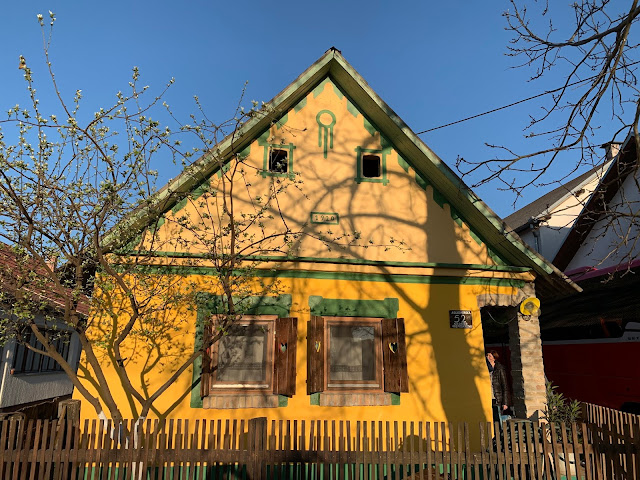
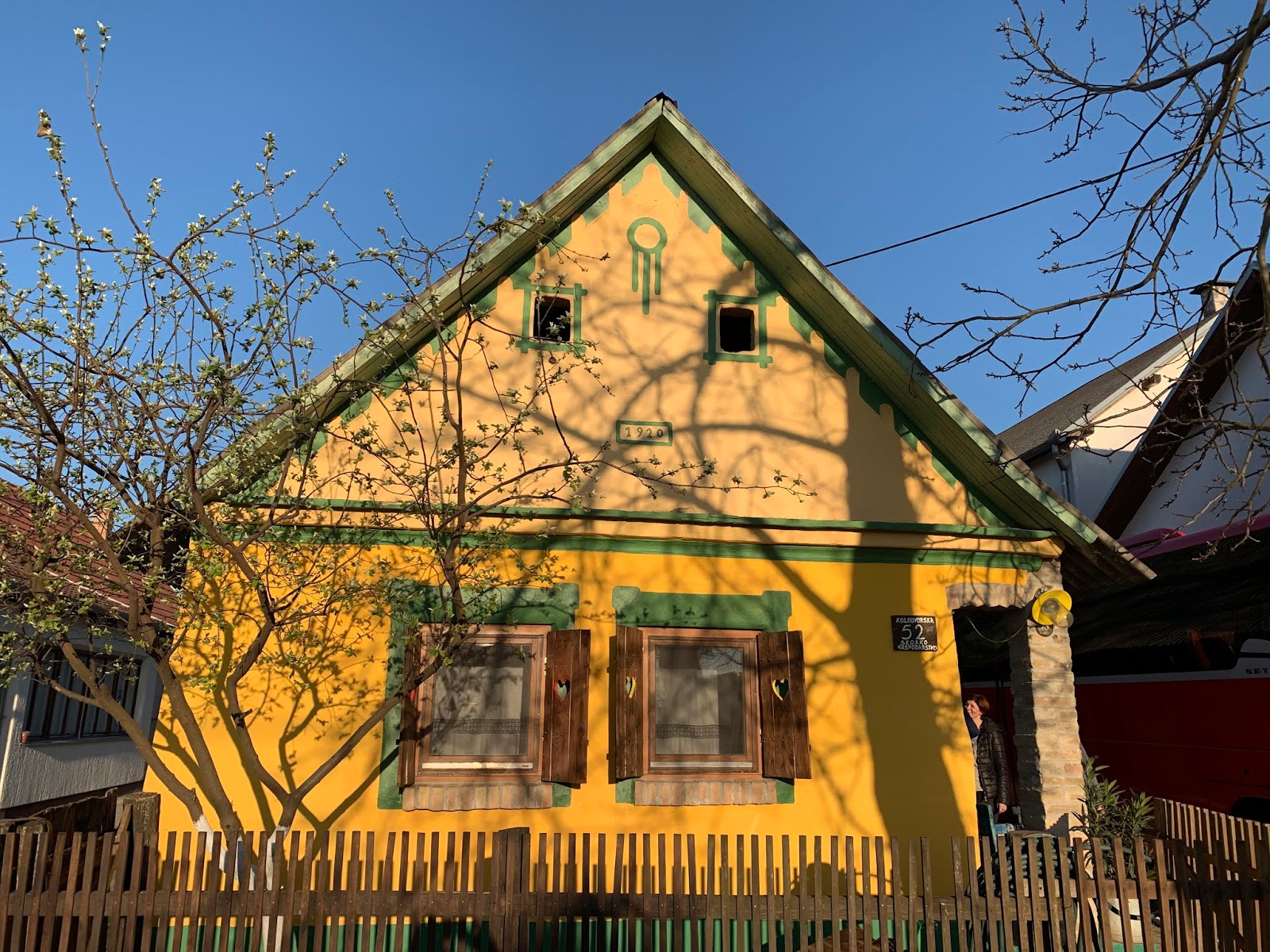
As all houses were once taxed based on the number of windows facing the street exceeding two,
they were built short in front (two windows) and extended far back. 

The house where I stayed.  It too was L-shaped.


We were in Karanac, a small town in a farming area–in flatland for the first time in a while, and only a dozen miles from the Danube that forms the border with Hungary.  You see the drying chilis, and can taste Hungary here in the paprika flavored food. Many locals are Hungarian.  The farm where we stayed was almost entirely self-sufficient.  We helped prepared some of our food, made cheese, and helped prepare a delicious soup* that was cooked over a fire.  All the vegetables came from the farm, as did the eggs, the meat (chicken, home-made sausage), jams, breads, and probably much more.  The couple that runs the place are remarkably industrious. Not only do they grow and prepare the food and care for the animals, they have decorated the entire place with stencil designs. It is a model farm in many ways, a deliberate effort to create a farmstay that appeals to visitors.  It's no coincidence that on tourist sites the town of Karanac is referred to as an “ethno village,” where one can experience “far gone, past times.”


One of our hosts, and one of their friendly dogs


Many delicious foods came from this kitchen; fresh-made jam-filled donuts are covered on the tabletop.  The walls are covered with home-made stencils.


We helped make theses cheese the day before. 
The soup we helped prepare was cooked in clay pots over a wood fire.


"Far gone, past times" is in some ways all too true.  As in other regions of the Balkans, the younger generation is leaving or has already left for greener pastures, metaphorically speaking.  Several of the houses in this lovely small town are empty and abandoned if they are not for sale. We met one householder whose son lives in Ireland, another in England.  They are hoping to sell but they’re not optimistic.  An elderly woman passed by selling eggs from her wheelbarrow.  A widow, alone, her grown children far away, she is making do.

We met this 82-year old woman who was walking down the street selling eggs
from a wheelbarrow. Her children live somewhere else in Europe.


Our guide Vladka talks with a woman who is hoping to sell her house and
move to northern Europe where her children now live.


Still, the town has possibilities.  The L-shape of the Danube-style house lends itself to becoming a row of guest bedrooms.  And the houses are available, probably inexpensive.  Maybe tourism will provide a better economic future.  


A picture of TIto, once head of what was once Yugoslavia, adorns this abandoned farmhouse in Karanac.

To make some extra money in hard times many locals took in orphans from the Balkan war as foster children. We were invited for dinner at a nearby house one evening.  A member of their family is one of those orphans, now an adult.  For him, it worked out happily.

Dinner at a home down the road. Their foster son, fluent in English,
translated. The dad is an avid follower of American sports.


Past the War Zones: Natural Sites


Unlike the Karanac area, neither Plitvička National Park in Croatia nor Postojna Cave in Slovenia are in need of publicity.  In both of these remarkable places we encountered tourist group after tourist group obsessed with selfie-photography. Many visitors took selfies without even looking at what they were standing in front of.  

And they were standing in front of some amazing places.

Plitvička is an unusual natural area where a river spills into turquoise lakes that spill into other turquoise lakes. The lakes are separated by travertine dams formed of carbonate minerals, very like the chemistry of the hot springs in Yellowstone.  The rock here is karst, limestone, that wears away to create underground rivers, caves, and sinkholes. The lakes and travertine dams are the result of a complicated chemical interplay of water, limestone, temperature and vegetation. 


The entire Plitvička area
It must be even more beautiful when the water is high; an unusually dry spring decreased the water flow. 


I’ve been in caves before, but I’ve never been in a cave like Postojna.  It's not that the structures are unique, it's the size of it that's impressive.  Tram cars, not unlike what one may encounter at, say, Disney World, zip you through underground room after room for about three miles. After the tram ride brings you deep into the cave, you begin a long hike through more of this twelve mile long cave on a path where many have gone before.  Tourism is nothing new.  The cave has been an attraction since at least 1819 when the Austro-Hungarian Archduke paid a visit. In fact, it was fitted out with electricity before the city of Ljubljana.  Tourism priorities! And it has wartime history: In WWI Russian prisoners-of-war were forced to build a bridge over a deep chasm in the cave (part of the trail today), and in WWII occupying German forces used it to store airplane fuel.  Which eventually exploded in an attack and destroyed a section of the cave.


A Word on the Countryside


Houses aren't thatched today, but under that snow there is a familiar conical hay bale. Outside of cities many women still wear kerchiefs and longish skirts. (Painting on glass from the "Museum of Naive Art," Zagreb.)


A house at the edge of a small town, houses just outside of town, and houses further from town may all have in common small, neat, hand-worked gardens.  The gardens are larger than any garden one might grow to get some fresh tomatoes or zucchini in the summer, but are far from large scale. I saw many people, mostly elderly, hoeing and planting.  Each house had neatly stacked firewood.  Haystacks were made old-style, the way all haystacks were made before there were mechanical balers.   The countryside looked the way Austria probably looked many years ago.  At least the parts that I saw. 


Every restaurant in the countryside greeted us with a
shot of the local brandy (e.g., slivovitz)

Beekeepers in Slovenia like to decorate their hives with plaques like this, but this is an early and pretty grotesque example (old wife ground up, replaced by young wife), reminiscent of old fairy tales.


A gingerbread-decorating business in a small country town.


Hill Country and Back to Baroque


Back on the Dalmatian coast I felt far removed from the Balkan war, and in fact those battles didn’t actually reach here, although the area is still part of Croatia.  Our guide Vladka lives in this area, and it is the place her brother called home when he was called up to the Yugoslav army during the Balkan war.  (See the post “Into the Land of the Balkan War.”)  

The Istria peninsula pushes up to Trieste, Italy, and feels very much like Italy, as did Kotor in Montenegro, and Dubrovnik in the southern part of the Dalmatian coast.  This is hardly surprising given its history as part of the Venetian Republic, not the Ottoman Empire, for several hundred years until just before 1800.

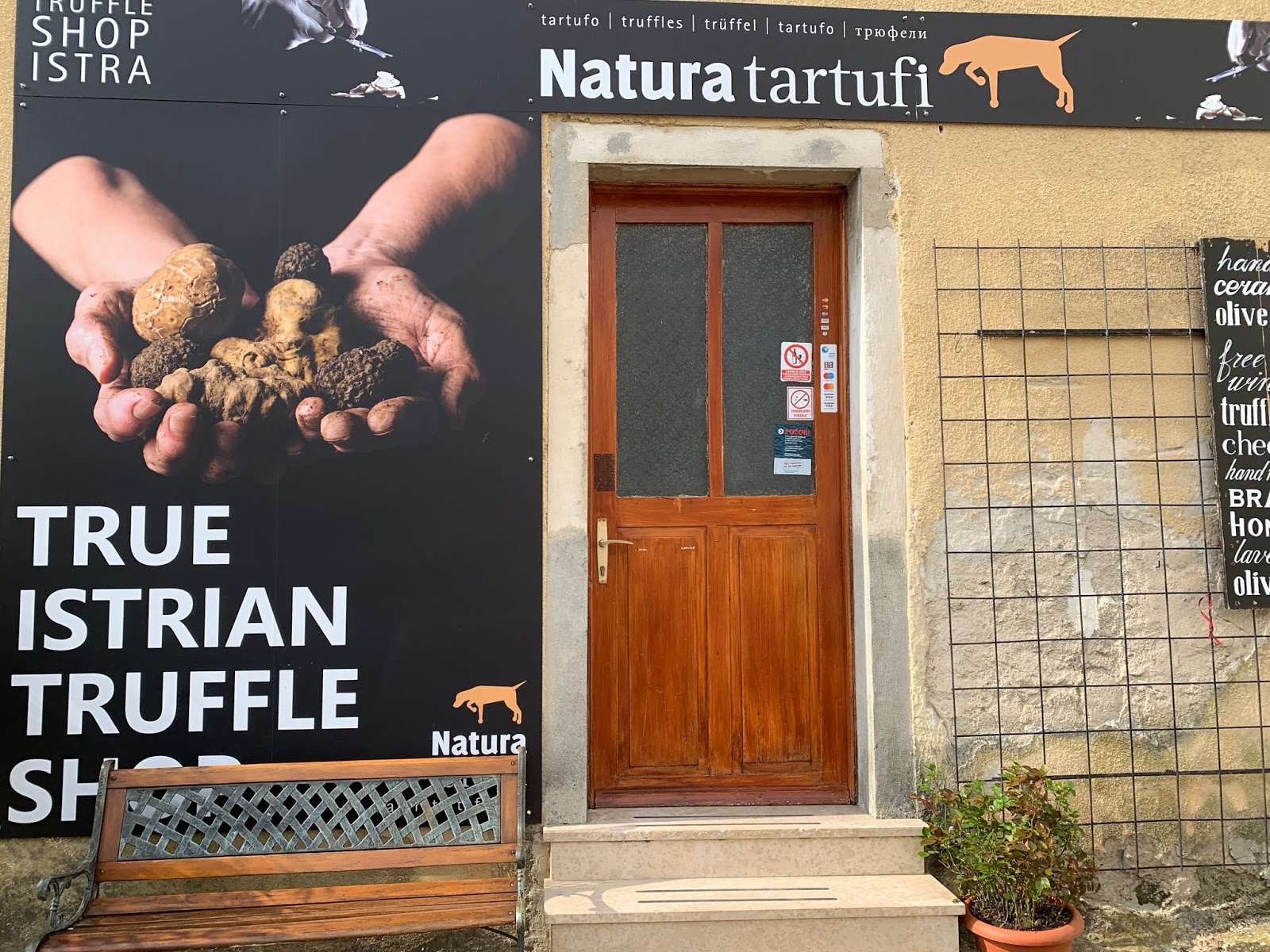
It’s hard to think of war anyway, when you’re in the land of truffles, olive oil, and wine. And harder still when you’re in a town on the Croatian Riviera, a town like Opatija. Or in a hill town that could as easily be in Tuscany.


The hill country of Croatia. (This painting is in the "Museum of Naive Art" (folk art) in Zagreb.)


A hill town in Istria. Could that be a superhighway at the upper left?  Not!  It's a canal built in the
Napoleonic era. A road follows alongside..


A shop selling truffles both white (white-ish) and black, plus other goodies.

Truffle hunting is done with dogs, in this case a lab mix. He was distracted en route by other interesting odors.
(If only we had truffles growing here. Goodness knows, I've got the dog for it!)

Opatija, on the Croatian coast just south of Trieste.


The seaside in Opatija. (I learned the Adriatic is saltier than the Mediterranean.)


By the time we entered Slovenia we were thoroughly back in Baroque.  Like Zagreb in Croatia, the architecture in Ljubjana is strongly a product of the Austro-Hungarian Empire.  Fairy tale land, surrounded by snowy mountains.  


A fiew of Zagreb from the heights of the old town.  Yes, people still smoke here. At least they are neat about
where they leave their butts.


Ljubljana, a view of the castle and the old town

Ljubljana at ground level one rainy day. The downtown is lively and full of bicycles and offers hybrid transport. 

Waste is separated in all categories; the bins lead to dumpsters under the sidewalk.
Ljubljana is one of Europe's greenest cities


Lake Bled, castle and village, a short drive from Ljubljana

It was a good place to end up, Ljubljana.  I couldn’t help but think about the waste, both literal (trash) and metaphorical (people without hopeful economic futures) in so many of the other areas I’d just visited. Albania, Montenegro, Bosnia, much of Croatia––all part of Europe, but not the Europe we usually think about.  Slovenia, an exception, perhaps, has been more prosperous than the rest of the Balkans for some time.  And its capital, Ljubljana, was the only city we visited that was so obviously “green.”  Maybe committing to being green is something that only a degree of prosperity allows.  I hope not. But a country most likely needs a stable government in order to make such a commitment.  It will be a while before that happens throughout the Balkans.


#1 Eco car, Slovenia!

___


*The soup in Karanac, as I remember it, with guesstimated amounts:  
(I made this soon after I got back and it was excellent.)

Black-eyed peas that have soaked overnight (~one cup or so)
Onions, chopped small
Carrots, chopped small
Garlic cloves (several), minced
Celeriac, chopped small (which I couldn’t find, but on impulse used bok choy)
Tomato juice, maybe half a cup
Salt
Paprika, sweet, a generous amount, maybe 1/3 cup 
Concentrated chicken bouillon (tablespoonful or more, my best guess to substitute for something added that looked similar)
Water, and an appropriate amount of water.  
Meat, cut into small pieces (I didn’t know what kind so I improvised with bacon)
Water, appropriate amount
Boil, then simmer for several hours.

Wednesday, April 24, 2019

INTO THE LAND OF THE BALKAN WAR


On the road 


Prologue:  Montenegro


Only a few miles over the southern border of Montenegro all is serene.


Leaving Albania, after a careful examination of our car’s VIN number at the border (did they think it was stolen?), we entered a bucolic section of Montenegro before we actually hit the coast.  We were driving to Dubrovnik (“we” being my co-traveler Nora and Klodi, our Albanian guide), taking what was likely the busier and more fashionable coastal route.  I knew virtually nothing about Montenegro (besides having read that it was the Montenegrin President whom President Trump elbowed aside at a NATO summit in 2017).  I figured the government had a good shot at being as corrupt as Albania's, given that in 2015 an international organization of journalists named the President (different guy than above) “Person of the Year in Organized Crime.” It  made me wonder who won this year.

Montenegro is very small. We were in one side and out the other in no time.  The visit to Kotor (pictured below) was made from Dubrovnik, just a half hour and one border away.  


Did I mention that Albanian currency is the Lek, while the Montenegrins have the Mark, Croatians the Kuna, Bosnians the Bam, and Slovenians the Euro? Fortunately I didn’t visit Serbia, or I’d have had the Dinar as well. 


Parts of Kotor, Montenegro, on an inlet of the Adriatic, date to the 12th and 13th centuries.
Ancient protective walls circle the mountain high behind the town. I hiked to the chapel (the tower halfway up).

 
Being in Kotor, Montenegro, was like being in Italy.  Camera distortion makes the buildings lean in; some of them actually did in a 1800's earthquake.


Many Russians own property along the Adriatic in Montenegro. Connections that date to tsarist times, as well as the frequent use of Cyrillic script in Montenegro, may help make Russians feel at home. 

We heard jokes about how laziness is part of the Montenegrins' nature.  Even our local guide in Kotor told a few of them.  Examples:  "Man was born tired, and he lives to rest."  "If by chance you wish to work, sit, wait, and you will see, it will pass."  And so on.  This attribute of the national character was even mentioned by Rebecca West in 1941 in "Black Lamb and Grey Falcon."  It was attributed to Montenegrins' long history of fighting to preserve their independence, a standard of heroism that allowed no failure, hence no desire to take on tasks at which one might fail.  Freely given foreign subsidies in the 19th and 20th centuries, especially from Russia, may also have contributed.  As if to prove this true, there was recently a TV program broadcast from Montenegro called "Good Morning," or something like that, but to much snickering it came on around noontime.   


Sadly, many of the roadsides gave evidence of thoughtless trash disposal.  Much of the junk looked as if it has been hung up on branches or lying around for years.


North to Dubrovnik, Croatia


Dubrovnik, a jewel of the Adriatic


It's hardly surprising that Dubrovik's old walled city looks like Italy (as did Kotor, in Montenegro) given that it was once part of the Venetian Empire.  The first thing a visitor to Dubrovnik's old walled city is likely to see on entering the old city gates is a reminder of the Balkan war of the 1980's and 90's.


The red squares denote buildings burned, the black dots are direct hits to buildings, the triangles are damaged roofs. The bombing continued for eight months. "Grad" means city.

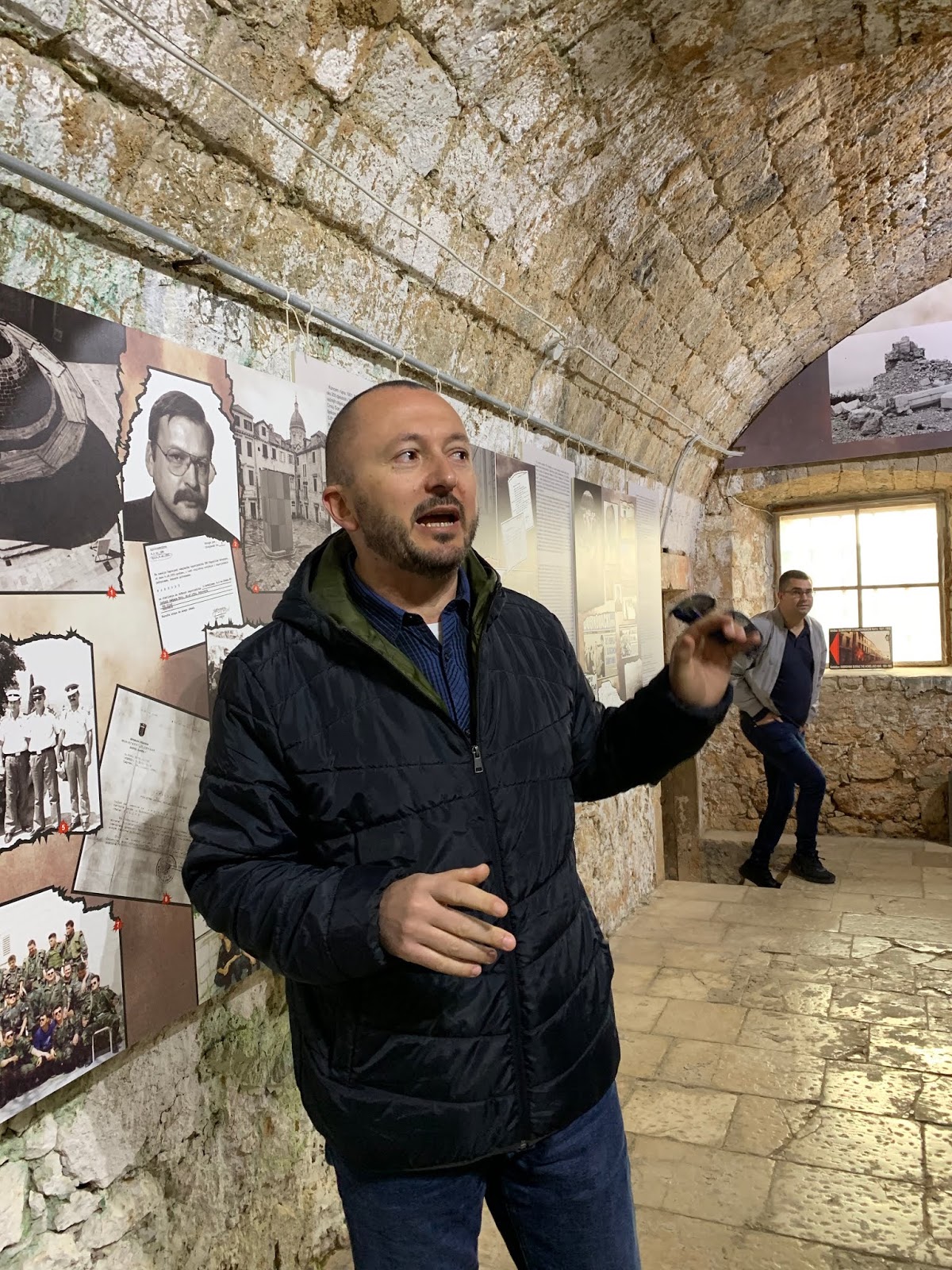
Above the town is a fort built by Napoleon. It was used by defenders of Dubrovnik, one of whom
(above) described his experiences in the war.  The fort is now a museum of Dubrovnik in wartime.

A major street in old Dubrovnik during the war.  It was bombed by Montenegrins
who had sided with the Serbs.


In Dubrovnik today: this street angles left to the one pictured above. Only new roof tiles hint at repairs of war damage. 

"Game of Thrones" filmed King's Landing scenes in Dubrovnik


Mountains...
...and more mountains, en route from the coast to Mostar and Sarajevo


It's time to talk about history.  (A warning: very ridiculously abridged.)


A Ridiculously Abridged History of Yugoslavia


It is hard to imagine a past in which the place where you were born, where you live, where your traditions and customs originate, was ruled for centuries by two warring empires, each affecting and shaping your traditions, customs, and even architecture. Each of these empires left its mark: The Ottomans from the 14th century onward, and the Austro-Hungarians from the 16th. Then, after WWI, there was no empire at all.  

The nation of Yugoslavia was created out of territories lost with the breakup of the Austro-Hungarian Empire after WWI. What the territories' people had in common was that they were, more or less, all southern Slavs.  Nevertheless, the country was never an organic union. What, after all did it have as its political model?  Only monarchs, dictators, occupiers, power brokers. Not surprising then, that this new entity, Yugoslavia, had a rocky political history up until and throughout WWII when it was occupied by Nazis and Italian Fascists. 
A unifier entered the scene:  Josep Broz Tito led a group called the Partisans that joined with Allied forces to fight against the Axis powers during WWII.  He also ended up fighting against Serb nationalists and Croat collaborationist forces each of which had its own agenda. Tito's forces ultimately triumphed, and he became the leader of a communist Yugoslavia by the war's end.  A different sort of communist, not a Stalinist like Hoxha in Albania, he positioned Yugoslavia in the world community as a non-aligned state during the Cold War.  This lent him a degree of international renown.  He built a powerful army and ruled Yugoslavia with a strong hand until his death in 1980. It was a dictatorship, but many thought it a benevolent dictatorship.  Especially in retrospect.

The death of a strongman/dictator often leaves behind a weakened central government. Even worse in this case, there was no one to replicate Tito or replace him.  Tensions related to the events of WWII–memories of Serb nationalism and Croat collaboration with the Nazis and earlier grudges as well–that had gone underground during the Tito's rule arose once more.  Serbian nationalism in particular.


Tito's birthplace, the house and barn, near Zagreb, Croatia. On Tito's first visit to the house as head of Yugoslavia he found his minions had torn down the barn because it looked "too humble" to belong to such an important person.  He demanded it be rebuilt immediately. The above barn is, of course, that reproduction.


Think what it must have been like to live in a country that was falling apart, that was a country no longer.  Our guide, Vladka, who lives in Ishia on the northern Dalmatian coast, has a brother who had been called up to serve in the Yugoslav army in 1991 when it was clear that the country was coming apart, with many areas of the country already deeply involved in war.  As he went off to Belgrade to report to duty (service had long been compulsory) his family was aware that he was about to serve in the wrong army.  His father secretly went to Belgrade in an attempt to bring him home, but it turned out to be too risky.  Some time later though, enlisting the help of a friend, Vladka’s brother escaped from the Yugoslav army and made his way back to Ishia. 


Soldiers: Stored casts for statues at sculptor Antun Augustinčić's museum near Zagreb, Croatia. There were also casts here of statues of Tito, Ethiopia's "emperor" Haile Salassie, and more. One of his sculptures resides at the UN in New York.


Bosnia and Herzegovina


To us westerners, the Balkan troubles began shockingly soon after the 1984 Olympics in Sarajevo.  One moment Sarajevo, Yugoslavia, was the enviable international center of sport and excitement, and then suddenly, inexplicably, the whole region and the nation itself disappeared into the fog of a war most of us had trouble understanding. The city of Sarajevo became a symbol yet again:  It was here that the stage had been set for WWI, when a Serbian nationalist assassinated the heir to the throne of the Austro-Hungarian Empire as the carriage carrying the Archduke Ferdinand and his wife Sophie crossed this very ordinary, unremarkable bridge.


Above:  The assassination in 1914 of Archduke Ferdinand and his wife Sophie, at left above; the same bridge today, above at right.  Below, a cable car in the building now housing a brand new cable lift, and at right, an "Olympics" artwork at the museum of the massacre of the inhabitants of Srebreneca; with heavy irony, it is now a town in the all-Serb Srpska Republic.


Symbols.  Mostar became a symbol of the war too.  Its rightly famous beautiful 13th century bridge built during the Ottoman era was destroyed by Croats.  It has been faithfully rebuilt.  I should say, “faithfully” to my eyes anyway, because the cobblestones forming the walkway over the bridge seemed authentic; they were steep, and made slippery with the feet of centuries. 


The bridge at Mostar, from a different angle than the most iconic photos. 


Menu
We had lunch here in Mostar


In today’s Mostar, the Muslims live on the east side of the river, the Christians on the west side. They attend school separately, at alternate times.  Only the university is unsegregated.  This was not the case before the war. (See The New York Times, November 20, 2018 article with the ominous title “In Bosnia, Entrenched Ethnic Divisions Are a Warning to the World.”) 


Former Olympic sites are shown at upper left and upper right. The siege of Sarajevo lasted nearly four years.

What many inhabitants in Sarajevo most feared during the long siege, more even than mortars fired from heights above the city, was snipers shooting from inside.  Our Sarajevo guide told us of a young girl who, like many others in the city, was on her way to get water for her family (there were only two places in this city of over 400,000 to get water during the siege) and was shot by a sniper who, it turned out, was her math teacher.  Everyone in the city older than, say, 35 or so has memories of the war.


Sarajevo, a view from the cable car.  The old Ottoman section is in the  center; to the far left are tall modern buildings.Tito's concrete apartment complexes dot the landscape just beyond the old center.


Walking on from the old Ottoman section you enter the Hapsburg part of town.  If you kept walking you would be in modern times.  Changes of architecture. Note the museum sign on the left, a "Museum of Crimes Against Humanity and Genocide." 


The narrow streets of the old part of Sarajevo are full of people, restaurants, cafés, shops.  The crowd waiting in line is not shopping, however, but queuing for free food.


Many small shops line the narrow streets of the oldest part of Sarajevo. The long-handled metal pots are for Turkish–no! here it's called Bosnian–coffee. 


Everything that was evil in the Balkan war and wrong in the peace agreement is evident in Bosnia-Herzegovina.  First of all, ethnic cleansing––for which Serb leaders were tried in the Hague for genocide––was essentially successful.  Secondly, the Dayton Peace Accords, more a cease fire agreement than a peace treaty, nevertheless formed the basis for the Bosnia-Herzegovina constitution, thereby setting in stone a separation of people that had not existed before the war. 


A house bears scars of war.


Where Muslims and Christians, Serbs and Croats lived side by side in Bosnia and often intermarried, there is now a Bosnia divided into three sectors:  the Federation of Bosnia and Herzegovina, Srpska, and the district of Brčko.  Srpska is an area for Bosnian Serbs and is primarily, or perhaps thoroughly, Orthodox Christian; Brčko, a miniscule district, actually a small city, has a remarkable mixture of people; the Federation of Bosnia-Herzegovina has Bosniaks (meaning ethnically Bosnian, not simply living in Bosnia), ordinary Bosnians and Croats, and is almost entirely Muslim.  Each sector has its own president and parliament; the three presidents rotating every eight months between Bosniak, Croat, and Serb. The Bosnian Federation consists of eleven governments and parliaments.  (I am not exaggerating.)  Below the level of the parliaments there are cantons, yet another political entity. 

This is a staggering amount of government. So much so that it is hard to imagine how anything can get done.  Given the current economic situation, very little indeed is getting done.  A standard Bosnian quip says “50% of the people are unemployed, and the other 50% work for the government!”  (The unemployment rate is no joke.  It is currently running at a whopping 57%.)  In order to work for the government a family must be 100% of whatever ethnic sector one plans to represent.  Merely living in Bosnia is not a qualification.  People in ethnically “mixed” marriages cannot be part of the government.  Since there are many mixed families, this disenfranchises much of the population.  A family we joined for dinner is one of those mixed families. Our Sarajevo guide's family is another.


Houses like this in Bosnia and Croatia were not left to decay by choice; the people who lived there were ordered out during the war.  Looters took or destroyed what was left.


This plant spewed toxic plumes for miles, covering the town of Zenica and well beyond.  We held our breath as long as we could as we passed through.

It is hard to be optimistic about the future of a place that carries so heavy a burden:  the weight of the past, plus the weight of a complex political settlement that leaves no one content.  A speaker we heard in Sarajevo talked about the impact of these double burdens on the young. What is there to hope for?  What kind of future is there for them in their own land?  The current situation appears to be untenable. It makes no sense economically or politically.  How long can it last?  

Many Albanians have left their country to find a better life elsewhere.  Many Bosnians are doing the same.  As we wound our way back into Croatia, this time to a farming area near the Hungarian border, we found the situation sadly much the same–the younger generation was emigrating to other, richer countries in Europe.  


A town in the Srpska area.  Serbs are Christian Orthodox, as is the church in the background.  Although these houses look neat, the amount of roadside trash reached a peak in Srpska; piles of junk were dumped into streams, ditches–anywhere–as if the land was held in some kind of deliberate contempt.


And yet…there were places that seemed healthy, that held promise.  When we re-entered Croatia for maybe the third or fourth time, heading north to the Hungarian border, the roadsides were clean.  And they stayed that way.


Note:  Apologies for any font irregularities. I simply got tired of dealing with the defaults.