Saturday, January 9, 2021

WHAT THE HECK AM I SEEING?


HOW MUCH DO THEY MATTER?  


There are some ugly truths.

I was out skiing in the woods behind my house around one o'clock on January 6th.  It is 2021, the new, better year. A lovely day, the snow perfect.  It wasn't until 2 o'clock or so when I came inside that I picked up on the string of notifications that had been piling up on my phone.  The Capitol Building had been breached by Trump supporters.  

Like a lot of people, I was shocked, yeah, but not surprised.  

You don't live through a couple of years' worth of demonstrations with people carrying Trump flags (Flags? With the President's name? Really?), reading about fantasies of pedophilia rings in the government and Trump portrayed as the pedophile slayer (Q-Anon wackiness), and Proud Boys and the like marching here and there with anti-Jewish, anti-Muslim and anti-Black shouts, without knowing something is afoot.  No presidents, none of them–ever–have been postered against all reason as some sort of cartoon-like Messiah/Terminator/Action Figure as has this elderly, overweight, jowled, pissed-off-looking narcissistic individual–you know the one–the one with the comb-over to beat all comb-overs.

This is what took me aback:  I stared into CNN's coverage the rest of that crazy afternoon.  I watched as the mob broke windows, wandered around inside of the building, entered offices and the House chamber, massed on the steps and on the plaza.  I saw the occasional Confederate flag.  I could pick out police here and there, small groups, vastly outnumbered, trying, mostly without success, to hold the line on the plaza and later, at the doors, and still later, in the halls.  CNN voices kept announcing that they had had word that reinforcements were en route from several different counties, and the National Guard was on its way.  I kept watching, but nothing changed.  I still saw only ineffectual groups of police. It was hard even to spot them amidst the mob. What the hell?  Where was all this security?  C'mon, this is our Capitol!

Now and then a camera panned to lines of fresh police, standing somewhere, waiting.  Another camera showed what I thought might be National Guard troops positioned somewhere else.  Maybe they were martial types in camo. When it came on six o'clock, after curfew time was announced, police who had been standing for as much as an hour apparently waiting for orders finally, leisurely, walked in and firmly but gently pressed the crowd back, away from the steps, and eventually away from the plaza.  No bullhorns, no batons, no big pressure.  Take it easy, folks. 

I'm old enough to have been to several protest Marches on Washington (not including, unfortunately, the most famous one when Martin Luther King spoke), all mostly peaceful. I was involved in a protest on the Lexington Battle Green in 1971 (only locally famous) when over 450 of us from the town, including some 100 Vietnam Veterans Against the War, were arrested.  The police, summoned to do this by the Lexington Selectmen, arrived at about 3 AM in full riot gear, although almost all of us were by this time simply sleeping–or trying to–on the Green. (That was actually our offense.)  The police were polite, even smiling, some of them, because they weren't really crazy about arresting their fellow townspeople, much less war veterans, some of whom were disabled. They knew us. They didn't fear us. We were like them.

Fear of "the other," that is at the heart of this. Masha Gessen in The New Yorker said this of the Capitol police actions: 

"Black Lives Matter protesters are other to the Capitol Police. So are survivors of sexual assault or women who protest for the right to choose. But an armed mob storming the Capitol, and their Instigator-in-Chief, are, apparently, familiar enough to be dismissed as clowns. (Some of them, in their face paint and strange headgear, even seemed to embrace their identification as clowns.) The invaders may be full of contempt for a system that they think doesn’t represent them, but on Wednesday they managed to prove that it does. The system, which shrugged off their violence like it had been a toddler’s tantrum, represents them. It’s the rest of us it’s failing to protect."


This has already been pointed out by many observers. Following nearly every police shooting of a Black person, there have been, predictably, demonstrations.  These protests tended to attract plenty of police fitted out with riot gear, pepper spray, tear gas, and occasionally rubber bullets. Protective barriers were often set up well before even the threat of a protest. This level of security was on full display when Trump took his infamous walk from the White house to St. John's church to wave a prop Bible around. The crowd had been peaceful.

Pro-Trumpers don't threaten white people very much.  Many white people have friends or relatives who are Trumpers, and Trumpers live among us in mostly white communities.  What's to fear?  A few paramilitary right-wing types seem scary, but not your run of the mill Trumper. Some of us may find them annoying, aggravating even, but for the most part we don't feel endangered by them.  We're white, after all.  I don't feel physically threatened by any local Trumper because I know they would see me as just another misled white person.  On the wrong side, but, hey, I'm white! 

A thought experiment:  Imagine the Trump mob in Washington (or maybe the one in front of your own State Capitol) as a group of Black Lives Matter protestors.  Pretend the protestors are mostly Black. Picture them angry.  Maybe they have weapons.  Picture the security: Is it mostly white people?  When the protestors try to storm the building, picture the results.

As to the above question, the answer is not enough.


WHAT ABOUT THE 74-PLUS MILLION?  


Over 74 million people voted for Trump. In any democracy there must always be a viable opposition.  At times that opposition can be particularly fierce.  But in this case many, or maybe most, of these 74 million live intellectually and emotionally in an entirely difference universe than the other millions.  This is something new and different. Social media has helped create that parallel universe.  Pro-Trumpers are securely represented in our government too, as the well over one hundred Congresspeople who bought into Trump's lie of a stolen election will attest.  Many of these elected officials, I would hope, know better, but are thinking, cravenly, of their constituents.  For these constituents anyone holding a view unlike their belief in Trump risks not getting their vote.  

I suppose representatives should reflect their constituents' views, but what about educating them?  What about leadership?  What about moral responsibility?  If no one was able to lead others to better ways of thinking, wouldn't we still have slavery?   

As for those members of Trump's party who have decided it's time to disassociate themselves, what's there to say?  How brave are they?

“Resigning with two weeks left feels less like some moral stand and more like leaving early to beat traffic.” Jimmy Fallon


 “It’s very brave of Republicans to start speaking out against Trump only 99.9 percent of the way through his term in office. You know, not to quibble about this, but for someone to ‘lose it,’ first they must ‘possess it,’ mustn’t they?’ James Corden

On PBS there I saw a documentary called "A Thousand Cuts" about the rise and rule of populist Philippines President Duterte.  A struggling democracy, the Philippines is one of the world's poorest countries, its people widely invested in social media. Duterte's reign is like a fun house mirror of what has happened in this country.  There was no coup, no grand takeover, but rather a chipping away, bit by bit, cut by cut, of democratic values.  Duterte lies regularly, and uses social media and social media stars to amplify his lies; he is explicitly mysogynistic, rewards his cronies, calls the press his enemy, and he is feared. The result is a democracy divided, a population living in two parallel universes. The majority of the population has absorbed the lies, no longer believing in or supporting a free press, and has learned to look away, or tolerate, or even admire "wiping out drugs and criminals" by his sanctioned policy of murdering them. When first elected, Duterte admitted in a TV interview to having personally killed "about three people."  In a chatty telephone call with Duterte in May 2017 Trump said this:  

"I just want to congratulate you because I am hearing of the unbelievable job on the drug problem.  Many countries have the problem, we have a problem, but what a great job you are doing and I just wanted to call and tell you that."  Confidential transcript of telephone conversation (Washington Post)

"You are a good man....If you want to come to the Oval Office, I will love to have you in [the] Oval Office. Anytime you want to come."  Confidential transcript of telephone conversation (Washington Post)

During a personal meeting with Duterte in November 2017, Trump shared a laugh about journalists, "...you guys," said Duarte, you are the spies, you are." Ha ha.
 

WHAT HAPPENS NOW?

 
Kamala Harris is our new Vice President.  This may hold even more promise for the future than Joe Biden being our new President.  True, we already had a Black man as President, but it's almost as if that was a really good first try, an attempt to raise the country to a higher plane and blur that ancient racial divide.  The real division before 2016 was only beginning to become an abyss. Social media was already feeding conspiracies. Still, few of us knew how far this would go.  Or what would happen when the electorate threw a metaphorical bomb at our government, embodied by Donald J. Trump–someone who would say and do all the things many white people had thought, but long suppressed.  

Well, now we know.


Wednesday, December 2, 2020

I CAN SEE CLEARLY NOW THE RAIN IS GONE


Even since that Saturday, the afternoon presidential election was declared for Biden, this Jimmy Cliff song, with that cool reggae beat, has been going around in my brain...


I can see clearly now the rain is gone
I can see all obstacles in my way
Gone are the dark clouds that had me blind
It's gonna be a bright (bright)
Bright (bright) sunshiny day
It's gonna be a bright (bright)
Bright (bright) sunshiny day
Oh, yes I can make it now the pain is gone
All of the bad feelings have disappeared
Here is that rainbow I've been praying for
It's gonna be a bright (bright)
Bright (bright) sunshiny day


Truthfully, realistically, the odds are not exactly good for a bright sunshiny day most days in November, in Vermont, anyway.  But it is nice to feel that a weight has been lifted.  A weight that's been hanging overhead since November of 2016, and that year most certainly wasn't a good one.  In that January, Ken and I had spent a few days in to New York City.  He tired more easily by that time, but yet we managed museums, walking, eating out.  He was more or less okay.  A few months later, in the spring, we visited a good friend who was living in Seville for a few months, a trip that had its complications, although it had a number of lighter moments, some fun, even.  (See "The Rain in Spain" post of 5/23/16)  It would be our last trip together.  After a dismal month or two, Ken died, just days before the election, having cast his final vote for Hillary Clinton.  He never knew Trump would become President. Had he known he would have been as astonished as everyone.  


But this year, this strange year, surpasses any I've known for sheer all around horribleness.  It's possible to see more clearly now much of what was hiding behind the curtain of daily Trump outrages.  The oh-my-God news that happened almost hourly, overkill insanities, sapped our mental and emotional energy.  Laid bare now, with that constant assault out of the way, are the issues we should have been seeing.  Issues like our changing climate, the alienation of our former allies, our global pandemic, our national pandemic, myriad humanitarian concerns across the globe, institutional racism, poverty here and elsewhere, student debt, cyber security... I could go on, but I have already overwhelmed myself. All this doesn't exactly promise a sunshiny day.

Yet...

There are sunny days, but clouds demand one's attention at this time of year.


It is literally clearer here now, too, for it's easy to see things with the foliage out of the way.  Not prettier, but more transparent.  I don't really dislike the change, partly because it is a change, although hunting season discourages me from venturing into the woods, even wearing hunter's orange, and that is disappointing because that openness is so inviting.  It doesn't help that there's a family further up the road that doesn't pay enough attention to hunting regulations.  Last year, on one day after the end of hunting season, when the previous night had laid down a thin layer of snow, the path we made, Skyler and me, were the only prints to be seen. Until we came upon some very disturbed snow behind this particular family's land.  There were streaks of blood on top of the snow and drag marks showing something heavy had been pulled to a place where there were tractor marks that led directly to their house.  Skylers sniffed out a pile of entrails right nearby where an animal had been gutted.  Such evidence of a deer shot after the end of the season may be circumstantial, but it is damning, like what Henry Thoreau called "finding a trout in the milk."  After the end of the current rifle season rifle shots have been heard coming from the same direction once again.  So, I'm not going into the woods just yet, clear and inviting as they are.


Three does came to visit very early one morning, days before hunting season began. 


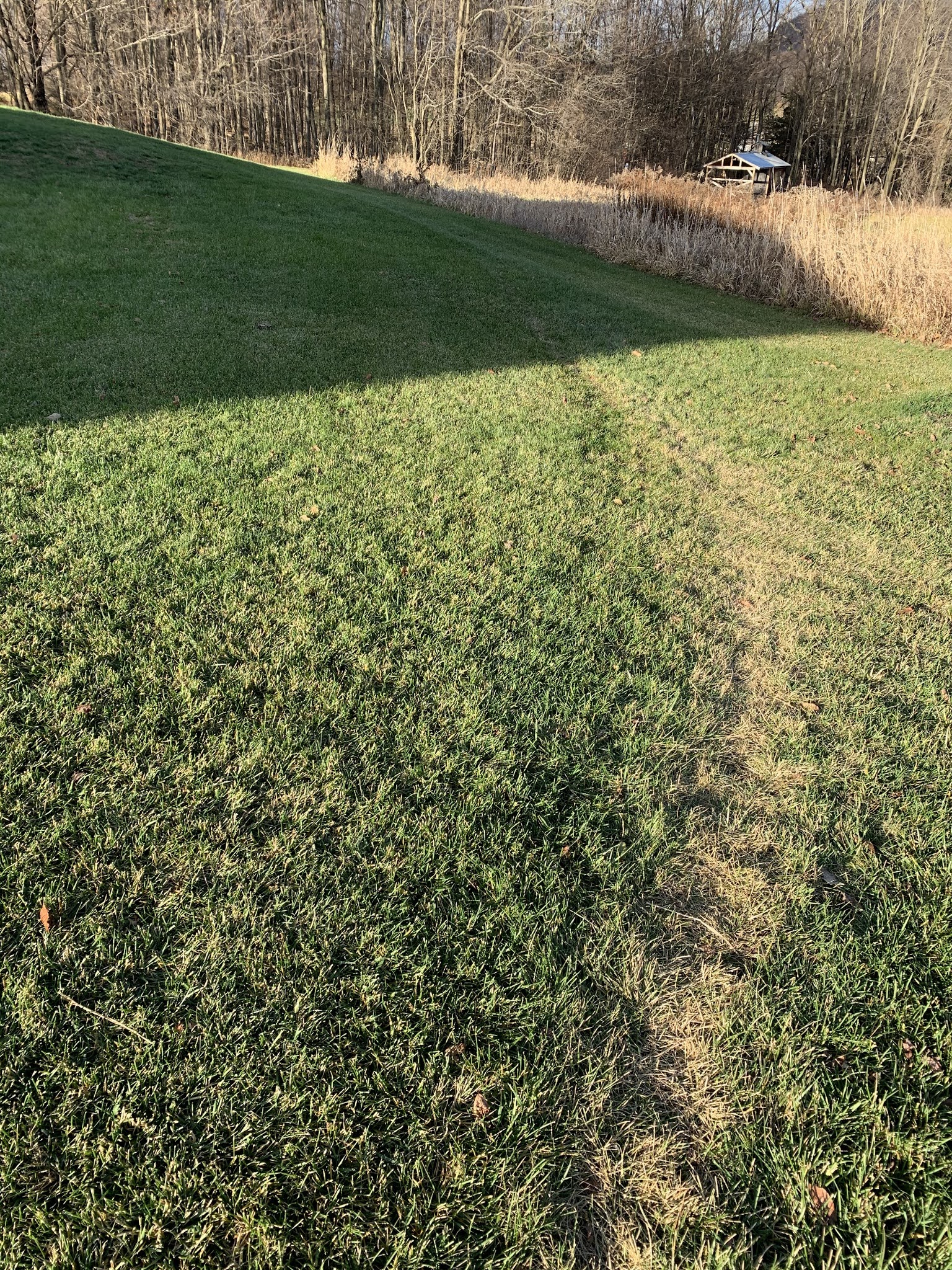
This extra visual clarity allows me to see the rocky hills behind the field, as if a green curtain has suddently been removed.  It helps to a degree with deer hunting, except that everything looks some shade of brown or beige, so it's more likely a rustling sound that you listen for.  More often than not, that turns out to be squirrels messing around in the dry leaves.  Also newly visible this time of year, or possibly newly created, is the line Skyler makes in the grass, the line that Skyler believes limits his area.  Why it only appears in the fall is a bit of a mystery.  Skyler's line is actually off by several feet from the "dangerous edge," but he's taking no chances. It's an electric fence, but I don't even put his collar on any more, so nothing would happen if he crossed over.  (Don't tell him that, though.)


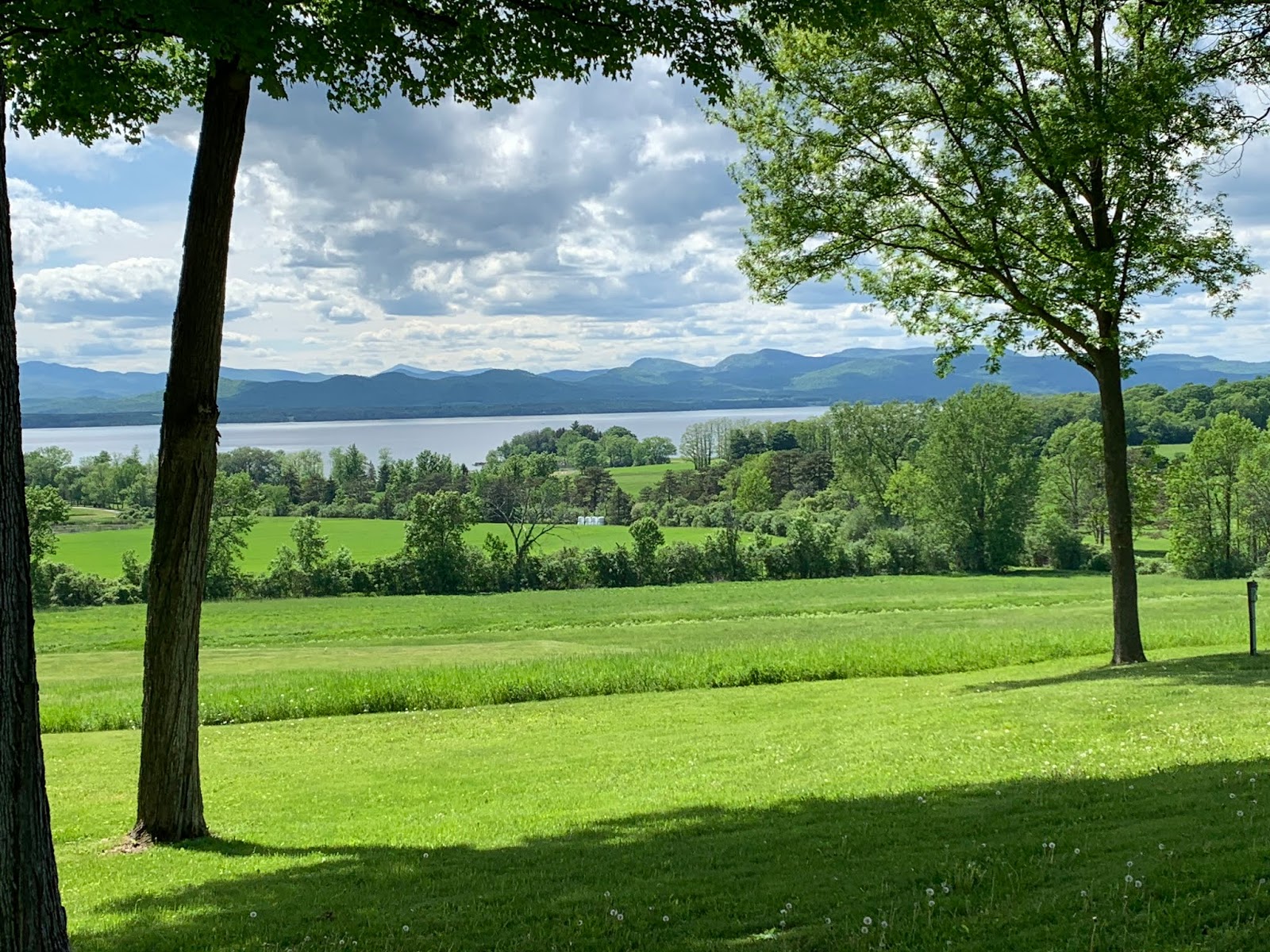
The ridge that summer hides.

Why Skyler creates the exact same path is a bit puzzling.


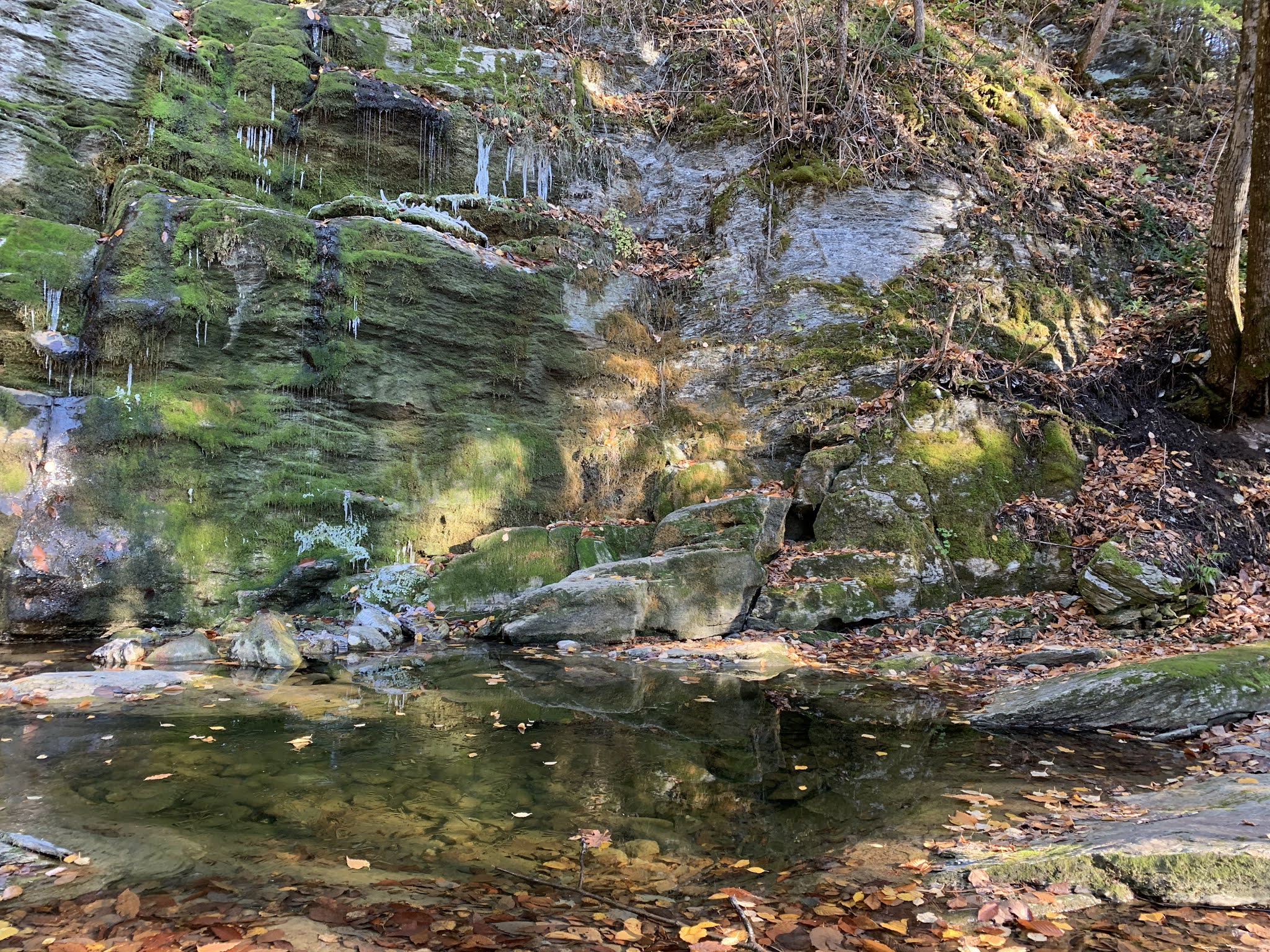
The lack of rain in late summer and early fall exposed things, too.  A few weeks ago I took a walk that led to Bittersweet Falls, a secluded den where a broad waterfall normally cascades.  But sans rainwater, there was only a mossy cliff.


A dried up Bittersweet Falls, although a recent rain may have helped.()


Sometimes looking back makes events look clearer, too.  I recently watched a documentary about Ronald Reagan.  I remember his presidency so I thought I already knew everything there was to know about him. What I didn't know was that "Make America Great Again" was his 1980 campaign slogan.  That message was accompanied by many of the same racial dog whistles.  Not exactly original, DJT.  And–this one I did remember–Reagan selected cabinet members who were put in charge of organizations they would aim to destroy. Probably the worst of a bad lot was James Watt, Interior Secretary: anti-conservation, anti-wilderness, anti-environment–you name it.  Not exactly original, DJT.  Deregulation, too, "getting "government off the backs of the people."  You rode that as well, DJT.  To top it off,  Reagan was also the first media persona (B-movie star, TV host, etc.) to become President.  Not the first, DJT.  A fervent but probably vain hope I have is that he be the last. 


We can always look beyond the clouds and hope for better things, right?


Monday, October 5, 2020

THE ILLUMINATI ARE COMING FOR YOU!


They're coming to get you!  


It's not BLACK LIVES MATTER that's coming to get you (although maybe they should be), but plain old white folks who are out to get the mobs (meaning protesters), and the looters (meaning protesters), and the violent (meaning protesters, the angry ones, or maybe other groups) and thereby save us all (meaning us white folks. Who else could it be?).  

Paranoia, merely paranoia.  But, oh, paranoia can do a lot of damage.  And paranoia goes way back.  In truth, it has never been absent.  

In the 1980's there was a national mass hysteria about Satanic ritual abuse.  Are any of us old enough to remember?  It was widely believed that young children, preschoolers, were being subjected to ritual abuse.  It began in California, in the McMartin Preschool.  It was believed that the teachers had tortured and raped children, killed them and drank their blood, and so on and so on.  You don't want to know the ways.  (Toddlers were interviewed by therapists, for those who do not know the stories.)  Or maybe it began earlier with a supposedly autobiographical book (one that I'd never heard of at the time) about discovering abuse through "recovered memories," memories that weren't, until they suddenly were.  The hysteria became a fever.  It was fed by talk shows (even Oprah), articles, books, lectures–it was everywhere.  It grew gravitas.  It became an international conspiracy–the elite were said to be abducting children world-wide for Satanic purposes.  People were prosecuted.

Every conspiratorial notion forms from a tiny grain of truth, like an oyster its pearl.

I remember a case that arose when I lived in Boston in 1984 as this hysteria was well underway, when teacher after teacher at the Fells Acres Preschool was accused of raping the children in their care in a variety of fanciful ways that seemed to me, even then, highly improbable. The stories were weird, and involved secret rooms, a clown, trees, and, I think, animals. Several teachers were sent to prison with lengthy sentences.  One was not released until 2004, another died in prison.  

That was before everyone started forwarding messages on the internet.

Therapists played an important role spreading the "recovered memory" theory of memory.  Until they didn't.  

Debunked.  Conspiracies.  All of it.  People learned from this.  

You would think.


This is an actual poster that I first saw in the background of a photo of a Trump supporter.  Conspiracies lie beneath.


Laughable, maybe. (That head, that body!) But I wonder. What might someone be thinking or feeling about the country, or our government, to exhibit this kind of adulation?  I read that some of those who kept vigil outside Walter Reed Hospital had signs that said Trump was a gift from God.  This is adulation to the power of ten.  What is he is supposed to be fighting?  It's more than just the usual political issues.  There's hellfire here.  Religiosity. We know that some believers identify a major evil that reads a lot like Satanic ritual abuse of children. All too familiar.  (Thank the Qnon faction for throwing in that idea.)  

What is it that is so compelling that it elevates Trump to this insane level?  I have trouble putting myself in that place.  What is that place?  What does it look like?

Many of us (I include myself here) feel strongly about the role of government; we want it to support public education, the nation's health, our environment, and we expect it to keep us safe vis à via infrastructure, a sensible foreign policy (arguable, precisely what that is), equitable policing to keep us safe (more of a wish, unfortunately; see Black Lives Matter), and you can imagine the rest. 

But I don't see a god anywhere.  

So what is it, this missing element that looks to Trump so worshipfully?

Is it fear? Fear of what?

I think of the fears of the white slaveowners when emancipation turned their world upside down, when it came about that the people they oppressed were now to be equal to them.  Many just gritted their teeth, hating it, silently. Many couldn't bear it, and needed to conspire, to act.  Bitter and smug in their imagined superiority, men formed secret societies to attempt to return the world to what it was before. We know that they failed, but their failure was an incomplete one. People still fear the protests of Black Lives Matter. 

Among other fears. There must be many.


I come to the Illuminati.  I suppose they come to mind because I wrote a paper about them in graduate school, probably after reading historian Richard Hofstadter's "The Paranoid Style in American Politics," published in 1964, that I remember reading in the 1970's.

The Illuminati were the USA's first off-the-wall hysteria.  (The Salem witch business happened in the 1600's before we were a nation, so I'm not counting that.)  The full name of the group was the Bavarian Illuminati, Bavaria being in southern Germany, because they originated in Europe in the late 1770's as a secret society formed to combat superstition, abuses of state power and the like.  They were essentially a by-product of the Enlightenment.  Secret organizations, like Freemasons, were a thing for like-thinking groups of men. And not only then.  George Washington was a Freemason.  So was my father, for that matter. 

Secret societies are like catnip for conspiracy lovers.  Starting from the pulpits of Massachusetts the Illuminati were pilloried, atheists that they were assumed to be, accused of conspiring to abolish Christianity and overturn the government and–again, there was that sexual element–it was preached that they advocated sensual pleasure and promiscuity. Unclean!  Save the children!

It was unlikely, at best, that any actual "Bavarian Illuminati" ever set foot in this country.  Nonetheless, the complete lack of evidence failed to slow the fear until the early 1800's when the failure of a Christian demise or lack of a government coup wore down the Illuminati fear factor.  

Well, that's not really true.  There is a film called "American Illuminati" (2017) that purports to tell the "real history of America as you've never known it.  The shocking truth of how America was engineered and controlled by a secret organization that has infiltrated religious groups, political parties, universities and corporations."  You can get it on Amazon Prime.  Although it told me it is "currently unavailable to watch in your location" (what's wrong with my location?), I'm told that if I watched this item I would also like "Prison On Earth, Beyond the New World Order," "Shadow Government," "Unsealed Conspiracy Files," "God Kings, the Descendents of Jesus," and "Alien Agenda." 

I demurred.


Here is a happier note.  For a bit of balance, I would argue that it's always fun to see some enthusiasm, maybe even adulation, on the other side.  Herewith:


 The house, by the way, is not really crooked, the street is slanted, but I decided to leave it this way.


Tuesday, September 15, 2020

INTO THE REAL –OR UNREAL– WORLD


Checking to see what's out there.  
(Actually: Edward Hopper, "Carolina Morning")


“Welcome back to the real world,” was the laconic announcement by a crew member of the Elizabeth Ann, the people-only (no cars) ferry returning us from Monhegan Island to Port Clyde on the mainland, and who a few days earlier, on our trip out, had announced in witty detail how to use the ship’s toilet, seeing as the navigation and ship safety was pretty much taken care of in the crew's very capable hands.


The Elizabeth Ann comes into Port Clyde


Was I back in the real world?  Did I ever really leave it?  This was my first time out of Vermont since when...February?  Or was it January?  It's hard to remember; it might as well have been a year ago, that other time remembered as a different kind of life. And yet it was only to Maine, not exactly Japan where I’d hoped to be at exactly this time. 


Two Views of Monhegan House, where we stayed:
As it looks now (above) and as painted by Jamie Wyeth,
before the porch was rebuilt.


Monhegan feels idyllic, a place away.  That, of course, is the prime virtue of an island, especially one far away, in this case twelve miles from the mainland.  A place to recoup, reset, renew.  While we (my daughter Leah and I) were hiking one day we met two young women, both doctors fresh from New York City who had been overwhelmed with pandemic patients for months at Beth Israel and Maimonides hospitals, respectively. One woman said she’d been so stressed she’d considered giving up medicine. This was their first complete break, and they were loving it.


Islands do that for you.  As a visitor you have a powerful sense of having left the real world behind.  And you have–literally.  On Monhegan there is nothing to do but hike the enchanted forest and the staggeringly beautiful cliffs along the eastern side of the island, watch the people and the dogs all of whom will look familiar after a day or so, and eat and sleep. There are few distractions: no bars, no clubs, no meeting places other than the schoolhouse and the church.


There is this one pub, warm weather only, with made-for-pandemic seating areas put together with  
lobster traps and painted blue.  


And yet:  Its beauty is surprisingly elusive to many a painter and photographer. Not that its attractions are subtle; the sea beating against the immense cliffs, the mossy paths through the dense forest, charming cottages–all that.   And not that pretty paintings and photographs aren’t the result, it’s just that certain kinds of beauty inevitably tend to show up as less dramatic than they are in reality. Or sometimes they are merely seascape clichés.  


The arrangement of lighthouse, sheds and boat are an irresistible shot, and the scene has found its
way into many paintings.


In the background, Black Head. Could you tell it rises 160 feet above the sea?


Leah perches on a precipice that may be 100 feet or so above the sea.


Enchanting forest trails beckon.


  Perhaps you also have to concentrate on the more intimate views.


The island is small enough (a mere 4.5 square miles) that people start looking familiar after a few days. We met nearly all the resident artists who were there this season. We visited the home and studio of one artist who lives on Monhegan permanently. That makes her one of only about fifty people who live here the year-round.  Probably many, or most, year-rounders are there because on Monhegan lobstering is allowed in winter when other lobstering sites are closed.  Her studio is full of her paintings of islanders. Leah asked what life is like when the tourists are gone. “It’s like a dysfunctional family,” she said.  A day or so later when we were sitting on the porch of our inn I recognized one of her subjects walking by. 


An artist's home and studio crammed with her paintings of islanders


One evening at dinner a woman sitting at a nearby table said, loudly enough for most of us to hear, “I said I was lonely!” and stood up and marched out of the dining room.  In the winter, I wondered, where can you go after you throw down your napkin and stomp out of the kitchen?


The day we left the island we saw one of the lobster boats, converted to one that offered fishing trips and tours, that had just pulled up to the dock and was unloading a family of tourists. On either side of the helm, starboard and port, there were large flags, one an American flag, and the other a Trump flag. It seemed like an unwise business choice.  Since when have political candidates had flags, anyway?  Was this for a Trump Nation?  His boat wasn’t alone.  On the other side of the dock was another lobster boat I hadn’t seen before with the same rig: American flag and Trump flag. Here, I thought, was one part of the dysfunctional family.  


Many of the guys you see driving beaten up old pickup trucks on the few dirt roads on the island, carrying tourist luggage or food and supplies from the ferry are likely to be lobstermen in the off-season.  From the pickup trucks to the lobster boats, the pickup trucks of the sea. But maybe they’re all of different minds, not fervent Trumpers at all. I am only an ignorant drop-in, after all and know nothing of the life that is lived here.  Still, I realized that Monhegan wasn’t all that distinct from the real world.  That’s only a tourist’s notion.  I did wonder, though, do the portrait artist and the guys with the Trump flags relate to each other in the winter?  Do they even talk?  And really, what does it means to be in the “real world” when each person can assemble their own reality. A world where news and views and, increasingly, conspiracies, are curated just for you.  (Thank you for that, social media.)  What, exactly, is the real world?     


I’ve often referred to living in Vermont as living inside a bubble–not the real world– but that’s not really true either. In the small town nearest me there is a house with two flags, one American, one Trump. I wouldn’t be surprised that if more people owned flagpoles there might well be more Trump flags.  Some of us with Black Lives Matter signs have had them stolen or vandalized. (Mine was taken down, I’m pretty sure, by wind.)  The same divisions cut through here as elsewhere, but they’re jut harder to see.  And where there is natural beauty, we sometimes are like tourists in our own land. 


Wednesday, July 22, 2020

INVADED!


Serenity beckons...
Serenity beckons...
 

The Voles


In the field, all over the septic mound, in the raised beds, in the border gardens:  holes, holes, holes.  And trails.  In the vegetable beds the low-hanging tomato that looks perfect from the front may have nothing more to it than a front, what with the backside completely chewed off.  The holes and the trails between holes make for an even bumpier ride when I mow with the tractor on the hard clay. The culprit:  voles!  Voles are a bit larger than mice, and look more like hamsters. They may have several litters a season and reproduce exponentially.  Why so many now, why this particular summer?  You would think there are enough vole predators; owls, hawks, weasels, raccoons, snakes and coyotes all eat voles. They’re near the bottom of the food chain.  Come on, predators, it’s a buffet!  Normally voles that aren’t eaten die by drowning.  Rain will pour down their uncovered holes and fill the burrows underneath. But this summer they’ve been undisturbed it seems, by flooding anyway, as the weather is staying dry with only occasional showers and short-lived rain storms. To date I doubt a single vole died by drowning.  


Vole signs, with the tip of my foot for sizing


The Frogs


In 2017 when the natural pool was new word got around very quickly in frog world.  It wasn’t more than a day after the pool was filled that frogs moved in.  This became awkward when it turned out three years ago that granddaughter Audrey was afraid of frogs.  (True no longer.)  Determined to get her to swim one day, her brother kindly captured every frog he could find and brought it down to the big muddy pond in front of the house.  He must have caught at least ten.  It wasn’t more than an hour later that they were all back. Don’t ask me why.  This summer there is once again, an abundance of frogs.  I had anticipated this back in early spring when I spotted floats of frog eggs and managed to dispose of some of them.  They are there in abundance now, enough of them, including tadpoles, to keep many a heron, snake, goose, raven or hawk happy.  There are a couple of snakes that hang out near the pool (I found one swimming one day), plenty of hawks and herons around, and for all I know, maybe they’ve all been busy doing their thing when I’ve not been looking. I don't really mind having frogs, to tell the truth.


I think it's interesting that on the afternoon of the same day I wrote the above, a heron was stalking the pond (not the natural pool).  Meanwhile, in the pool, unlike every day this summer, no frogs were sitting along the edge.  Not a one.  In fact, when I explored, no large frogs were to be seen.  I did find two very small ones among the reeds.  Had the heron already visited the pool?  Or were the frogs just in hiding?  Time will reveal all.  Maybe.


The Mice


I made a mistake one day after shopping at Agway.  I bought birdseed and put it in the back of the car.  It was raining when I got home, so I left it there overnight.  That overnight turned into two overnights.  When I went to get the bag out of the car I noticed mouse droppings.  Uh oh, I thought, and I looked around to see what else they might have done.  When I lifted the cover to the spare tire I saw a mouse nest. Made with what could only be the car’s insulation.  Lovely.  On my next trip to the hardware store I bought some peppermint oil sachets–mouse repellents. They seem to work.  The other location mice seem to frequent is the basement.  This isn’t surprising in winter; what mouse wouldn’t want a nice warm and protected home? My mouse traps (baited with peanut butter) are usually pretty effective, but I’ve found that when you place them with the bait opening facing the wall (mice like to move along walls), they odds on catching them improve. Meanwhile, in the car, now smelling of peppermint, the repellent seemed to work.  That's what I thought. Then I looked again.  They were back. Oh no! Time for real traps! 


So much for peppermint oil sachet repellent!


The Swallows


Barn swallows like to nest in the rafters of barns, but front porches are considered every bit as welcoming.  Every summer they build at least two nests somewhere on my front porch.  Last year there were three nests and an attempt, never followed through, for a fourth.  Nest building is sloppy and dried mud and pieces of straw get stuck to the walls.  Once a pair tried nesting right over the front door. I noticed it in the early stage of nest building because every time I went in or out there were new clumps of mud stuck to the door.  That was one site too far for me.  It’s interesting watching the parents swoop into the nest with insects for the babies. But when those babies start to grow, they add daily to the pile of bird poop on the floor beneath the nest. Unlike the case with the mice and the voles, however, I don’t mind living with swallows.  It’s just that I resent them when I have to clean up their mess at the end of summer.


Nest building is a messy process, as the light fixture on the porch will attest.


The Weeds


When you own a field as well as a garden and a wet area (pond and pool) to boot, you will have every weed imaginable. Every year it seems there’s one weed that’s particularly outstanding for its ability to annoy, nevermind the fact that every weed on earth is the progenitor of our beloved garden beauties. Weed-of-the-year honors change annually only because one year there may be more of it than another, or more of it in the wrong places.  This year is the year of Plant X, the single weed I am unable to find in any of the guides of Vermont weeds.  Pulling it up isn’t hard, but my hand is left feeling sticky.  If you let it get too big before you pull it, you risk the small prickly thorns that have grown on the stem. It’s not exactly a pretty plant, and it doesn’t even pretend to blend in.  It’s just sticks itself out there.  Up yours, it says.  Of course it’s not the only annoying weed.  There’s another  that is annoying on a yearly basis, and that is burdock.  It has huge leaves which would be fine if it wasn’t for the giant burrs that open up in July.  Getting one attached to hair, yours or the dog’s is pure murder.  Burdock wants to grow everywhere, and would if it could.  A runner up for worst weed is thistle.  If thistle was confined to unmown fields, I could live with it, but this year it’s been growing amid the grass. This could give you second thoughts about running around barefoot.   


The unnamed annoying weed


Why oh why do weeds grow when grass has given up?


The Unknown 


I’ve been hearing a lot lately about visiting bears.  People in all the neighboring towns have reported bear sightings, bears rummaging around in their compost heap, bears tearing apart bird feeders, bears merely lumbering through back yards.  Often they attack bird feeders as they love the taste of sunflower seeds. My bird feeder that holds sunflower hearts has ended up on the ground twice in the past week or so.  But bears make a bigger mess than what I found. The feeder was intact and plenty of the seed was left inside and right nearby.  Bears smash up feeders. They scatter the seed. They don’t dip into compost piles daintily, like raccoons dip into mine.  It was odd that the lid on the feeder had been unscrewed from the seed holder, as if it was done with deliberation, unscrewed by something with, well, hands.  And good old watchdog Skyler, almost always on alert, said not a word.


Friday, June 5, 2020

AWAY FROM IT ALL––REALLY?


Talk about being in a bubble, beyond the reach of what’s happening elsewhere. 

But am I?   Are you?   Is anyone?


In the small northern Vermont town of Lowell a guy who had been in a meditation retreat in an isolated cabin since mid-March, no phone, no media, no human contact, emerged to a changed world.  It blew his mind. (“Did I Miss Anything? A Man Emerges From a 75 Day Silent Retreat,” NYTIMES, June 3,2020)  

It blows my mind, too.  And I haven’t been hiding.


In the 1930’s when the notion of building a north-south highway that would mirror the then-new Skyline Drive in Virginia was proposed to the Vermont legislature the plan, after much debate, was defeated, but not so much because of environmental reasons (although there were plenty of those) but because it would encourage “outsiders” to come to the state.  Outsiders in those days meant people from New York City, people who were thought to be, well, different.  The Vermont Digger, an on-line Vermont news source, in a March 2015 story mentions that more than “a hint of anti-Semitism” wafted through the opposition.  A 1995 write up by The Vermont Historical Society fails to make any such reference.  

Outsiders have been seen as “different” for a very long time.  But we already knew that.

In the 1960’s I was in an automobile accident at a ski area, probably Mt. Snow, during a snowstorm with my first husband and a college friend who was in the back seat.  As we left the slopes the snow became heavy and our car skidded across the road.  Then were hit by another car from behind.  (It wasn’t serious, but I remember being in the hospital overnight.) We were driving a VW Beetle.  The car that hit us was a Mercedes.  The next day the Brattleboro Reformer wiped its hands of all of us in a news story, saying essentially:  a “foreign vehicle was hit by another foreign vehicle, and both drivers were from out of state.”  Move on folks, nothing to see here. 

All three of us were white.  Some difference.

One percent of Vermont’s population is black.  We are basically a white state.  Our prison population, however, does not reflect our actual population. Eleven per cent of our prison population is black.  How did that happen?  You can only imagine what it must be like, if you’re not white, driving around on our rural roads through small communities that haven’t changed much over time, with a skin color that is obviously different from most everyone else’s.  Black among a landscape of white.  You must have come from elsewhere, and the odds are it is an elsewhere that may not be as good as this place.  Some lesser urban place, probably.  So, what, then, are  you here to do?   What is your purpose?  A few years ago a parent reported to the local police a suspicious person standing and watching a school soccer game, or maybe it was a baseball game, here in my little town.  That suspicious person turned out to be a person from India, hired to work at the local technical company.  He was different, you know, “different,” not black, but darker than us.


We can’t say that we no longer skirt racial issues.  Saying you don’t see race don’t mean much, as it only tries to make race invisible, as if no one knows, as if race is not even noticed when it very much should be taken into account.  A phrase in a recent column in the Addison Independent, our local liberal-minded county newspaper, jarred me. The column, usually philosophical ruminations about our history, is written by a former local professor and one-time town board member, and a liberal. A recent, and laudable, column was about historical racism in the era of eugenics.  This time the subject was the many achievements of Woodrow Wilson, a president who had a notable impact on this country’s history, much of it positive.  Wilson, about whom we have a heightened critical awareness these days, was also a southerner in both heritage and values, in word and in deed.  White supremacy values, believing, for example, that segregation was good for blacks and should be total. (Details can be found in The Atlantic, November 27, 2015 issue.)  While putting forward Wilson’s “high moral principles” and “great moral courage,” was it enough to preface this comment with “Notwithstanding his racial prejudice...” ?  Doesn’t this avoid having to say that he had, most unfortunately, a fatal flaw?  One that prevents his moral principles and moral courage from being “great”?  Can one “not withstand,” his racial prejudices?  Should we not condemn as strongly as we praise?  Do his accomplishments completely override his sin?


As protests continue now in this country, must we continue to hear “on the one hand” and “on the other hand” with regard to police behavior?  Is it necessary to flatter in order to condemn?  We know that many police departments have acted righteously, and where they have been peaceful toward protesters the protesters in turn have been peaceful. This is proof of the possible.  It requires a degree of humility.   People (read: police) resent being told they are not behaving appropriately, that they are part of a group that has been shown to be in the wrong. And honestly, their view of society may well be shaped by the crap they often have to deal with. Given all this, it doesn’t take much to upset the balance when people are angry: a shove, an angry curse, an aggressive gesture.  Worse yet, when police are togged out in riot gear with batons, pepper spray, “foam projectiles” and other quasi-military equipment, they are sending the message they are ready for battle.  It’s almost like incitement; when  you’re in battle dress the likelihood that there really will be a battle rises significantly.  How ironic, then, that in protesting brutality you may meet brutality.  


It’s not clear how this is going to end.  If it’s going to end.  Sure, the protests may stop, but the feelings that sparked those protests will not disappear. The sad thing about all this is that it’s hard to know what the outcome will be, since we are lacking the leadership it takes to respond in a major, positive way. Change may have to happen in many different places, bit by bit.  The other “outsiders,” immigrants, are not named as part of this particular movement. They too, are victims of brutality, and not just from police. 

Where do we end up? Does anyone imagine the Trump administration would unequivocally work toward racial equality, unity, and peace?  


I wish.