Tuesday, July 6, 2021

BUILT TO LAST – TWO WAYS


THE WAY OF BEAUTY


Arguably the prettiest valley in Wisconsin: Spring Green


The valley is lovely.  Very Vermont-y.  And the main residence sits as it should, tucked into the brow of the hill.  The view is pristine, electricity poles buried, as Frank Lloyd Wright (1867-1959) had the clout to ensure they wouldn’t spoil it.  This is Taliesin, the place where so much happened, whose architecture evolved as new ideas replaced older ones and fires erased pieces of the past.


The main residence sits below the brow of the hill. The section you can see jutting out was a viewing platform for his wife to see the birds.  There were more trees around it at the time.


Rear entrance to the main residence


When I first saw a Frank Lloyd Wright building, one of the early ones that incorporated his revolutionary designs and was built at a time when horses were more common than cars, it took my breath away.  It was out of time, an anachronism, like seeing a Tesla in 1950.  The fact that the wood was aged, edges marred or peeling, had me imagining a new building that had been made with old, used materials.


Dining hall of what was the Hillside Home School, a boarding school built in 1932, later his architecture school. The chairs are as uncomfortable as they look. The furnishing are made of plywood.


Once the entrance for horses and carriages, modifed for cars.  A signature color was red, and cars at Taliesin needed to be dark red.  


In the main residence.  Plywood again, but beautiful this time.  (I don't know about comfort.) The Japanese influence can be seen in the painting that is reflected beautifully in the glass table top.


This, from a 2009 New York Times book review:


Frank Lloyd Wright was a visionary who produced some of the 20th century’s grandest architectural designs. He was also a reckless adventurer who got lucky. He liked to position structures over water­falls, on steep slopes, at the bottom of arroyos. He designed a hotel that withstood a major earthquake. He designed private houses marred by leaking roofs and poor heating systems. He rewarded his clients with buildings that suited their needs. He ignored his clients’ wishes and didn’t pay his bills. He was devoted to his art. He would let nothing stand in the way of success. He was passionate and affectionate, manipulative and denigrating. By all accounts he loved — and hated — publicity.


He designed his country estate, Taliesin, in Wisconsin, as a retreat where he could live — and love — in peace. Taliesin was where he went to escape the press. It was where he gathered with his apprentices and worked for long stretches. And it was where he brought his mistresses and wives.


He did love plywood, used it everywhere, and in several rooms it shows its age.  And it’s probably no surprise to anyone who has visited a Wright-designed place (“place” often includes not just the building, but everything inside of it, chairs, lamps, tables, placement of ceramics, etc.) that the chairs are often uncomfortable, unforgiving. (Yes, we were allowed to sit.)  Design über alles, my ideas over yours.


Wright designed the entire farm as well. The silos are low because he felt tall silos would mar the overall design. 

Wright's office in the main house


Rooms were added and changed many times. A bedroom had 21 (!) ceiling revisions.


Apprentice architects or interns–perhaps acolytes is a better word–were expected to work on the farm, the house, and elsewhere on the estate. They were the ones who physically built nearly everything. Some had had enough after a month, others stayed for a lifetime.


Drafting room for apprentices/interns/acolytes.  They sat on the little slanted stools. The room was heated by a fireplace at each end.


I’d visited Taliesin West in Arizona where the Wright entourage migrated in winter and have seen other Wright houses, but this is the one where his life was mostly lived.  It was a tumultuous life.  Three wives, a liaison that ended in tragedy:  a servant butchered his then partner, Mamah Cheney, her two children who were visiting, and a colleague after having locked the doors and set the house on fire.*  This was the second and worst fire to happen here, the earlier one caused accidentally by poor wiring.  Wiring was not one of his strong points.


Much of Wright's work was inspired by Japanese architecure which he admired.


THE WAY OF IMPORTANCE


The Capitol building in Madison, WI as I saw it.


Capitol building, as I did not see it. Construction began in 1837, completed in 1917.  
Cost:  A whopping $7.2 million.


Just up a slight rise and two blocks from the hotel I could see the what appeared to be the main entrance to the humongous Capitol building.  Walk on the street toward that entrance and take a right, and there it is again, or what looks like the same entrance.  Keep doing that, twice more, squaring the circle, and you will see it has four identical entrances, four streets cutting diagonally across the grid to take you there, as if it were the sun, orbited by everything else, on the highest piece of land, a strip between two lakes.  The Capitol Building of Madison, the capital of Wisconsin, has a layout that has been seriously designed.  Imagine L’Enfant inn 1791 laying out the center of Washington, D.C. but on a much smaller scale.  You can do that when you’re starting a city, or a state for that matter, from scratch.


Only the best materials. 


All of it is pretty impressive.


Some “scratch.” It’s not as if the land was just there.  The local (Ho-Chunk tribe) had to be removed, or ideally, disappeared in some way,* after which the city was pretty much created by smoothing over the original ancient native mounds and adding more soil where it was needed, along with rerouting some water.  But, really, how different are the stories of other cities, other states?  It was James Duane Doty (1799-1865), land speculator and politician–a useful combination then as now–who drove the process, named the place, laid out the square and streets, with his purchase of 1,261 acres–not from the Ho-Chunk of course, but the government–for $1,500. It was for him a start on the road to riches.


"X" marks the spot, literally. (Capitol building)
 

The almost-always-visible state Capitol as seen from Manona Terrace designed by Frank Lloyd Wright.


AND A MASH-UP


Wright’s influence is noticeable here and there around Madison.  The house below, however, says importance much more loudly than it says beauty.  


Home for sale, Madison area, $1.695,000.  It's giantism is hidden behind the front view.


BUILT TO LAST?


The so-called Romeo and Juliet towers, originally built as a windmill in the late 1880's for the Hillside school looks old, but was actually demolished and rebuilt in 1992.


Behind the ferns at right is scaffolding holding up the not-yet-rehabbed apartment where Minerva, 97-year-old former assistant to Wright's wife Olgivanna, still lives.


Every building needs repairs from time to time.  Wright’s buildings may need it more than most.  I didn’t take a photo of crumbling stone steps (in an used entry way, as it happened), but their appearance suggested other stone steps had been in need of help.  After his third wife Olgivanna died in 1985 and the Foundation took over the estate, major rehab was required.  It is still underway and may continue to be, in perpetuity.  The Capitol, obviously, is made of sterner stuff.  (Although it, too, was rehabbed or "restored" in the 1990's.)


But which is really more important?


NOTES

 *A fictionalized version based upon actual events is engrossingly told by T. Coraghessan Boyle in “The Women,” published in 2009.


**Chief Black Hawk was both Sauk and Ho-Chunk.  The story of the Black Hawk War is a complicated one.  It marked the end of Native American armed resistance to U.S. expansion into what came to be called the Northwest Territories. Here’s an irony for you:  According to University of Wisconsin historian Kerry Trask (credit: Wikipedia), after their defeat, “Black Hawk and his fellow prisoners were treated like celebrities because the Indians served as a living embodiment of the ‘noble savage’ myth that had become popular in the eastern United States.  Then and later” argues Trask, “white Americans absolved themselves of complicity in the dispossession of Native Americans by expressing admiration or sympathy for defeated Indians like Black Hawk.”


Saturday, June 19, 2021

BOUNDARIES, AN ILLUSTRATED GUIDE

Boundaries: borders, restrictions, partitions, borderlines, dividing lines, cutoff points thresholds, confines, limits, outer limits, extremities, margins, edges, fringes, peripheries, perimeters...


I draw the line here. The meadow keeps trying to cross it.

Maybe I wasn't all that clear.  I'm talking about physical boundaries, and very local ones at that.  To the eye, they are nowhere, and yet everywhere.  I like to think I'm the ruling party here, but often that seems in doubt.

I could describe them.  So I will.

What put this in mind was a morning of transitions not long ago, not sure just when––time has been very mutable this past year and a half.  Mask wearing was in its last official day, but I didn't know that yet.  In the first store, people at the registers were masked, customers were not. (Agway)  At the second, only one person at the register was masked, others not. (Hardware)  At the third, about 80 to 90% of the shoppers were unmasked while all the clerks were masked. (Supermarket)  At the fourth, nothing had changed at all, everyone kept their distance and everyone was masked. (Co-op)  Unrestricted restrictions.   It got me thinking about limits and borders, and boundaries.


MOUSELAND

Mouseland covers the same relative space as as the ratio of planetary water to land.  No area is off limits. There must be hundreds (thousands?) of them in the natural and built environment.  By built, I mean indoors. Indoors includes inside-type things, like a a tractor, car, a grill.  For a long time I've been setting mouse traps (instant kill, lest you wonder) in the basement in winter, as they prefer a warm, non-windblown climate.  My record for trapping was eleven mice one winter, a record that could easily have been greater if I'd been rigorous about keeping the traps in dabs of peanut butter.  This season I decided to continue setting traps to see what, if anything, would happen.  I had little thought of catching any, but yes, there they were, even in warm weather––four so far.  

This brings me to another aspect of Mouseland.  End-of-Life Mouseland.  


Beneath the burdock (infamous for its burrs*) is my mouse cemetery.  It is an above-ground
cemetery, however, as I have no mouse death ceremony, no burial.

A suburb of Mouseland, or kind of town-within-a-town, is Voleland.  Voles, unlike mice, are McMansion types.  No discreet little holes for them.  No, they need to have massive entryways and massive exit holes.  Their works pretty much ruin the neighborhood. It makes for an incredibly bumpy ride on my mower.  Last summer the voles were very busy in homebuilding, and I can't help but wonder whether they will recycle the homes they've already got instead of even more construction.  Or maybe I should called it de-construction.  


One of altogether too many vole holes.  The entrance has a 3-inch diameter.  
Why is that necessary? After all, they're about the same size as mice.


THE AREA OF INTOLERANCE, FORMERLY THE AREA OF TOLERANCE

I've mentioned this already in a previous post.  How lovely I used to think it was to watch the swallows make their nests on the front porch and raise their babies.  Once the chicks had fledged I faced the  yearly mess of swallow poop clean up.  It seemed like the price I had to pay for watching them nest.  They had made the nest along the molding and atop the light fixtures.  Brown mud would stick on the molding, impervious to scrubbing, and white poop dribbled down the red wall.  Prayer flags flapping along the molding and small rocks atop the lights have done the trick.  After years of this, I'd had enough. I drew my line in the sand, so to speak.  It worked.


Prayers for good fortune flap in the wind and declare this space off limits.


LOST EDEN

Last year and the year before that, and the year even before that, the swimming pond was the place to be for frogs of all sorts.  They seemed happy, the evidence being the fact that they laid many eggs and produced even more frogs with each year.  They swam contentedly with people around and without.  If snakes or herons managed to make a meal of any of them, they were quickly enough replaced that I never noticed a change in numbers.  

But, alas.  The Eden is not what it was.  An invasion of what first looks like an innocent moss turned out to be a virulent strain of an algae called hydrilla.  Hydrilla loves to grow in quantity under the deepest water, in the shallower water, and in the shallowest water, the domain of the frogs.  I countered with supposedly "good" and "safe" hydrilla killer, in appropriate amounts.  Taking stock some weeks thereafter I was shocked to find fewer plants and, lucky me, just about as much hydrilla as before.  There were also one, then two, monstrous bullfrogs.**  It was as if those two giants were full of all the little frogs.  (Actually there were still some little frogs. And tadpoles. So all was not completely lost.) Or maybe the little frogs left because the thinness of the plants wasn't to their liking.  At any rate, there are lots fewer frogs in the swimming pond.  Fewer plants too.  


Frog Eden; the Golden Years

No more Eden. (Photo taken at about the same time of year, give or take a week or so.)


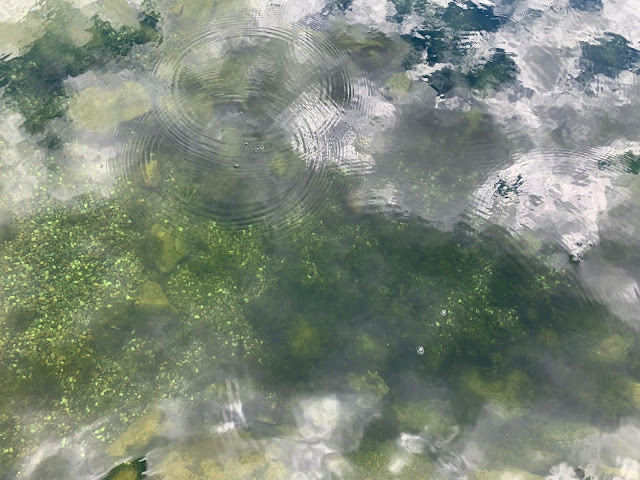
The bottom is obscured by reflections, but that green stuff is hydrilla 'way down deep. The gravel is greenish too.  

Let no one say that a "natural pool" is simple to manage.  Hah! You still have to watch the pH, and look after the plants, and add good bacteria at the right time, and keep an eye out for algae.  You have to learn to read the water.  I think (I hope) I'm there now.  But it took me a long time.  I've wrestled with hairy algae, which has a reputation for being hard to get rid of, but I managed that. This stuff?  It's gotten to me.  The result is that the pool will have to have a major rehab.  Drained, cleaned, refilled, and maybe a UV filter to boot.  That's not likely to happen until late summer, or, worse yet, maybe later.  I haven't even swum in it yet.  It's because I'm mad at it.  I drew my line.  Stay tuned.


PLACE OF THE ANCESTORS


It was here in the Beginning, the place of Origin.


We're talking frogs again.  Before there was a swimming pond, there was the big pond.  In the days of yore, before human memory of this particular site, there was a seep, perhaps a small marsh, absorbing the waters from higher ground across the meadows.  It was here the frogs' ancestors lived.  When the swimming pond was first built, it wasn't more than a day or so before they found their way to this new site.  They seemed to like it.  I remember a few years ago when my grandaughter Audrey was still afraid of frogs her kindly brother Ben captured as many as he could lay his hands on and carried them back to the Place of Origin.  It wasn't a half hour before they were all back.  They knew they had moved up in the world and they were planning on staying.


COYOTE VISITING AREA


This visiting area was not my choice.  Skyler has an invisible boundary just a few feet behind the foreground.  Two coyotes have come to this precise spot a month or two apart.  The first one, a big guy, stood just behind the intersection (mid-photo), the more recent visitor about six feet closer.   It happened about 8 o'clock one evening. I was upstairs when I heard Skyler in agitated barking.  I looked out the window.  There was Skyler and the coyote, separated by only a few feet. Skyler was at his invisible boundary line, the coyote just outside of it. When I saw how close the two were I nearly flew down the stairs.  As I leapt out the back door I grabbed my coyote scare can, a tin can with pebbles inside kept just inside the door for this exact purpose, and ran out shaking it as hard as I could.  The coyote left. Not in a hurry, but determinedly.

Skyler looks at this path every night, in anticipation, or fear, or curiosity.  Or just because he's guarding what's on the inside of his boundary.


BEAR VISITING AREA? (URSA INCOGNITA)

This is unknown territory.  There may have been a bear right here in the woods.  I don't know.  Skyler has often barked at mysterious beings there.  A bear visited next door early one morning recently.  It was a young bear and he was easily scared off.  But I don't know if one has ever come here.  If it did, this is where he/she would come from.  There have been no obvious signs, no messed up compost, for instance.  The messes I've seen there are the work of something much smaller, maybe raccoons, or opossums. Bears leave bigger messes.


What's out there?  Bear? Coyote? Or just a rabbit?

 
Skyler catching a plume of scent.  Of something...


I know where my boundaries are.


*Burdock burrs are the worst kind.  Trust me, I know. This spring I bent over some plants and when I raised my head I discovered to my shock I had a headful of burrs.  It took me painful hours to get them out, along with a small amount of precious hair.  A lesson learned:  Use only oil, oil and more oil.  No water as this makes the little hooks hold even tighter.
**The size of actual bullfrogs is surprising, especially when you're used to seeing ordinary frog-size frogs.  They put in mind that Australian scourge, the cane toad.


                                                                Okay, which is which?


Tuesday, May 4, 2021

RURAL NEWS: Spring is Wild


Spring is always a disappointment.  But only at first.


Wet daffodils, well into May.


April is the cruelest month, breeding


Lilacs out of the dead land, mixing


Memory and desire, stirring


Dull roots with spring rain.


The Wasteland, T. S. Eliot                              


Oh, the cold, the wet!  When will it end!


Then May arrives.   Well, somewhere around the beginning of May, anyway. 

Yesterday afternoon a red fox was dancing about in the field.  He trotted along, stopped, leapt in the air a few times, now and then eyeing his surroundings to make sure he wasn't been checked out by anyone or anything else.  He seemed confident, unperturbed.  At nearly the same time in the same part of the field a porcupine lumbered along, looking back now and then to be really sure dog Skyler was all bark and nothing more.  Soon after two deer tiptoed into the open, but for them, bark was as good as bite, and they fled.  So did a gang of turkeys, making a less graceful exit.


This is exactly what the fox looked like, black tips on his ears, the luxuriant tail.  With Ken's super binoculars–the ones he used to identify the area of the sky he would hone in on with his telescope–I could see him almost as closely as this.


Turkey hunting season is on right now, but it's not the kind of hunting that keeps people out of the woods, like in deer season when you need to wear hunter's neon orange.  Good thing, because there are ramps to be gathered now, those amazing plants that taste like garlic and onion all in one.  I haven't gathered many, to be honest, because it's still fairly muddy.  Walking in the field is all squish, squish.


Every bit of green in sight on this steep hillside is ramps as I saw them last spring.  But this is extraordinary, you are more likely to find groups of ramps here and there, often in the same area as in past years.


Birds are returning, bit by bit.  A pair of Canada geese have taken to dropping by to spend an idle afternoon on the grass or drifting around on the water in the big pond. Occasionally they are joined by a lone male merganser or lone male mallard.  (Have they been cast off?)  Of course Skyler is not that far away on the near side of the pond, but there seems to be mutual agreement that there's no offense taken on either part.

This time I am prepared for the annual visit of barn swallows.  The first sign they have arrived is a wad of mud plastered to the house, somewhere.  Sometimes they fling mud right at the front door while trying to build a nest just under the doorway roof.  That attempt is doomed by the constant opening and closing of the front door, not to mention humans going in and out, sending them in to a panic.  (Such fright behavior is what caused one bird, a chickadee possibly, to fly inside the other day.  I didn't realize what had happened until I found bird droppings and heard fluttering.  The bird flew to the highest possible point in the house. I closed all bedroom doors upstairs, making at least those room out of bounds, and opened a window, then hoped for the best.  Within an hour or so the bird apparently managed to sense where the outside air was, nevermind that it was only a tiny rectangle in an otherwise huge open area.)  This year I decided I was not going to continue my years of dealing with swallow poop, that gray-white mess that coats the floor and the wall around the nest.  I settled on using prayer flags to deter nest building.  It's not as if there aren't plenty of other choice spots available; they could nest in the big shed or the woodshed.  Why not?


I could barely see the bird, way up in the–what do I call it?–the cupola?


The culprits.  Three, of what are most commonly five, fledglings.

From the splatter visible here, you may be able to imagine the total accumulation.


My prayer flag solution.  Will it work?  Additionally, each light fixture below has a small rock on top, in case that seems a convenient nest site–again.  


A snake (harmless garter snake) slides around the side of the patio. It has a particular liking to hang around the stone wall when the sun is out and have a swim in the pool from time to time.

This one is probably one of the larger ones around, but looks bigger in the photo than in real life.


So  much for spring!


Sumer is icomen in


Lhude sing cuccu!


                                            Medieval ditty


See?  There isn't really any news here.

Sunday, March 28, 2021

THE REMARKABLE COLLECTIONS OF RALPH FARNSWORTH


You wouldn't ordinarily expect to find little boutique museums around here, would you? Not unless it belongs to a nearby college (Middlebury has its Mahaney Arts Center) or is perhaps the collection of a local Historical Society (Middlebury–the town, this time–has its Sheldon Museum).  The Farnsworth museum, that is, Ralph Farnsworth's museum, open by appointment only, is neither.  


Ralph Farnsworth, of the eponymous museum


Localized for you!

It is the obsession of one Ralph Farnsworth who lives in my town.  He is a gentleman, I suppose one would say, of the "old school," not being a newcomer in any sense of the world, still living on the same farm he grew up on, taciturn, the kind of person you might picture when someone refers to an "old Vermonter."   I use the word obsession because you would have to call it an obsession when you collect so many old things over a period of many years and amass so much of it that you need to devote an entire building to house it all.  If his collections were disordered, you would considered him a hoarder and the collection a hoard.  But his collection is very much in order.  And ordered.  By shape, size, and category, mostly.

Still, it's a bit of a shock when you first walk in and see all the–well, stuff.  It's as if you walked into an old general store, pharmacy, farm shed, hardware store, gift shop, all in the same space. 


Everything that's fit to keep

Did I say orderly?


Pencils. Why not!  Plus the odd ruler. 
   

Yes, pencils are arranged together with pencils, hasps, knobs and latches together with hasps, knobs, and latches, clocks with clocks, vacuum cleaners with vacuum cleaners, and so on.  I have no idea what the pencils share in terms of history, if any, but they do make for a pleasing design.


Many, maybe most of us, have samples of the above artefacts in our sheds and garages.  But do we
arrange them anywhere near as well?  I don't think so.


The above are merely decoration compared with the collection of old tools and what I would call "pre-appliance" appliances, when the word "appliance" still meant merely applying oneself to something, or was used as a noun to describe a water wheel or other such mechanical device.  What, after all, do you call a vacuum cleaner, sans electricity, when it functions more like some sort of dry suction pump (if there is indeed such a thing)?  You could claim it helped build up your arm muscles while using.  But for the fact that those women who cleaned probably weren't in need of additional exercise.  They would more likely have said the hell with this! Give me a broom!


The "Success" model, made by the Hutchison Mgf. Co. of Wilkinsburg, PA,
its function being demonstrated.  (Mr. Farnsworth hovered, so we weren't
allowed to touch.) 


Or imagine mowing your lawn with the implement below.  The model in the ad suggests it dates to the 1940's or later.  Was this someone's nutty idea, or was this actually on the market?  Since our curator has two of them, we can guarantee they sold more than one.  (Hmm, it says "sold only by mail order.”)


It weighed in at only 8-½ pounds!


Can you see an early Cuisinart in this food chopper?


We were told by Mr. Farnsworth what each piece was supposed to do,
but this one had a tag:  "food chopper" 


In the radio, television, phonograph, telephone, toaster and "other" aisles ("other" is part of every display) there are some beautiful old victrolas and an authenticated (provenance on display) Edison equipment.


Toasters and clocks and telephones and more...


Homage to Thomas Edison


The DVD is foreshadowed!

"The Picture Record"?  How, exactly?


And the tape recorder...?


I forget what this was, but it seemed a pretty amazing invention for the time.  No! Not a stove!


Evolution of the light bulb, sort of.


There is what I would call a memories section, labels and advertisements, comic books, and huge stashes of old newspapers.  Nevermind that old newspapers can be found via microfiche.  A few examples below.


Mementos of places visited, events and people remembered, a kind of bulletin board of the past. I
wonder what it was like at "The Tops" back in the 1920's.  Intriguing.


From the stone age, before Siri began telling us how to get there from here.


Collectibles.  Shocking–to me–that these 'ancient' calendars are only from the 1960's.


As we wound our way through the crowded aisles of things and more things, we came to the Coca Cola section of which there was quite a lot of material, considering it is just one brand.  Why so much about Coke?  "I like Coca Cola," said Ralph.  There you have it.


Toy trains and Matchbox cars join the endless Coca Cola logos.


The Coca Cola area was the last major section of our museum tour.  By this time we were glassy-eyed.  Throughout our wanderings through his collections Mr. Farnsworth dogged our steps, perhaps fearing our fingers might be a tad too nimble.