Friday, March 18, 2022

AT WHOSE FEET WOULD I LAY ROSES?


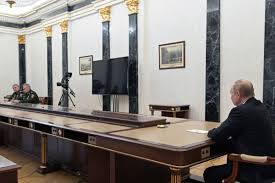
This is not a Covid-related distance.  It's a power-related distance.  

Putin, reminding his underlings they are underlings.  (Apologies for the low res.)
 

What does this photo tell you about the person behind the desk in this outsized space?  I guess that d
ictators, like all autocratic rulers, kings, tsars, caliphs, sect leaders, et.al. need to distinguish themselves from the rest of us, emphasize a difference, a majesty if that is at all possible.  Especially if they're a bit short (viz: Napoleon).

Here in this country's White House I was struck by its intimacy and the quiet elegance of the place, and also by how decidedly unmajestic it was. Is.  I remember seeing the President's chair in the Cabinet Meeting Room which has a somewhat higher back than all the other chairs around the table.  You could miss it if you didn't look specifically at it. That, I guess, is part of the visual messaging of democracy, although we well know democracy is practiced with exceptional unevenness in reality. 

Are Russians simply used to autocracy?  Does it make them feel more secure?  When your history has had rulers with the powers of the tsars and rulers such as Stalin in more recent times, and has been through massive disruptions of war and their economy, as well as the dissolution of an empire (the USSR), what is one to make of one's history?  Should it be a surprise that in 2008 the winner of a popular national television contest to choose "the greatest Russian who ever lived" turned out to be Stalin?  The TV station, taken aback by the outcome, decided that the voting must have been rigged, and they ran the contest again. This time it looked as if the winner was going to be Tsar Nicholas II. It was decided this also must have been rigged. A few weeks passed before the winner was announced.  The "greatest Russian who ever lived," they announced, was Alexander Nevsky, a 13th century prince who led Russian troops in an epic battle shown in Sergei Eisenstein's* 1938 film Alexander Nevsky.  Putin, by the way, had been voted the 5th greatest Russian who ever lived behind Peter the Great, Pushkin, and Lenin.  (Source for this story:  The Future is History, Masha Gessen, 2017, pgs. 303, 304.)  Gessen commented that her fellow Russians clearly admired power.  I don't doubt it. 


The Winter Palace in 2012, the throne room of Tsar Nicholas II, killed by the Bolsheviks along with his family 
during the Russian revolution in 1918.  Not much appearing in the photo at left has changed since the portrait below was painted.


I remember that the people we talked with when we were there (we had hired Russian guides for a few days as Ken and I were there on our own) were either cynical or pessimistic. Or wanted to leave.  No one came across as an optimist or–even less likely–an idealist.  A Putin suppporter summed up his feelings about Putin in a word:  stability.  He was a proud admirer of his country's history. 

I know this was small sample of opinion, but telling.


But what can one make of the sheer weirdness of the Putin photos below?  These are meant to be intimate meetings, one with Putin's chief military advisors, people he knows well, and, presumably, trusts.  The photos are comical. There's something about the meglomania that seems to afflict those whose power is absolute, and grows ever more elaborate, eventually reaching almost cartoonish proportions.  The death of Stalin in 1953 had distinctly comical aspects, monster though he was. The actual history cries out for satire, as in the 2017 film The Death of Stalin, with Michael Palin and Steve Buscemi, among others.  Comical as it was, it is based on some pretty strange history.  Start with the fact that Stalin's rule was based on fear, a fear that permeated all levels.  Days before he died he had imprisoned the nation's leading doctors all of whom were accused of plotting against him, and they were awaiting trial and–very likely, execution. So there was no doctor in attendance when Stalin suffered a stroke (or heart attack) at his dacha. Everyone was afraid to act.  What might happen to them if things, anything, went awry?  No one trusted anyone else.

Such a history.


The next thing to wonder might be why the Russian people appear to accept this kind of leadership.  Obviously they rejected it when they threw out the monarchy in 1918.  But what was it they accepted–or settled for– instead?  What role model is available?  I recall that anywhere there was a statue of Lenin fresh roses had been laid at its base.  This was also the case of statues of the poet Pushkin whose verses a guide could recite at will.  Are they equally revered?  At whose feet would I lay roses?

We have seen only too often how once people believe in something, or someone, it becomes almost like a religious belief, held firm, impervious to reason.  There have recently been many series on television about people who have conned someone, both in business (We Work, the Theranos scandal in The Dropout, etc.) and personally (all too often stories of women who thought they fell for someone who ended up stealing from them and taking over their minds), and that belief becomes the very devil to erase. It may be that erasing the thing you believe in is like erasing a part of yourself, admitting that a part of you has been invalidated.  No one likes to be invalidated.  No one enjoys being wrong.  Your own history is the only one you have.  There is great resistance here, for example, for white people, for anyone, to admit to having any racist beliefs, to holding any stock in white supremacy.   Change is humbling.

Autocrats are not humble.  How much better the whole world would be with a dose of humility.

But who am I to say?


*Sergei Einsenstein directed and co-wrote the classic silent film "Battleship Potemkin" which dramatizes the mutiny aboard the battleship Potemkin in 1905, a historic moment in the start of the Russian revolution.  It is also known for an unforgettable sequence showing the populace fleeing down the steps at Odessa.

Thursday, January 27, 2022

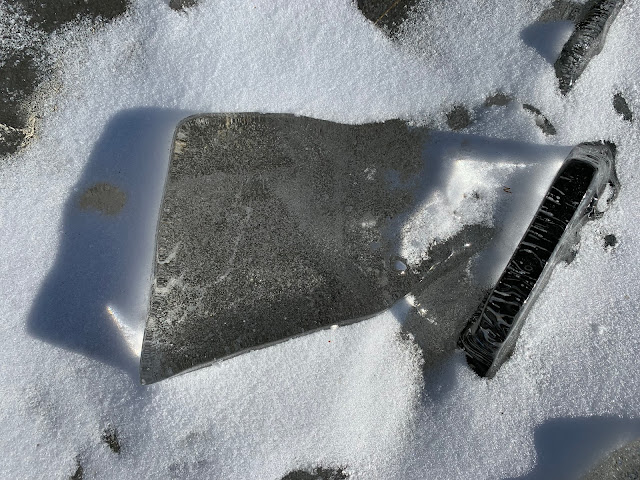
ICE!


ICE IS...


NOTE:  The photograph above and the photos below are not mine, but were taken by Chris Huston.  I'm just publishing them.  I wasn't even there, but at home nursing a bad knee.


water in another form...


...and can appear in many shapes...


Like a cube, as if cut by hand


An almost-parallelogram


Trapezoidal, nearly


Triangular


Free form?


The photographer


...and it can make butterflies


and other crystals.


Listen!


To the sounds of the ice.

(To hear audio, push play on the video below.)


Wednesday, January 19, 2022

OUT FRONT, OUT BACK


Did you know that car crash deaths rose by 18% in 2021, even though the number of people driving to work–and presumably anywhere else–has dropped?*  This doesn't make sense.  Have people gotten so used to being in lockup they've forgotten how to drive?  Are they driving angrier?  What the heck is going on?


A relic: Rusted enough to be an artifact instead of trash. 


Some of us are very angry, angrier at a level I can’t remember happening in the past.  Disruption on flights, part of our daily news lately, with over a thousand incidents racked up by the FAA in just the first six months of 2021.  No longer mere disagreements, but disruptive yelling has been rocking school boards across the country.  Even students, or maybe that's not so surprising.  Resignations are happening all over when antagonisms became unbearable.  Any public meeting seems to have become an opportunity to vent.  (Even here in Vermont, where northeastern Vermonters, including their state representative, actually applauded extraordinarily gross racist comments at an anti-critical race theory meetinglast summer––the subject matter itself an evidence of misrepresentation.)**  Demonstrators protest mask wearing and snipe at health workers, even in areas where the pandemic is raging.  No surprise that gun purchases are rising.  Again.  We have lost any sense of an “us.” We are only aggrieved individuals, each with our own axe to grind.


Once upon a time, as begins the fairy tale, when there were threats from something outside of our individual selves, we pulled together and felt strengthened by that.  Now, we are at war with just about everyone else. And this isn’t just us, the U.S. us.  Social media amplifies it all as we well know and brings it home, makes it personal. Once gossip was the hottest news to read about, but now it's the latest paranoid speculation.  It’s all out there and everywhere, released like the virus. I believe it began somewhere in the still-unraveled past from which Donald Trump emerged. He freed people from holding back, made it feel okay to be angry, mean, even cruel. He embodied a sort of ignorance-based fascism.  


That genie isn’t going back to the bottle anytime soon.  


**


That's what I start thinking about when i'm looking at the Outside, the "real world" outside.  Everything feels much better when I am in the physical palpable outside, the one that's right out the back door.


We explore, Skyler leading the way. 


My neighbors (and family) next door bought some 30 acres of land behind my house in the last days of 2021. It had belonged to a person who had owned it for many years, never used it for much except for some woodcutting a few years ago, and had been frustrated by the fact that it was pretty much devoid of access except by means of a long neglected and now much overgrown road originally created in the late 1700’s.  This resulted in an ultimately fruitless attempt to re-create that road with the not-so-benevolent aid of another neighbor from further up the street who indulged in making this a tiny local cause celebre. (The complete saga of this episode can be found in my post called “Road Stories,” May, 2018.)


Posting was one of the first things to be done, as there have been episodes of out-of-season deer hunting, and sometimes an unknown number of hunters showing up in what is a relatively small area.  And then there’s the old “road” issue which you could figure leads somewhere to hunt or cut wood or camp.  (It doesn’t.)  Next on the agenda was clearing paths, some that already existed but were overgrown, others that made new connections.


Posting means no hunting without permission. And NO HOUNDING!***


Fallen branches everywhere and the occasional fallen tree were cut and cleared.


The land is surprisingly rugged, considering that before you enter the woods you are in meadow that has been kept clear, except for a copse here and there either by mowing or cows.  There is wetland, cliffs, small mountains, and deep bowls.


The deep bowl (I call it the abyss) slopes down to the left.


And behind this cliff is the northeast end of the property.


By the time you I’ve done my usual circumlocution, a loop extended now by new trails, I have gotten so distracted by the prints in the snow by the sounds, and, well, by everything, that all the rest of it is forgotten. It’s hard in the woods to think of all the anger and violence and benighted ideology out there, most especially the hateful, paranoid kind.  


Deer trails are everywhere.  I like the tiny handprint-like tracks of raccoons.


A flock of turkeys marched along this path as if it were made for them.


For a while, anyway.


*Article in Substack by Matthew Yglesias

    ** VTDigger quoted in blog post, September 10, 2021

  *** Hounding, or hunting of game (e.g., bears) with radio-collared dogs is still permitted in Vermont, although it is widely opposed, as the dogs are usually far from their handlers, hence not controlled, and often harass wildlife.  

Monday, December 6, 2021

ISN'T IT IRONIC?


(Borrowed from the New Yorker cartoon archives.)


Maybe November and December have this effect, all those dim days and long dark evenings, but it gets you to thinking, ruminating.  Bear with me.

 ~


Now, right now, in case you haven't noticed, but of course you did, we can access everything–everything– in the digital world.  We know so much!  It’s all there!  For the taking. And it's free!  Most of it, anyway. Look it up.  We can express ourselves.  I'm doing that right here, actually. 


But can we stop loudly expressing every single opinion we have on all of it?


There is exciting new data available about almost everything around us. Take early humans, for instance: the complexity of earlier ages are being examined with new tools, and found to be far more interesting than we used to imagine.  Neanderthals were not hulking dim-witted pre-humanoids after all.  They had some kind of social norms, rituals, behaviors we are still working to interpret.  There are even more types of humanoids.  Dates for the development of societies, growth of towns, building of houses, forms of governing, are being pushed further and further back in time, and on a regular basis.  Understanding of diseases (sure, even Covid), the microscopic, the atomic, the cosmos, are yielding more secrets than even we uncovered as recently as ten or twenty years ago.   We know more about animal behavior.  Some laws even reflect that new knowledge. I could go on.


It was always the plan

To put the world in your hand

Hahaha


        Lyrics from  "Welcome to the Internet" from the album "Inside" by Bo Burnham


But are we any smarter because of it?


What happens in this country is usually reflected in what is happening everywhere else on the planet.  No surprise.  We’re all in this together, after all. But, honestly, nothing  is looking especially great.  I used to think we were really “getting it” with regard to all kinds of issues, mitigating pollution, for example.  We’re all recycling, aren’t we?  Even though it’s actually aspirational recycling.  We hope it’s working but we aren’t anywhere near certain it really is.  It's disappointing.  Every May there are groups organized in every town around here to pick up the trash dropped in ditches along the road the previous year.  All too many bags are full.  So if we’re not doing so great, what about elsewhere?  Not great.  I’ve looked at a hillside at a beautiful Buddhist monastery overlooking the Mekong River in Cambodia that was serving as a dump, all the junk tossed over the wall and down the hill, out of sight, out of mind. Old tires and whatnot along major roads in Russia, all of which is shrugged at helplessly. This is especially pronounced in failed states like Bosnia and parts of Croatia where it seems stuff is tossed into the woods to spite...what? Who?  Others!  Projects are planned in Chile that threaten areas of great beauty.  Ive seen logs piled in giant heaps taken from the Amazon.(and that was way upriver, with a thousand miles still to go.)  Even in Australia I watched plastic bags stuck onto tree lilmbs, waving like flags as they blew in the wind. At home, meanwhile, we can all see the burnt forests in California, pictures of coal sludge threatening wetlands, land drying up, and...you know, it goes on.


With new information about animal behavior we have a growing understanding of migration patterns, the effects of forest fragmentation, reproduction, evolution.  But who needs to go further than this state?  Leg-hold traps are still being used here for trapping.  (You might wonder why anyone is still trapping animals anyway, given that no one–almost no one–wears fur these days. Is trapping now the province of taxidermists?  Makes you wonder.)  Coyotes can be hunted in any manner, at any time, day or night, 365 days a year, tossed in ditches.  Bears can still be hunted with hounds wearing radio collars–not exactly your bear hounding of the 1700’s or 1800’s anymore when the hunters could wear themselves out chasing their dogs on foot.  Not that that period was some Golden Age of Hounding.  So much for our wildlife here in Vermont.  


 Are we getting simultaneously more filled with data and, yet, stupider?


 Hard to know, frankly.


Could I interest you in everything?

All of the time

A bit of everything

All of the time

Apathy's a tragedy

And boredom is a crime

Anything and everything

All of the time


Lyrics from "Welcome to the Internet" by Bo Burnham on the album "Inside."


I was listening to NPR/VPR the other day, and happened to catch a program where they were talking about the deep discouragement that environmental activists and researchers sometimes–sadly, often–feel.  It can get bad enough to cause burnout, depression.  Maybe I’m super susceptible to this kind of thing, but while I was listening I began to feel really sad, discouraged.  I felt that way for much of that day. But at night I decided to watch a NOVA show about black holes and another that followed about the origin of the universe.  I was captivated.  It was exciting.  Work of the past several years have revealed so much that hadn’t been known before. (Not that I understood it all.) But hey, I thought, everything is bigger than I had been feeling.  There was so much fascinating stuff to think about and ponder.  I felt much better.  


Is science supposed to save us, make everything right?  Hah!  Half the world doesn’t even believe in science.


I have no idea.  I haven't even mentioned the human component, but I could reference the fact that the many of the same anti-vaccers who don't want the government "messing with their bodies," or "telling them what to do," support laws that have the government messing with women's bodies (presumably other people's bodies!) creating laws prohibiting abortion. There is a certain irony about it all, you have to admit.


~


Instead— Let us celebrate the dark days of early winter! 


Winter is icumen in,

Lhude sing Goddamm,

Raineth drop and staineth slop.

And how the wind doth ramm!

Sing: Goddamm.


Skiddeth bus and sloppeth us.

An ague hath my ham.

Freezeth river, turneth liver,

Damm you; Sing; Goddamm.


Goddamm, Goddamm, ‘tis why I am Goddamm.

So ‘gainst the winter’s balm.


Sing Goddamm, damm, sing goddamm


Ezra Pound


Or maybe it will snow. 

Monday, November 1, 2021

STRANGE THINGS

THREE KINDA STRANGE THINGS... 


Well, it did happen to be Halloween as I wrote this...


1.  ODD


It's been a warm fall.  The first frost happened barely a week ago, the second frost shortly thereafter. The trees seem a little out of whack. It seemed it was every tree for itself.  Not the ordinary "let' s get all bright and yellow and red together."  I realize this wasn't true absolutely everywhere, as  I did pass through the White Mountains of New Hampshire where, even at high altitudes, as late as the 15th, it looked beautiful while trees around here were just sort of washed out.

Admittedly it did look quite colorful right here.  However....


...this was distinctly not early October, and not even mid-October, but just before the first of November.  Peak foliage here is normally––if there is still a "normal"––anytime from around October 10th to the 18th.   At higher altitudes the peak date may be as early as the 8th or 10th of October.  Maybe the trees figured, dull as they'd been all the rest of the season, they'd better shape up and get color before their leaves get blown away.   Nearby trees were already deep into November mode, leafless.


This maple seemed to signal fall was all over for much of October, vaguely yellowish, and then to my surprise it took on vibrant red and orange.  On Halloween, October 31st, it was the only tree around that has vivid coloring.  This is odd.


At the very same time the apple trees, following their own calendar, are still completely green. The apples are now overripe, and look more like giant plums.


Besides the foliage there was this unusual scene.

It looks as if the little bridge could wash away.

An unusual occurrence on Halloween.  This pond never flooded this much before, not even as a result of hurricane Irene when much of Vermont flooded.  The ground was already wet when the rain began, and probably couldn't hold much more water.  Good thing the muskrats abandoned their tunnels two years ago, or the holes in the lawn would be much worse,  Still, one of their old tunnels that I'd filled in became a little creek.


2.  WEIRD AND CREEPY


These two laughing ladies are wearing actual fur hats that they made out of animals trapped in Vermont.  (The trapping season begins November 1 and allows leghold traps.)  They have a business nearby called Otterway Fur Millinery (https://www.otterwayfur.com).  

The following is from their website, in answer the posed question, "Why wear fur?"

"We humans are a keystone species; we are dominant, the top predator. We can and do make other species extinct. We have intelligence and therefore a responsibility. Fur bearing animals are part of the life cycle. All that lives, dies. Nature has the right to exist, maintain and regenerate its vital cycles and its processes in evolution.

Trapping is the controlled harvest of wild fur bearing animals to maintain healthy populations within the carrying capacity of the environment. Trappers conserve wildlife and preserve our outdoor heritage for future generations. Gratitude and respect are a practice of ethical trappers.

Fur is free-range, sustainable, renewable, and warmer than petroleum-based plastic and acetone derived faux fur."


I find it especially creepy when words like “free-range,” “sustainable,” “renewable” and the oxymoronic “trappers conserve wildlife” are thrown out to the public, maybe to make themselves feel good, or worse, to signal imagined compliance with wildlife ethics to would-be customers.  Sad.  Environmentally decorated gobbledygook.  Eco-decor!


Code words are everywhere lately, faux non-racism, faux non-discrimination, faux ecology.  Alas.


3.  SCARY


I was rummaging around in a drawer a few days ago and came upon a ring that my grandfather, a jeweler, had made for my grandmother.  I'd forgotten about it.  It's been in this drawer for thirty years.  Maybe longer.    

My grandfather studied jewelry making when he was young, and lived in southern Germany, in or near the town of Pforzheim, a town that was then, and still is to some extent, a center of jewelry manufacture.  It's near the city of Stuttgart, and not terribly far from Munich.  It was the 1920's.  My grandfather came from a family of seven brothers of which he was the youngest.  The brothers apparently* vied with one another for money and position, and he was squeezed out. By the time he became an adult, times were bad economically and restless politically.  Not a good time for jewelry.  He married and had two children, but their future was not promising.  He decided he needed to find out if he could succeed in America, and so he traveled alone to New York, to suss it out.  He either found a job or had confidence that he would.  After a short time he returned to Germany, perhaps hoping against hope that things had improved, perhaps to check out whether or not his family would be willing to make a big move.  While he was there he attended one of Hitler's speeches that he was often making in that part of the country.  Uh, oh, this doesn't bode well, and ihe decided to leave.  He took his family and came to New York City where he worked as a jeweler, or maybe returned to a job he'd found earlier. He must have have been good at it, because as he ended up making particularly high-end jewelry.  

Some of his work, maybe a lot of it, was for the firm of Harry Winston. One stone he worked on was the famous Hope Diamond.  One night he put it in the pocket where he often carried diamonds, probably folded in the complex style jewelers still use today.  He went home to Queens the usual way, on the subway, with the Hope Diamond, because he wanted to show it to his family.

Was he uneasy on that trip home? Or on the return trip?  Was he frightened?  Even for a minute?  If something had happened it would have had tremendous repercussions.  How could he not be worried?

I remember him warmly, though I knew him when I was very young for only  a short time. (He died of a heart attack in 1950.)  I remember he had a calm and welcoming manner.  But this had to have been a scary moment. How could it not be? 


History, of course, reveals that he made it back to Manhattan safely, the diamond secure in his pocket. Harry Winston gave the Hope Diamond to the Museum of Natural History in 1949.   I've only just put the whole story together, never having given it a thought—ever.  It was only yesterday that I realized my grandfather must have made the stone's setting.  After all, who else?


*Much of this about my grandfather I learned from my cousin who had been filled no doubt by his father who may have seen it, having recently gotten out of the army and probably living at home until he got married.


Friday, September 10, 2021

SUMMER IN THE REAR VIEW MIRROR


SUMMER IN THE REAR VIEW MIRROR


Looking back doesn't show much, does it?


Goodbye, summer 2021.  I won't miss it.  Not that it was terrible.  Just blah.  For starters, I wrote no posts whatsoever.  Somehow or other the air went out of all my thoughts that floated by in the heavy humid air.  I accomplished nothing.  Things fell apart, and mostly they got fixed.   Or done with, or completed in one way or another.


It was a summer of petty annoyances.  

   The tractor got fixed (after the rain-fed grass grew without restraint and created a mess of cut clumps for the rest of that month), 

   the valve on the water tank was replaced (having flooded part of the basement at such a rate that it kept me awake emptying a brim-full bucket on a 3-hour schedule), 

   the car windshield was replaced (cracks happen, so it goes), 

there’s a new lock on the front door (the door that had tried to lock me out, save for the existence of another point of entry),

   I somehow cracked the band on a ring Ken had given me (not yet repaired), nevermind also losing another opal (also from Ken, and unfixable), 

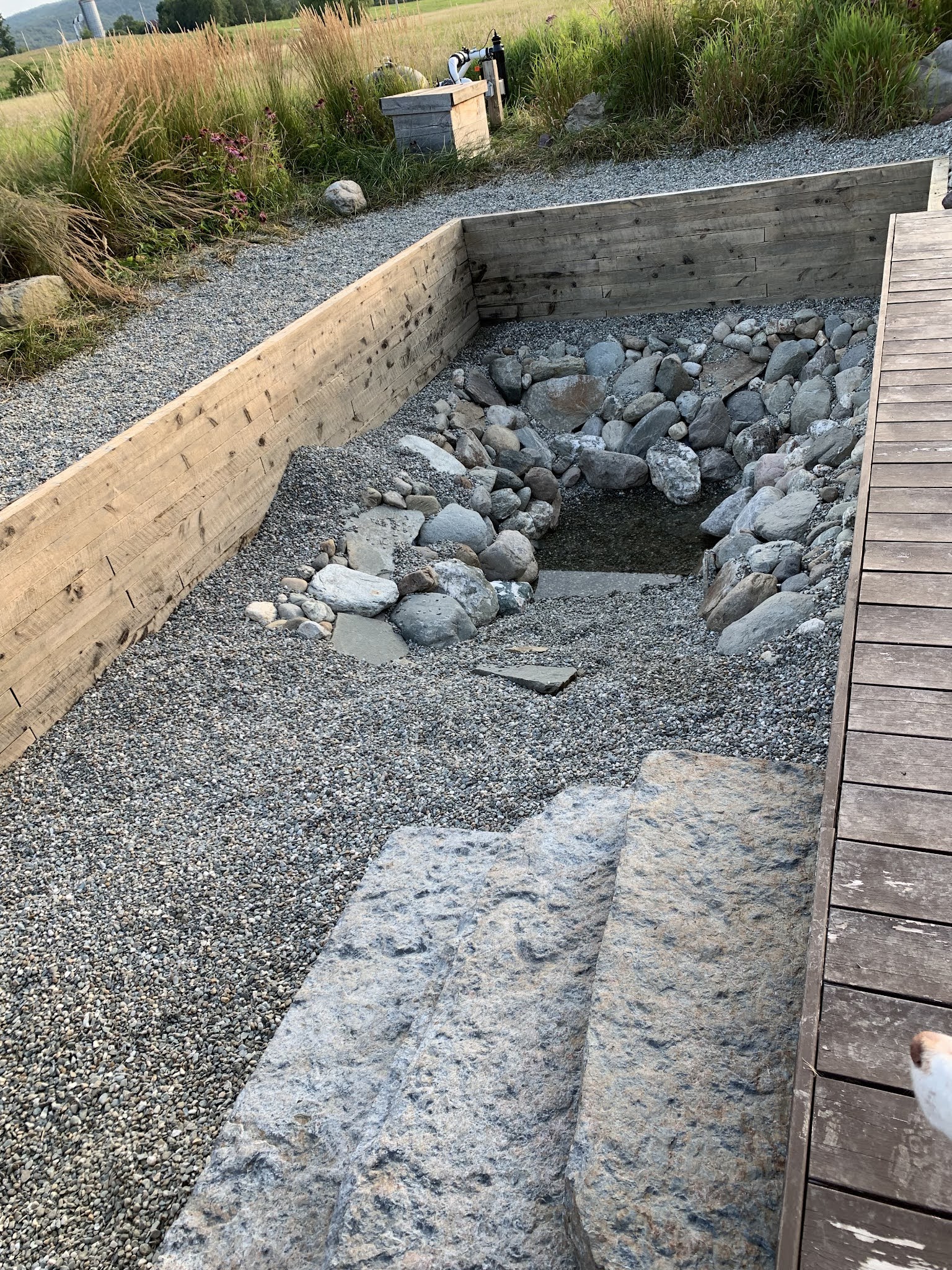
   my “natural” pool underwent some rehabbing (how “natural” natural is, is another story*) and is once again inviting (although this didn’t happen until the end of August sos there was little to no swimming), 

   two family members recovered (one from post-vaccine COVID, another from a very bad mushroom, and me from some mid-summer stomach bug),

   there was the continued masking because of the Delta variant... 


Enough!


On the purely positive side, a new painting was hung on my wall (commissioned from artist Carly Huston), and I had a couple of lovely days on Monhegan Island.  So, all in all, what is there to complain about?


BEFORE REHAB:  A large amount of algae in the pool, plus an excess of plants around the perimeter.


IN PRODESS: Notice ballooning of the liner because of outside water pressure


IN PROCESS:  The pool, drained, with fresh gravel and rocks


Since it's now September, the flowers are done, and there's still a slight greenish tinge, but it's under control.  Of course, by now it's also a bit chilly.


Just about everything has been far better than what has been going on elsewhere.  With so much world-wide bad news it was easy to almost overlook small local stories. 


Here's one late summer tale that really got to me.  It was about the primitive thinking going on the peaceful, remote, unspoiled, beautiful Northeast Kingdom of Vermont–a place everyone loves whether they've been there or not.  A story in the digital Vermont news report VTDIGGER that took place in the heart of the Kingdom was so awful I had thought I'd write a blog post about it.  


It took place in the little town of Brighton (pop. ~1,222), tucked in a bit south of the Canadian border and a bit west of the Maine border. The story described a meeting held by State Rep Brian Smithwith his constituents from the district of Derby.  He set the tone, telling the gathered crowd “I’m really quite proud to be white,” a statement eagerly defended by State Senator Russ Ingall of the Orleans district (also part of the picturesque Northeast Kingdom) who had helped to arrange the occasion.  Then, attempting a more statesman-like pose, he added, “You should be proud of any skin color that you’d like,” which of course is a bit like saying “all lives matter,” a statement that is so self-evident it’s like saying you favor gravity.  Hence, meaningless.


Rep. Brian Smith (R)  Proud and white.


But what struck me as particularly appalling were the comments from the audience which went pretty much unchallenged:  


"Immediately after Smith’s comments — about an hour into the recording of the meeting — a white man stood up in front of the seated crowd and said, 'Anybody in this room know who the first slave traders were? They were colored people.'


A voice from the crowd responded, 'Yes they were.'


The man continued, 'They rounded them up, sold them. They come to the United States to work.' 

He then spoke of Vermont’s contributions to the Civil War and made the historically inaccurate statement, 'Ninety-nine percent of the colored people stayed in the South because they weren’t treated that bad.'

The man concluded his speech, 'So please don't tell me I'm a racist.  I'm not a racist.'" 


Most of the audience applauded. The State Senator applauded. (See? There are no racists anymore!)

Shocking, right?  Did no one ever manage learning some history?  As I began to think about how easy it was, pointing out such primitive thinking. It was too.  A cheap shot. Those statements were either a result of a lack of education, possibly stupidity, or of living in a bubble, or perhaps some combination of all three.  I’d have felt good, superior, maybe smug, and definitely “woke.”  (Aren't all of us good guys, and woke?)  It was, after all, a gathering to oppose “critical race theory,” so one would expect the mood of the audience hot for battle. That particular issue, critical race theory, or, in reality, non-issue, is yet another example of Trump’s hold on all too many minds, given that most people never heard about it until our ex-prez called it out as a threat following some FOX news banter after the death of George Floyd and the protests and discussions about race that followed.**


It was a reminder, if I needed it, that even when you live in a beautiful place, that doesn't mean all is beautiful as well.  A summer can be just as blah if you live in a less lovely place, or just as wonderful if you revel in it, and are happy with yourself.  I felt grouchy, and everything around me was strangely complicit.  I welcome fall!


* Thanks to swimming pool owner stepdaughter Christine, I’m no longer a stranger to using chlorine.  I have learned, albeit slowly, that keeping a natural pool clear of algae takes more than just pond algaecides and "good" bacteria.


* * For the story of CRT, see the 7/27/2021 NYTimes story by Jacey Fortin titled "Critical Race Theory: A Brief History, or "How a complicated and expansive academic theory developed during the 1980's has become a to-button political issue forty years later."