Tuesday, February 10, 2015

O CANADA! OH. CANADA.


Bundled up tourists ride around Old Town Montreal

Don’t we Americans always start comparing countries when we go to Canada?  Without even thinking about it, subconsciously half the time.  The word that comes to mind, usually, is bland.  Canada’s backstory seems less turbulent, less violent, and hence ultimately less interesting than ours.  North of Montana in a small town in the Canadian far west (that would be Alberta Province—I’m not even sure, I had to look it up) some years ago we went into the equivalent of a western-movie-style saloon––it was the kind of town that would have had exactly that that, had it been in Montana––but when we entered the place looked about as interesting as the local coffee shop complete with fake wood walls, formica tables, fluorescent lighting, and no menace whatsoever. 


Borderland, Canada


As you approach the border from almost anywhere in the northeast the land changes, the mountains dwindle and the earth flattens out, suggesting you really are in a borderland, a place that feels different.  Crossing is a bigger deal than it once was, pre 9/11.  Lineups to return to the USA can be traffic jams on weekends on the major routes to Quebec Province. 


Along the icy St. Lawrence, Montreal
Place Jacques Cartier in the old town

 
In the heart of Montreal


In the early 1990’s Ken and I were driving through northern New Hampshire headed for Quebec City.  It was late in the evening but we weren’t inclined to find a place to stay overnight on the New Hampshire side of the border so we decided to keep driving, see what turned up.  I forget quite how this came about, but we found ourselves on a narrow road without a route number that after a few miles turned into a dirt road.  We didn’t feel like turning around so we kept going.  Further on a small sign appeared by the side of the road quietly announcing “Canada.”  Nothing else was in view and nothing barred the road.  It was nearly eleven.  We drove on.  The road remained unpaved.  It was nearly midnight when at last it ended in a very small town that had only a handful of buildings.  One large old wooden building was brightly lit and had a sign that we were grateful to see reading, unmistakably, “Hotel.”  Given the lateness of the hour it was surprisingly lively, rollicking in fact, but we were too tired to look in on the partying, wanting only to sleep.  Yes, said the person behind the desk, there was a room we could have.  Not until later did we wonder what he might have been thinking:  Where the hell are you guys from?  Our room was on one of the upper floors.  It had a sagging bed, the décor of an era long past, unusually dim lighting, and the whole room was colored red by cloths placed over the only two low wattage lamps.  Huh.  Guess the light's not meant for reading.   A huge transom above the door was fixed wide open so we could hear everything.  Anyone passing in the hall would also hear us.  We left first thing in the morning.

Thanks to 9/11, GPS and mobile phones this would not happen today.


In Montreal's archeological museum below present street level one finds the old stone walls of 17th and 18th century Montreal settlements


Of course there wasn’t always a border at all.  The Western Abenaki, an Algonquin people, spread from Vermont, New Hampshire, western portions of Massachusetts up to the area that is now Montreal and further northeast. Settlement in New England  forced many Abenaki north into Quebec eventually forming two large communities at St. Francois and Becancour that still exist today.  New England names we know well are Abenaki:  Androscoggin, Kennebec, Ossipee, Nashua, Penobscot, Pemigewasset, Winnepesaukee, and more.  The language today almost disappeared.  A few years ago there were only six people in the world who could still speak Abenaki.  Now, as a result of years of teaching, Jeanne Brink, an Abenaki who spoke here recently thanks to the Vermont Humanities Council about her years of efforts to preserve the tribe’s culture, there are some ten to fifteen.  (It is a language that contains no “r’s” she said, and even now she has trouble pronouncing that letter.)  Until the Jesuits appeared at the reservation in Canada there was no written language.  Jeanne’s first language was French.  Her grandmother spoke Abenaki as her first language, French as her second. 


Jeanne Brink, holding an Abenaki "pouch"


She recounted how her great great (three greats perhaps?) grandfather was killed in a raid on the Abenaki in 1759, the aim of that raid, like many others, having been simply to wipe them out. This is the story below via Wikipedia, and the tale as recounted by Jeanne Brink at www.vermontfolklifecenter.org ”Malian’s Song.” 

            The St. Francis Raid was an attack in the French and Indian War by Robert Rogers on St. Francis, near the southern shore of the Saint Lawrence River in what was then the French province of Canada, on October 4, 1759. Rogers and about 140 men entered the village, which was reportedly occupied primarily by women, children, and the elderly, early that morning, slaughtered many of the inhabitants where they lay, shot down many who attempted to flee, and then burned the village. Rogers reported killing as many as 300 people, while French reports placed the number closer to thirty, mainly women and children. One of Rogers' men was killed, and seven were wounded.

            Rogers and his men endured significant hardships to reach the village from the British base at Fort Crown Point* in present-day New York, and even more hardship afterwards. Chased by the French and vengeful Indians, and short on rations, Rogers and his men returned to Crown Point via the Connecticut River valley. Missteps in caching food stores for the expedition's use led to starvation, and some of Rogers' men were reportedly driven to cannibalism in order to survive. However, Abenaki historians have a different story than this one. About one third of the raid's participants did not return.
British colonial reports of the raid were unapologetic, as St. Francis had long been a place from which the natives raided colonial settlements as far south as Massachusetts, and Rogers reported a large number of English scalps decorating the main village buildings.


Before there were white settlements Abenakis used drums for tribal occasions, as did other Indian tribes.  As white population around them increased they adopted fiddling.  The sound of drums, Jeanne explained, made whites feel threatened.  Fiddles were more acceptable.


Abenaki artifacts made recently by Abenaki craftspeople.  Jeanne Brink is herself a master traditional sweetgrass basketmaker 


On the way to Montreal, less than three hours from here by car, the Abenaki don’t come to mind.  It’s a straight shot on a superhighway, then you cross a bridge over the St. Lawrence and you’re there.  In winter it seemed no colder in this northerly city than it did at home, both places this particular winter being on the low end of cold.  Only the sight of nearly everyone wearing fur-lined hoods gives away the usual reality.  It doesn’t seem bland here, either.  As in Quebec City, there is history, beautiful buildings, a hot restaurant scene and a lively atmosphere.  

Not bad, we think, for Canada.  Not bad at all.

 
A view of Rue Saint Paul from our room


*The ruins of Fort Crown Point are preserved across the Lake Champlain bridge several miles from here, seen here on a day in late fall:


Thursday, January 22, 2015

WONDERLAND


Just over the ridge, in the distance, is the way to Mad River and Sugarbush ski areas.


It appears we live in the Banana Belt.  The Deep South part of the Banana Belt, judging by the snow we haven’t got right here, on our road, that is.  ('Banana' is relative, of course, as we’re talking about Vermont.)  There are dustings of white and frozen puddles underneath that snow, but the fields show as much brown stubble as white, and the woods are half white, half brown, the trees bare.  So it is surprising to travel a few mere miles to the east, toward the high mountains, and find fresh snow, plenty deep enough to ski on, and, a bit closer to the mountains, abruptly discover a world of white on white on white.


As soon as you drove up one of the gaps (i.e., mountain passes) the world looks different.
This happens to be Appalachian Gap.


How did that happen?  We had a day of warmish (30’s) weather during which it rained, then sleeted, and then, while the temperature still hovered around freezing, there came a layer of wet snow.  The wet snow glued itself to the trees, and was followed by several inches of light, fluffy snow and very low temperatures.  The cold (in the minuses, and no higher than about 15-20 degrees) allowed every bit of fluff to stay exactly where it was.  Not even bright sunshine managed to loosen the trees of their burdens.   But all of that didn't happen right here.  But close.


A creek along the Robert Frost Trail on Middlebury Gap.


A row of trees or perhaps bushes, bowing as if in homage


Branches form an arbor on the Robert Frost Trail.


"The woods are lovely, dark and deep..." (Frost)
But today they have an inner light.


Many trees had already shouldered a load a month ago when they had to carry a tremendous load of ice and snow.  That wasn’t pretty.  And there was so much damage.  Sadly many of those same trees never had an opportunity to try and straighten again before this fresh, albeit somewhat more gentle, assault.  Along the Robert Frost Trail on Middlebury Gap the path I walked was often blocked by limbs bent so low they formed a kind of arbor.  I noticed with pleasure that although there was one set of footprints before mine, whoever had walked the trail had taken care not to disturb the snow on the limbs he or she had slipped beneath.


At the top of 'App Gap'

The effect was more pronounced on Appalachian Gap.  But as you drove over the top the phenomenon abruptly ended, the trees showing only some fresh snow, nothing frosted.  At Sugarbush, if you looked back at Mt. Ellen, you could see the top third of the mountain covered in white. 

Beautiful conditions, but brutal wind, plus cold!
Couldn't take the ride up, we left early.


This side of Ap Gap, looking ahead to Mt. Ellen


The large view is not the only angle for seeing something beautiful.


The very cold mornings sometimes make frost on the side of the house, like these butterfly crystals.


A seat from which to contemplate the view, at the Robert Frost Trail.  Aaah!


Wednesday, December 31, 2014

WRITING IN THE DARK

WHITEOUT


It’s the darkest time of the year. 

I began writing this on December 9 and 10––the two days of heavy wet snow that blocked views of almost everything, mountains, trees, even our road––and that storm was followed by days, no, weeks, of shrouded grayness that weighed down the sky. A single sunny morning was an exception, soon forgotten.   The solstice was still nearly two weeks away.  All day long it looked like early evening.


Everything looked blurry in snow-fog and low clouds.

Much cheerier:  The same view, more or less, just before all the leaves fell.  


While we were away for Christmas the snow melted away in several days of warmth and fog. When the fog lifted and the sky cleared at last nearly all the whiteness had vanished.  The ground lay bare, awaiting 2015 to whiten up again.


More of the same

Nice as it was to see white everywhere, this wasn’t the kind of snow we welcomed.  Sure, it was attractive in the way it coated the trees as if sprayed on–although it would have been really beautiful had the sun shined on it, just once–and loaded the firs so heavily that they looked like the fir trees kids make around sandcastles on the beach by dripping wet sand into little peaks.  Firs seldom look that perfect naturally.  The snow load was a painful burden to other trees:  Higher up from here, in the mountains, you would have heard the crack of limbs and tree trunks for hours through a day and a   And, chances are, you could have been without electricity for as long as five days.  Even the Middlebury Snow Bowl had to close because of the lack of power. Forest trails were closed because of many broken, fallen and partially fallen trees making them dangerous or impassible.  Skinny and flexible trees, like birches, spent nearly the whole period bent over, without a thaw to release the pressure.  Tree torture.  In the valley damage was minimal, only the occasional broken branch. Clearing the white stuff, though, was dispiriting. 


Bent trees hang over Route 17 on the road to Sugarbush

The “here,” as in “nonewsfrom” was whited out, too.  I put it to a lingering aftereffect of our visit to Cambodia and Vietnam, Cambodia especially, where life is so much harder for so many, and where any actual “news” is likely to have a memorable impact on your livelihood, your world.  What happened here seemed trivial in comparison.  Hence, a mental kind of whiteout.  Or blackout, maybe.  

Or just a blank.


CONSIDERING ARMADILLOS


Where was I?  Oh right, the transformation of everything here from white to, well, kind of brown and greenish.  The snow vanished so quickly it was like pulling off a blanket and realizing someone was asleep underneath. Suddenly without cover, rodent trails were exposed everywhere, but most startlingly, near the pond.  Every spring warm weather reveals their wobbly pathways that used to be tunnels under the snow.  On the far side of the pond I had never noticed rodent signs before, and certainly not holes you could actually fall into. I checked the internet for likely culprits. 


Uncovered pathways near the pond


The Center for Wildlife Damage Management (who knew?) suggests one first look to see whether or not there actually is a hole.  Of course I knew there was a hole.  Holes.  That was the point.  Nevertheless, I read on. “If there is no hole and just a groove present, consider armadillos. 

Okay.  


Next:  Look for a hole that may lead to a burrow.  Measure the hole.  Three inches or less (there were several of those) suggests chipmunk, crayfish (Really? Crayfish?),* ground squirrel, kangaroo rat, Norway rat, skunks, or voles.  Winnowing the list of those from other habitats leaves chipmunks (who prefer living under the bird feeder), skunks (not around in the cold, and even if they were, Skyler would notice), rats (unlikely; no grain lying around, plus they prefer chicken coops).  That leaves voles.

The really big trails and hole:  The tape gives a width of nine inches.  At top  is the frozen pond.


Then there are the big holes.  Holes larger than three inches suggest one consider: badger, river otter, prairie dog, fox, coyote, mountain beaver, or woodchuck.  Of course half these animals are western except for the coyote, fox, river otter and woodchuck.  Foxes and coyotes wouldn’t dream of denning near a house, much less a house with a dog.  It would be nice to have river otters, but unlikely, and a pond is not a river.   There is little doubt that the digger is a woodchuck.  On second thought, make that plural: woodchucks.  Woodchuck holes can be 8 inches wide.  Our holes are at least that.  For the past two years we were pretty certain a family of woodchucks lived under our patio.  Their burrow entrances would appear now and then amid the flowers as piles of dirt or stones excavated from under the cement.  Woodchucks had made homes in our suburban garden in Lexington, Massachusetts.  Woodchucks are everywhere.  I needn’t have bothered looking this up, for it should have been obvious.  (Some circumstantial evidence is very strong, as when you find a trout in the milk,” remarked Henry Thoreau.)  Maybe they moved?  Or maybe this is another branch of the family.  It could explain why Skyler has occasionally been barking at night in that general direction.  He may not have even seen them as they were under the snow, but he very likely sensed that they were there, somewhere.  

Woodchuck, groundhog, whistle-pig.  (Woodchucks, when threatened wil make a whistling noise to alert fellow groundhogs.)  A major business recently built a factory in Middlebury to turn out Woodchuck Cider. The nearby town of Shoreham has a distillery that produces Whistle-Pig rye whiskey.  Another name for woodchuck is land beaver.  I like that one.

  
That's a woodchuck all right...
But the Whistle-Pig company appears to think a Whistle-Pig is a Pig


*Yes, crayfish do in fact burrow in the ground near water.  Their two-inch burrow openings are surrounded by a ring of mud.  But not here.

Sunday, November 2, 2014

VIETNAM: REVISITING FOR THE FIRST TIME


One of many great buildings left by the French is the famed Metropole, Hanoi's iconic hotel, linked with Jane Fonda, Joan Baez, Richard Nixon, Henry Kissinger, et al in the Vietnam War era, mere celebrities (and us!) today.


Brides and grooms use the front of the hotel as a backdrop for photos


Hoan Kiem Lake in central Hanoi with the Turtle Pagoda opposite


GOOD MORNING, VIETNAM!


Above the entrance to the men’s toilet it said “NAM.”  I realized “Vietnam” meant Viet people.  That’s how little I knew about Vietnam, never mind that it was a place I thought I knew all about in the 1970’s.  It’s as if I had been here before in some way, and was here again, but this time for real.  It’s an odd feeling, visiting a country whose history is so intertwined with ours, and not––until very recently––in a good way.  (Those early days are remembered here:  http://www.lexingtonbattlegreen1971.com/)  If I were French my feelings might be equally mixed.  The buildings the French built remain grand.   They lost their war too, in 1954, with the battle of Dien Bien Phu, remembered in a large diorama exhibit at the Military Museum.   Memories, artifacts of wars past are everywhere.


At the Military Museum, Hanoi, remnants of ruined planes, are stacked in a war monument (below).


The "Maison Centrale" is actually the infamous old Hanoi prison built by the French early last
century during their occupation of Indochina.  Behind it, incongruously, there is now a tall apartment complex.


Mannequins stand in for the live prisoners held by the French during their occupation.  The prison was later dubbed the "Hanoi Hilton" during the Vietnam (American) War and housed John McCain, among others.  Shackled Vietnamese like these were mostly political prisoners.  At least they had others to talk to, unlike those held
alone in dark, almost medieval, dungeons to either side.

Instruments of torture and two guillotines, of which one remains, were also on display.


We were not in Hanoi (two words in Vietnamese, Ha Noi) a full day before we met four young people from Hanoi University who were overjoyed to practice their English on us.  Their enthusiasm was overwhelming:  Ken’s blue eyes (“We all look the same!  Black hair, dark eyes!”) caught their attention.  If they wanted to, they said, they could study in China, but where they really want to go is America.  “We love America!” 


Students from Hanoi University.  Why the "V" signs?  No clue, but it's common in China as well.


Students celebrating a graduation at the Temple of Literature, a Confucian center of learning,
dedicated in 1070.  The women are wearing the national costume, the Ao Dai


It wasn’t only students.  Everyone seemed welcoming.  Even people who lived through the US bombing of Hanoi in the 1960’s.  A long-time employee of the Hotel Metropole led a tour of the bomb shelter below the hotel, recently rediscovered when contractors enlarged the swimming pool. Even people like the food vendor who wanted me to buy a sweet, but even as I said no, asked where I was from, and when I answered “America” she reached out and took my arm, gave me a broad smile, and said, “Oooh, nice.”


In Hanoi's old quarter one street will sell only shoes, another silk, another hardware 
In another street, chickens
Vendors everywhere


We noticed this warmth especially in the north, the home of what had been the “enemy.”  I refer to the “American War,” as of course it’s labeled here.  A guy on the street sells zippo lighters with what look like US military insignia.  “One dollar!” (Zippo lighters!  Symbols of destruction––images of troops setting the thatched roofs of farmers’ homes on fire come to mind.) Were they even authentic?  Maybe, maybe not.  In tourist-visited shops there were T-shirts for sale that resemble the Vietnamese flag––a red field with a yellow star:  The Socialist Republic of Vietnam.  They were selling well.  A member of our group picked up a Tee in Saigon featuring heroic Cold War era Communist warriors and read, “Communism–Worth Fighting For!”  It’s obviously made for westerners, but you wonder, does everyone get the irony?   Can we really say we've gotten to that point?


Houses in Hanoi's old quarter


Houses are tall and narrow, 12 feet wide.  Balconies atop catch the breezes and are often quite fanciful.


Typical housing in a typical town main street, much of it fairly new
In a village, a more modest house.  Above the man is a photo of Ho Chi Minh.
Some live on their boat


One of our guides mentioned how after the end of the war (the American War) the victorious new government of the North Vietnamese gave the people of the north and south ninety days to decide whether to move to the south or to move to the north.  This was wrenching for many families.  No one we talked with in the north appeared to harbor bad feelings about the south.  Quite the contrary.  In Saigon (rarely referred to as Ho Chi Minh City), however, our guide, whose father worked for a South Vietnamese general, was deemed to have a tainted resume and said he was forever blocked from holding certain positions. 


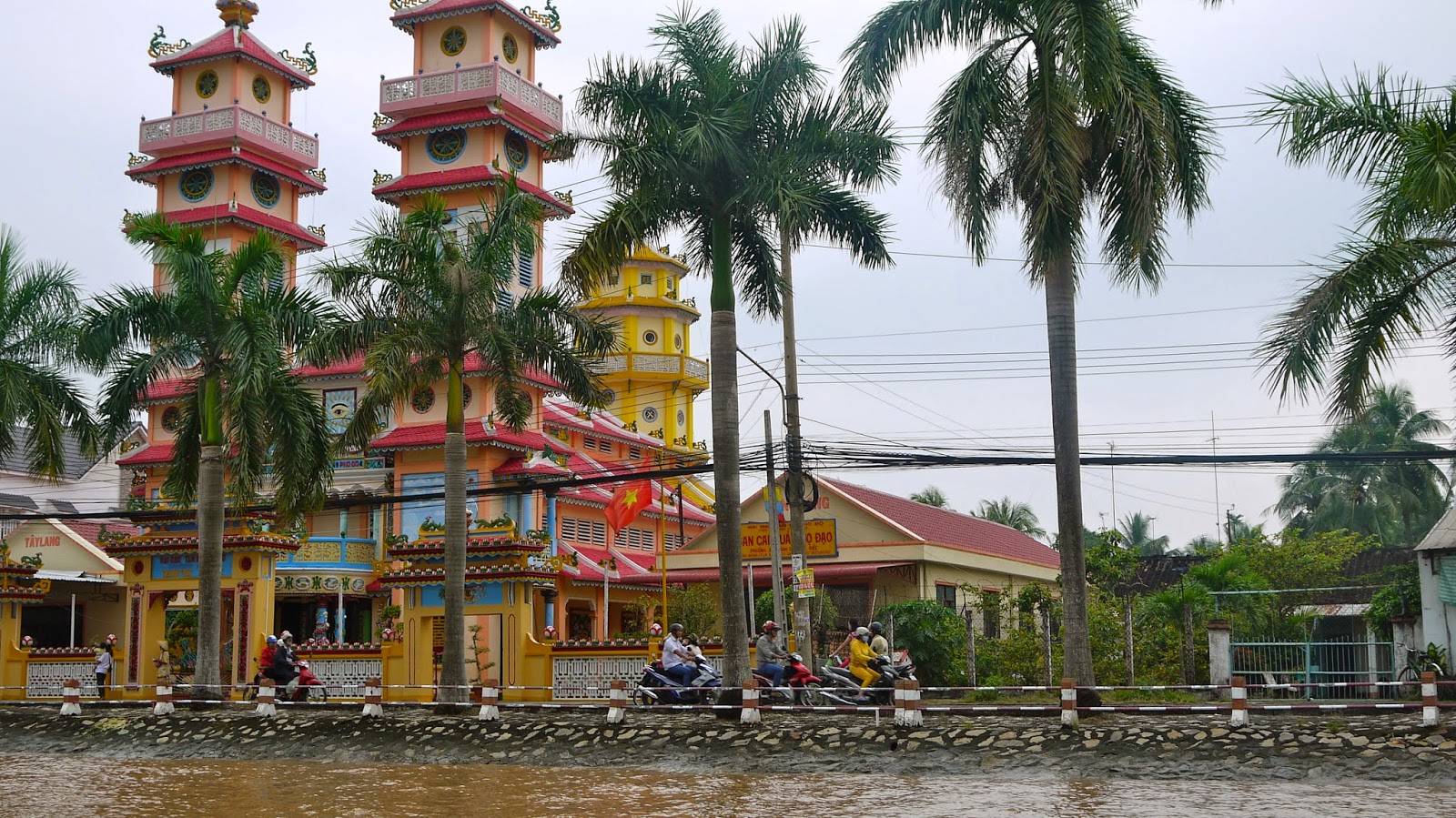
A delightfully many-denominational church or temple in Cai Be with symbolism from everywhere (Buddhist, Christian, Confucian, and perhaps others) along the Mekong


The inside is quite spectacular!
Stored next to the church/temple is a funeral compartment built upon a pickup truck–– talk about leaving in style!


We forget, too, that there was another war on the heels of the American War.  (I was unaware there had even been another war.)  In 1979 China launched an offensive against Vietnam in response to Vietnam’s invasion of Cambodia the year before.   That was the act that, thankfully, ended the rule of the Khmer Rouge. (Strange alliances:  the Khmer Rouge had once been supported by the US because they opposed the Viet Cong, but by 1978 the Khmer Rouge had the support of China, at the time our potential foe.)  In that short war––it lasted only a month––Vietnam lost another 16,000, according to our guide. 


Rice fields to the horizon.  The rice is about a week or so away from harvest.


We visited the site of Ho Chi Minh’s mausoleum.  But he was not there to be viewed—the body was off for its annual cosmetic repair.   Ho didn’t actually want his body to be preserved like Lenin’s, preferring to be cremated, his ashes placed in three jars to be scattered in three regions of a united Vietnam.   But that was not to be.  The country was not united until six years after his death––he died in 1969––following the final withdrawal of American troops.  The years following unification were rough economically, and the country began a slow march to some measure of prosperity only after the lifting of US sanctions in 1994. 


The market at Cai Be, a vision of plenty.


The wholesale vegetable section

Innumerable kinds of fish

Fruit on the right, frogs at the left

This elderly woman has been selling food here for many years

Selling in the market draws the whole family

Rats for dinner:  These are "country rats" that ate rice and whatever else, not city rats.
(Note:  Eating of dogs is not approved of.)

I felt that within a few more years the cities, and maybe even the countryside of Vietnam, would look a lot more prosperous.  After I got home I checked the labels of some of my clothes and was surprised how many read “Made in Vietnam.”  We saw several major construction projects that are being financed by Japan.  Korea recently built an immense Samsung complex outside Hanoi.  In the cities electric wires, strung thickly and haphazardly on city poles, attest to constantly increasing needs for power and make-do solutions.  Shops, like the most common housing all twelve feet wide, fill every conceivable niche.  Everyone seems to be an entrepreneur.   


A rice wine with, yes, snakes.  Cobra rice wine, in fact.  We actually drank some.

Making rice "popcorn" involves adding black sand, then sifting it out.  Later something sugary and sticky is added and it is rolled flat and patted into squares.


Workers in this rattan weaving workshop work 8 hours a day to earn $5 per day, and tend to work 7 days a week to make ends meet.  After, say, 10 years or more  of work they will still make $5 a day.  The room is very hot, incredibly noisy, and the equipment looks dangerous.


In Hanoi the bicycle rickshaws fight for space with scooters and cars.  In some pedicabs, rickshaws or tuk-tuks you are propelled from the rear, others from the front.  It can be unnerving to sit in front as half the scooters on the road look as if they’re coming at you from all directions, like so much incoming shrapnel.  In Saigon the rickshaws have already been replaced by even more scooters.**   The city is striving like mad to become the next boom city in Asia.  Its tallest building, the Bitexco, is a replica of Dubai’s Sailboat Hotel with its circular protruding helicopter pad at the top.  In Saigon, however, a helicopter has yet to land.


Saigon's new skyline with the Bitexco Tower, copy of a building in Dubai
The Saigon Post Office, designed by Gustave Eiffel (yes, that Eiffel)

As in Cambodia, people worry about the environment.  Dams on the Mekong are on the minds of many, and with the increase of industry, so is pollution.  The entire Mekong Delta area (hard by Saigon) and towns along upper parts of the river depend upon the river for food and for their livelihood––and for drinking water.  The Mekong in flood spreads to fertilize rice fields, as it does in Cambodia.  We were there at a time when the river was relatively low––the hoped-for flooding did not happen this year––but it was nevertheless brown with silt, carrying along islands of water hyacinth at a good clip.  In a month or so, we were told, it will even look blue. 

Small scale fishing traps near a village whose economy is based on fishing
Commerce along the Mekong; carrying sand that will likely be used for fill in construction


In beautiful Ha Long Bay near the border with China coastal development is moving fast.  There are new high rise hotels and a good many tourist “junks”*** that ply the waters.  We had a lovely kayak trip in the bay.  Since our guides were forgetful and not experienced kayakers––they couldn't seem to keep to a straight line––we had an especially interesting trip, longer than the other kayakers in our group.  (For one thing, our mother ship moved without our knowledge to another bay while we were on the water so we were lost for a time, and when we found our hapless guides they managed to lead a kayak they were towing into a situation that caused it to overturn, nearly drowning one passenger.)  Monkeys inhabit the miniature island mountains that offer little access to humans.  We visited a cave there as well, nothing like the enormous caves we've heard exist in the mountains of central Vietnam..


Ha Long Bay, with its limestone mountains, near the Chinese border

Ha Long Bay in the evening, with "junks" in the background


Vietnam sorely needs prosperity.  With the US and Vietnam now becoming fast friends, or at least good trading partners with parallel political motives (for instance, we support their assertion of rights against the Chinese push to claim ownership of the sea near Vietnam), and Vietnam appearing more and more in travel news (the NYTIMES featured "36 Hours in Hanoi on 11/1/14) the future looks pretty bright.   I certainly hope so.  We owe it to them.


                                            *****


*Joan Baez returned to the Metropole for the first time post-war this past spring, presenting the hotel a portrait of a young Vietnamese boy that now hangs in their lobby. 

**The proliferation of scooters, totally out of control, is the unfortunate result of a lack of government support and funding for public transportation at a crucial stage of the country’s development.  Now it’s too late for buses (they would only increase the traffic jams), but Saigon is at least beginning to build a subway system.  No saying how long that will take, but no one is optimistic.  Most of the women on scooters have arms, head and much of their faces covered;  the reason, according to a guide, is less pollution than keeping their skin from the sun.

***They are really only pretend junks, as the ships are quite large and comfortable with no actual need for sails.