Saturday, March 24, 2012

DOG DAYS


DOGS

It’s a good thing we love Rufus, our adopted beagle.  Very good, because he’s been costing us a small fortune.  He has already set a record as the most expensive dog we’ve ever had.  It’s kind of an erosive process.  It starts off with one obvious thing that needs specialist-type fixing (cataracts, in his case; he would bump into things, fix you with his clouded gaze), and before you know it, you’re off and running.  Treatments that carry warnings along the lines of  “in a few cases, there could be complications…” often don’t get my full attention.  Rufus, however, is in that small percentile of dogs in that category.  Removal of cataracts was not a straightforward issue.  Resulting eye issues, ongoing eye issues–including reactions to eye medication–led to more treatment. He’s now in recovery from both the latest specialty treatment (laser eye surgery) and his medications.  Our senior dog Harry, getting into the spirit of things, developed an eye problem last week–a minor one, happily–so he’s been getting eye drops as well.  We are developing close relationships with our vets.


DOG DAYS

View from the hammock


Like everywhere else in the Eastern half of the USA, we’ve had a few samples of the dog days of summer as well as the sweet days of spring.  Except for the fact that it was still mid-March when this happened, everyone found it hard to actually complain about the balmy weather.  The alternative, after all, is the rawness of mud season. 

It is weird, though, because everything seems to be happening at once and at full speed.  In March the grass began to green almost overnight, and then it started growing (are we going to have to mow the lawn in April?) and the weeds are sprouting as if it were summer.  Buds are opening.  The forsythia is in bloom.  Ducks have been visiting our pond in the mornings, a month earlier than last year.  The chorus of frogs in our pond is already creating a din.  Last year I commented on the frog sounds in mid-May.  Granted, they probably began chirping well before I wrote about it.  Still–mid-May? I picture creatures out there in a crazed rush to do what they have to do because spring already turned into summer and whatever happened to winter anyway?  Talk about living in fast forward!  Only two weeks ago we were skiing at Sugarbush in cold weather with good snow.  Maple sap was running then and we made syrup.  But the sap run was over shortly after it got going. We barely finished boiling a couple of barrels of sap when it got so warm the sap stopped running.  Maple season is officially over, and major producers say the season gave them 50% less than last year. 

The evaporating pan over a wood-fueled fire

Part of our sugaring crew (the next weekend we were fully staffed with Leah, Cliff and Olin)


DOGGED LAWMEN

Notes on our local law enforcers from the police blotter of our local paper:

“On March 6 at 4:24 AM responded to a call for help from a Chipman Hill resident who said her toilet was overflowing and her plumber was in the hospital.  When police arrived they found that the overflowing had stopped.”

“On March 6 at 5 PM responded to a caller who reported a barefoot man standing next to a white truck on Merchants Row, possibly parked in the handicap parking and with the truck radio playing loudly.  The man told the police officer that he was cooling his feet and would be leaving shortly.”

“On March 9 at 8:30 PM were called to a Middlebury home by a woman who said she heard footsteps downstairs and when she asked who was there, the footsteps stopped.  Officers went to the home and found it was the husband who had come home without telling his wife.”

(Of course there’s more going on than this; I’m not bothering to cite the more prosaic arrests for drugging, drinking or fighting or driving while drugging, drinking or fighting.)


Goodbye, old dog winter!
(Last bit of snow in the woods behind our house, just a few weeks ago.)

Saturday, March 3, 2012

I STILL CAN'T STAND QUEENS

As I was saying...  (see previous blog post)


About a year or so I came across a couple of pages of writing on a yellow legal pad, something I must have written in the late 1970's or 1980's while I was staying at my parents' house in Queens for a longer period than the usual weekend visit.  Don't remember why.  But I was going stir-crazy for sure.  That I remember.  


Here it is.

65-19 78th Street, after an outdoor clean-up, 1952


The sky is pink at night, a lurid color, hinting at some violence happening somewhere, not so far away.  I hear police cars heading east, south, west, every direction, just not down these particular streets.  Only chance, of course.  “Don’t go out at night,” he says.  “A woman down the street, she was attacked, and they took her purse.”  No saying exactly when this was, or how, or even why.  Maybe she’s the only one.  Maybe she’s one of thousands. Maybe rapists and muggers and killers with long knives are crouching behind the few pathetic bushes that pimple the tiny five by five plots of grass that reside redundantly before each nearly identical house.  Maybe.  I don’t really know.  It’s easier just to stop going out after dark.  Except to the mailbox or to the corner.  I kind of enjoy sort of sneaking out to the mailbox, defying danger, as it were.  All those hairy dark men won’t get me.  If they’re there.  Which I doubt.

But why push it.  There’s a black world out there–not just evil people, evil things–but the raw, unbuttoned grotesqueries of life itself.  Sloppy houses, dirt, unkempt people who are all right otherwise–you never know, give them a chance, right?  Things said and done that you wouldn’t believe.  Everyday.  Things to be afraid of.  All of them.  Yes, even nature.  Scrape, scrape scrape, each morning.  Neighbors raking leaves off chipped cement sidewalks.  What a mess.  Nature itself, so filthy, so disorderly.  Just a few miles away, the sea. True, one must travel miles of too narrow streets, traffic lights, turn onto tightly compressed highways onto other highways that all look the same, all built too long ago, under-maintained, rutted, with rusted dented railings that bear the marks of accidents, years of accidents, weedy shoulders on which reside the deserted wrecks of more recent disasters vandalized now–each day another tire gone, door hanging.  And beyond that, just another couple of miles–I know it’s out there–the sea breaks on the shore carrying the rumblings of water from far away to New York City which, to the sea, is just another place.  Here, this tiny part, is a complete universe.  The smallest one I’ve been in for a long while.

Keep it away, keep it away.  It must be that there are too many risks–could that be?–letting in the sea, all that unkempt life.  Is that it?  Risk of what?  I have talked with many people this week, and yet, with one exception, the world, the rest of it, has not entered this small universe.  Women in their sixties and seventies who can’t drive, never did.  While their husbands were alive they transported these women.  The women served their husbands, served good food I’ve no doubt, agreed with them or went along. (I‘m just guessing on the evidence, the ready simple phrases, the sighs, “Well, that’s just the way it was,” which passes for thought.)  Another phrase, about the world “What can you do?” No choice, you see.  One cannot hope to change anything, much less one’s own self.  Her husband and mother to care for, for nearly fifty years.  He worked, she cared for both.  In a tiny house–another in one of those endless rows.  Finally, finally, because it was a strain, they both died, and she was now free to roam the world (and she travels mightily, even to Russia, but it doesn’t show) and move to an even tinier place.  Big sigh.  Acceptance.  But wait.  She has a friend. (I hear this all from my mother.  Is the story screened at all, I wonder?)  Her friend, frail and old now, was building a boat, a goddamned cabin cruiser, in the basement of her tiny home.  Yes, really.  He began it years ago when he was in better health, and has had to let up when he grew too weak to lay wood, beautiful wood, carefully smoothed and sanded and fitted.  But surely here is a romance, a story of yearning and hope and desire and beauty.  That’s what I think, but that’s not how it is told.  He just stopped, you see, and now they have to get rid of it.  (Will it fit through the door?  Can it get to the sea?)  Maybe he built it out of instinct.  Maybe he had nothing better to do.  Like a weaver bird knitting its delicate nest–what else could it do?

The right thing to do, of course, is to have a nice house, something well kept up, you know, always dusted, always neat, good solid food, not too spicy (spicyness allows that unwashed world to enter), nothing extreme, muted colors are safest but bright ones would be all right if the house was really nice and the car large, comfortable (no stick shifts) and clean.  And the husband in a good job (doesn’t matter what kind, that won’t be discussed) and the wife (not me!) a good housewife, nothing extreme.  No job for the housewife, but if there is one, best it have a low profile.  Of course it won’t be discussed.  Except to say, “How’s it going?  Is it all right?”  “Yes, it’s all right.”  “Good, good.”

One can get by here with very few words. “Look at that.  They never clean it up.  Even in the winter.  The snow.  They don’t shovel.  It’s a mess.”  (Fall leaves cover a brief skirt of a yard, the sidewalk, a car.)  “Oh, look, it’s really beautiful today.  I wish it wouldn’t get cold.  Look at the color on the trees.”  (Eroded shades of dark red, an occasional yellow, mostly brownish trees–pollution-resistant oaks–lining the highway.)

Those aren’t the few words, just some that come to mind when I think about the sea, such a few short miles away…

The words to get by on have to do with food.  What shall we eat today, how should we make it, where to we need to buy it.  It’s bought European style, a bit here, a bit there, and takes an enormous amount of time.  It is the main event.  It doesn’t allow for other highly theoretical main events.  What could they be?  No time to see the ocean until at least perhaps Thursday of next week, if there’s no traffic, if the weather’s nice, if, if.  Keep away a possibly frightening search for other occupations.  (What else is there to do?  In such a city?) 

If there’s rain, close the windows, keep inside.  If snow, move it away.  Sun, stay in the shade.  Tick, tick, tick.

Don’t analyze.  No need to question.  Ask why?  Why?  Avoid unpleasantness.  “You know how it is.”  “That’s the way it is.”  “Well, what can you do.”  “That’s nice.”  “It’s not the way it used to be.”  “The politicians, they’re all the same.  What difference does it make?”  “Everybody’s lazy, they don’t care.”  “They’re only out for a buck.”  “People don’t keep things up like they used to.”  “Well, I don’t know.” 

Sigh.

Friday, March 2, 2012

SKATING WITHOUT SKATES, WALKING WITHOUT SNOWSHOES, CITY WITHOUT SNOW, & SAP RUNNING EARLY


This winter the fields looked more brown than white

Sometimes there's a dusting of snow


To be honest, we have seen some beautiful snow here.  Well, not precisely here, as in right here, but nearby, in the mountains.  On the first of March, for example, while the Champlain valley was experiencing mere flurries there was a virtual blizzard up at Rikerts at Middlebury’s Breadloaf campus where we had gone with Lesley to cross-country ski.  When we skied in the open it was pure Antarctica: howling winds and pelting snow, almost a whiteout. Once in the woods the snow turned turned gentle, most of the trails untracked powder.  Downhill skiing has had its great moments too.  It’s just that there have been too few of those days.


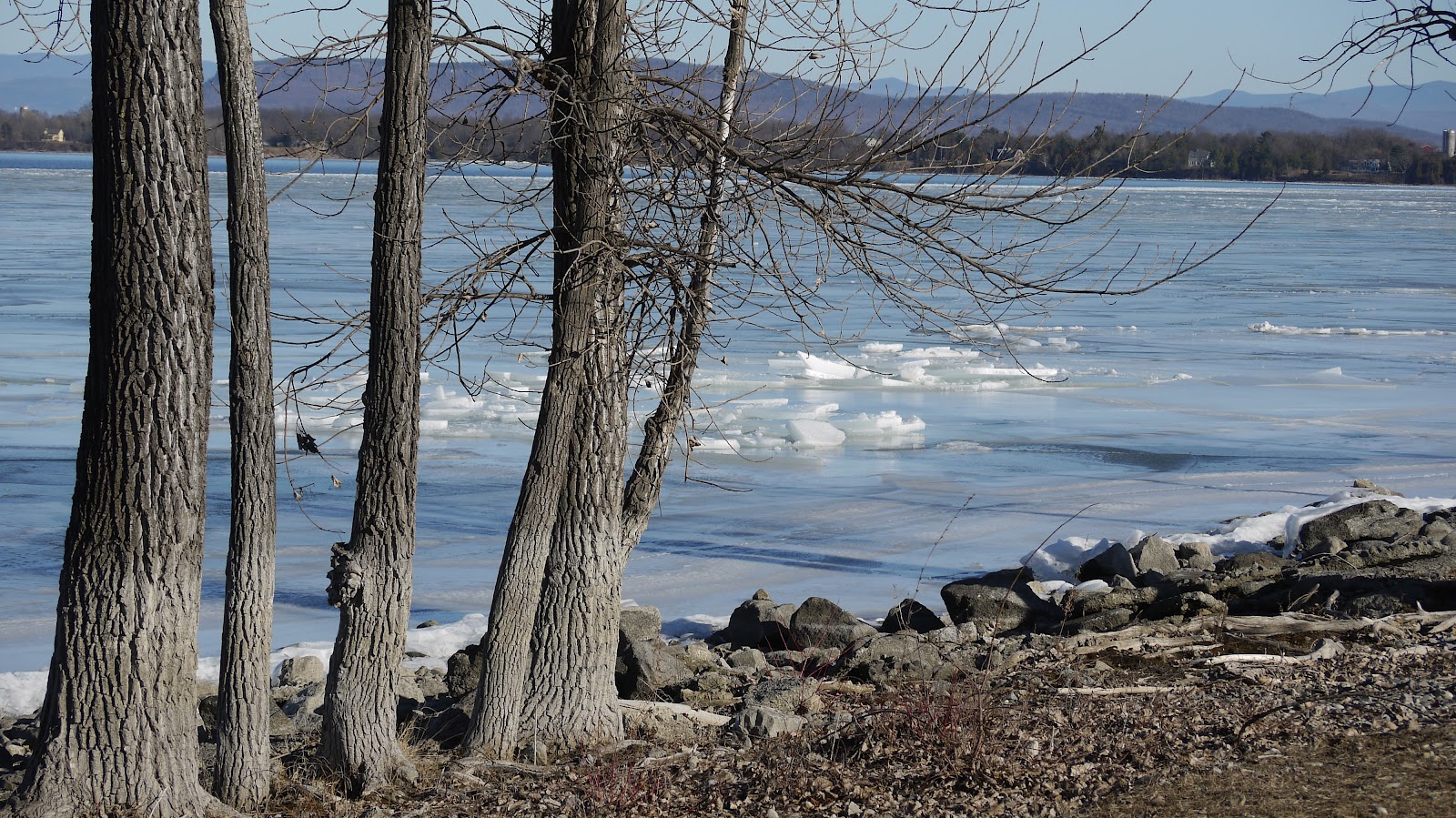
Having no snow to shovel or plow has its advantages.  Obviously.  The fields are easy to walk about in, especially with the dogs.  No drifts to push through, no need to get all toggled up.  For those who ice skate, this has been an excellent winter.  Even though it hasn’t been steadily below freezing the ice has been amazingly thick.  We have walked on ice just offshore on Lake Champlain, have seen people ice skating there, and heard talk of prime conditions on Dead Creek where you can reportedly skate for kilometers.  (A neighbor told us about how people who routinely skate on the Lake or Dead Creek carry a rope at each end of which a block of wood is attached with a stout protruding nail–if you fall through the ice you use the nails like ice picks to pull yourself out.)  


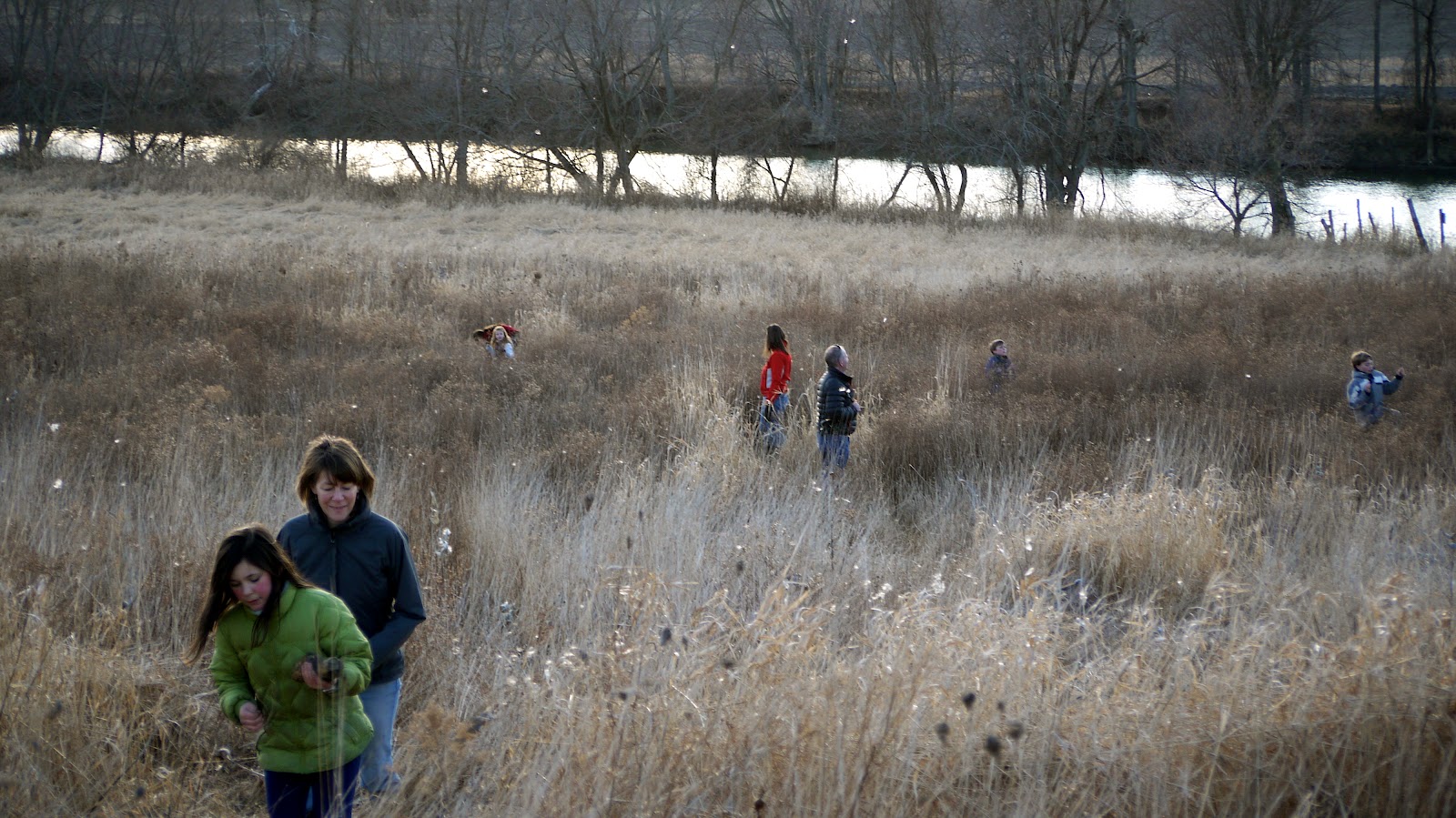
Our pond has been frozen since early winter.  The weekend of Ken’s 80th birthday (yes, hard to believe–80!) everyone here for the celebration took off for a hike across the road through the field to Otter Creek, starting off with a little pond sliding.  There were many styles of pond sliding as no one had ice skates.


It was the first time we’d walked all the way across the field to Otter Creek from our house.  When we look west its easy to imagine the Creek flowing just beyond the distant trees.  Not so.  It may be as much as a mile away.  The texture of the field is more complex than it looks.  There’s a rocky hillock (in Africa this would be called a koppie) right in the middle, and the smooth appearing field is really waves of rising and falling ground that appear flat only from a distance.


Pastures in warm winters like this one present complications to farmers, the kind of complications that are completely foreign to anyone who lives in the city or suburb.   Or are newcomers to the country, like us.  In our local paper I read that alfalfa depends on good snow cover to prevent its fragile root system from heaving out of the ground.  There are dangers for domestic animals too.  Wildly varying temperature swings can begin a causation chain than begins with barn ventilation.  Many barns are closed tightly in winter, limiting ventilation.  But when the temperature warms rapidly animals (mostly cows, I guess) can be exposed to respiratory pathogens.   Then there’s this:  “During the cold weather in a normal winter, intestinal parasites become encysted in the animals’ (horses this time) gut walls and are inactive.  Since weather has been warmer than normal, the parasites have not encysted and horses are paying the price with an increased number of colic cases, a potentially serious condition.”  Then there are the sheep and goats and new lambs (lambing season is approaching)–all endangered by parasites.  As if this wasn’t enough, “In adult cattle the winter has brought an increase in foot rot, caused by frozen uneven ground causing stress on the skin between the claws of the foot, allowing the organism, which lives in the soil and organic material around the farm, to cause disease—a challenge to treat on organic dairy farms.”  Severe winters undoubtedly have their own costs, but this sounds like the margins are really slim for a “good” winter.


The sap has been running early.  There’s some concern on the part of big time maple syrup producers as to quality this year.  Will the lack of snowpack mean less sugar in the syrup?  Will the varying temperatures affect production?  The weekend of Ken’s birthday with many hands available, our sugaring operation was set up for Year Two Syrup.  While we were in New York City one recent weekend we received this email from Chris, our de facto maple sap wrangler:


On the sugaring front, we reached critical mass on Thursday and had to do a boil Thursday night because the temps were dropping.  I got started around 6pm and the night ended at 1:30.  The evening was still and the stars brilliant.  I missed sharing the experience with you all, although the solitude was delicious.  At 11:30 a lone coyote howled for probably 10 minutes and he/she was in the field between your house and the Gallant’s.  Moments after the coyote stopped, an owl treated me to a guttural kind of hoot in the woods just to the east.  That was my first night boil and it was altogether different.  I did not have the endurance to finish all the sap; the last hour and a half was trying.  Interestingly, our trees were flowing more that your trees, I suspect because of the solar exposure.  I am guessing that our trees will also dry up sooner.  All said, about 6 quarts of excellent syrup.  Maple sugar is starting to run in my veins.

Two inches of snow here in the valley.

We read Chris’ email in a hotel room in New York–deliciously far from the scene he described.  It’s the contrast that’s the beauty part.  What better than to be in NYC (where we saw a photography show, a musical, a drama, an art exhibit, a concert, and ate Korean, Thai, Austrian, Israeli-Druse, and walked until our legs hurt) and know that at the same time our trees are making syrup to the music of the woods.  


When I grew up in New York I never felt as if I lived in the “real” America.  To me, New York was a separate world with different points of reference.  I remember a song from childhood that began, “Over the river and through the woods, to Grandmother’s house we go,” that was for me about another place entirely, a place I’d rather be.  In Queens there were no woods, no river (I didn’t count the East River or the Hudson) and there was no grandmother’s house (grandmother and everyone else lived in apartments or attached houses, and they didn’t count either).  Now I can like New York.  The buildings.  The streets.  The people.  All of it.  Wait, let me qualify that.  I still can’t stand Queens.

Friday, February 10, 2012

OF MEAT AND MINES


Houses in Port Henry, NY


The Police Blotter in our local newspaper, February 2:

”Received a complaint from a North Street resident about a suspicious white male in his 40’s.  The man apparently asked the resident if he wanted to purchase some steak or chicken.  The resident told the police he had a friend who encountered a similar incident, and the salesman later broke into his friend’s house.  The suspicious man’s black Toyota pickup truck had New York plates, two freezers in the back, and a sticker that read “Prime.”  There were no further complaints related to such activity.”

This is a story that belongs to this part of the country in several ways. First of all, there’s the issue of meat. 

You might well ask:  What’s the likelihood of someone knocking on your door and asking if you want to buy meat?  Stolen meat?  Poached meat?  Who would buy meat without knowing where it came from, anyway?  No, I don’t think anyone is going to knock on our door anytime soon looking to sell meat. However, up here buying meat from people or places that are not actual meat markets is not unusual.  After all, people who shoot deer may end up with some two hundred pounds of venison.  And people who raise animals for their meat sometimes end up with more than they need.  At the end of this month, for example, we will be buying half a pig (the other half going to my daughter’s family in Newburyport) from someone who will have more pork on his hands than he needs after having several pigs slaughtered.  There’s meat for sale all over the place at different times of the year, grass-fed, organic, or not.

So much for meat.

Looking back toward Vermont from the New York side, Port Henry

More interesting is the fact that the suspicious man’s black pickup truck had New York plates.  Maybe mention of the New York plates was inadvertent. In any case, some Vermonters have a thing about New York State, or at least the part that’s directly across Lake Champlain.  I heard a story, possibly apocryphal, about someone from Vermont, I think it was an ice fisherman, who left his pickup on the Lake overnight, quite near the New York side.  Too near, I guess.  Next day, the pickup was on blocks, all the tires gone.  If he’d parked it on the Vermont side, you see, this wouldn’t have happened.  So they say.

The New York side of the Lake is noticeably different from the Vermont side.  At least one town immediately across Lake Champlain–I’m thinking of Essex, for example, at the New York end of the Charlotte, Vermont, ferry–has that old New England character with quaint buildings, an interesting store, an art gallery, an ice cream shop, a small restaurant, nice homes, all with good paint jobs.  If you traveled no further you might imagine the road ahead would lead to much the same.  This is, after all, the home of the famed high peaks that loom just behind the foothills that begin right at the shoreline.  But it doesn’t.  Just as the Adirondack mountains are wilder and rougher than the Green Mountains, more woods than meadows, less farmed than mined, the town also are rougher and more unkempt.  

On this side of the lake the mountains seem to press aggressively into some of the houses.


In the Adirondacks, but these are not actual mountains.  They are mine tailings near Moriah.
It’s mostly about mining.

Mining operations began in 1824 with the discovery of a top grade of iron ore in the mountains around the New York town of Moriah.  A lode called the Cheever bed, located some 1 to 1-1/2 miles north of Port Henry, is the oldest, although there are other, mostly smaller ones. In Moriah's earliest days settlers would go to the mine, pile the iron onto sleds and drag them back to town, according to Wikipedia.  The Cheever bed began to be worked more seriously in 1853, along with the other smaller beds. An economic boom was set in motion.  Along with mining companies came the railroad to bring the ore from the towns of Mineville and Witherbee to the main line at Port Henry, eventually turning that port into a busy transport terminal for the railroad and lake barges. An aggregate of 230,000 tons was produced from the ore beds in 1868, presumably the heyday of iron mining.

The local economies of towns like Moriah, Port Henry, and the uninspiringly named Mineville boomed for as long as the mining operations lasted.  But that wasn’t long enough.  In the early 1970’s when huge open pit mines were developed out west, the mining industry in New York State went bust. Now the towns look worn out and tired, with more closed storefronts than open ones. This probably has little to do with the recession of recent years; this downward slide looks as if it’s been going on for decades. 

Several of the large companies that operated the mines left their marks in the local architecture. The company headquarters of Witherbee, Sherman now serves as the Moriah/Port Henry town offices. 


The amazing building that was once a mine company headquarters; now town offices.


Once grand but now decayed Victorian-era buildings beg for rehabilitation. Streets are still filled with company houses, many of which were built with blocks made from iron ore tailings.  Sadly there are no signs of the charms that animate Essex. 


This Moriah town park has it all: directional sign to "Moriah Shock," gas or electrical meter, a digital clock, a gazebo and who knows what else, dedicated to a Medal of Honor winner.


Someone may be trying to save this house in Port Henry.


Rexall drugstores went out of business in the late 1970's.


Perhaps all is not lost:  In 2011 Port Henry was the port where sections of the stunning new Champlain bridge were assembled and towed to its site.  And the area has one noticeable industry: not far from town is the New York State Shock Incarceration Correctional Facility.  Housed, fittingly, in former mine buildings in a remote area north of Mineville. Which is itself remote.

Thursday, February 2, 2012

SNOW AND ICE AND DOGS


Gazing west to the Adirondacks I could be convinced this is the heart of winter.  The mountaintops have been white since December.  But there's no telling how deep the snow is.  The Vermont mountains to the east of us have no cover, thin cover, or half-way decent cover at the highest elevations.  Ski areas have been suffering, as has the Vermont economy that depends upon ski tourism.  Most of us have been skeptical of ski reports, not expecting much, given this strange cycle of cold followed by warmth, without a single serious snowstorm.  We see the words "frozen granular" and figure it's time for spring skiing.  ("Granular" being ski slope-speak for half-melted soggy and/or icy stuff, permissible in late March or April.)


In the valley winter has been looking more like this:


Enough snow to last maybe a day or so, then back to bare ground.


Fifteen or so miles away things can be very different.  Monday, the 30th of January was one of those days when things were unexpectedly and spectacularly different.  It was cold here in the valley although just under freezing and the ground was completely bare.  There was a mild wind.  The night before we had our usual 1-2 inch dusting of snow. It was time to give Sugarbush a try.  As we drove there we began to notice snow cover beginning above the town of Bristol, altitude 570 feet.  (Vergennes is at 194.) By the time we crested Appalachian Gap at 2375 feet ("App Gap" in local lingo) on Route 17 the snow was a respectable 2 feet or so, a fierce wind building drifts.  On the other side of the Gap the Mad River Valley ski area was operating and the slopes looked good.  When we got to Sugarbush we could hardly believe our luck.  There was powder skiing on a packed powder base, a wintry wind swirling with fresh snow, and few other skiers.  Better yet, all the snow boarders were in school!


Other results of this not-quite-winter weather have included a lot of ice, like the ice shapes on our pond:


And sometimes the ice has covered the driveway, like this (claw marks in the foreground are the result of braking with studded snow tires):


Meanwhile, here by the fire


...are Rufus and Harry.  Rufus just had his vision restored (double cataracts removed) and will be recuperating for the next two weeks wearing a collar to protect his newly repaired eyes. He's not pleased with the collar, bumping into things, getting stuck, but his world has brightened and a playful and contented personality is blossoming.


Going where their noses lead, as Rufus will again once his eyes have healed.


Tuesday, January 10, 2012

THE SKY ABOVE, THE DOGS BELOW


The sky tossed us a freaky snowstorm (twelve inches!) the day before Thanksgiving, but within the week all the snow that fell had completely disappeared.  Since Christmas, or as far back as the first official days of winter, we haven’t experienced serious winter weather.  I mean the real thing, winter the way it’s expected to be in Vermont, the way everyone imagines it–stormy, snowy, cold.  We are certainly ready.  We look at the cloudy skies–and they have been cloudy a lot– with hope: we have cross-country skis, downhill skis, snowshoes, our tractor is outfitted with a huge snow blower and chains, and snow shovels are at the ready aside the front door. But, alas, we have only had dustings of snow strewn like confectionary sugar that are either blown away or melted by the next day.  Our pond is in a pattern of freeze, thaw and refreeze.  (Interestingly, the water that was so muddy in summer is now clear.) We managed a taste of downhill skiing one day last week in pretty good conditions, although trail choices were very limited and cross-country was out of the question.  We find ourselves looking more to the beauty of our dark storm-less clouds and our magenta and ochre sunsets than our drab snowless landscape.


Two dogs live here now.  A few days before Christmas we added Rufus, an eight-year-old beagle from the Addison County Humane Society, to the household.  There were three beagles there at the time, a two-year old, a middle-aged guy, and an older guy.  The young beagle was insanely excitable, the middle-aged one walked all over Harry and pulled on his leash like the dickens, but the older guy was “just right.”  At the shelter he bore the uninspiring name of “Bud.”  Since he was said to have been a stray in Panton with no additional back story, we figured “Bud” was just a throw-away “hey, bud” kind of name.  So we renamed him Rufus.  Rufus been a fast learner of “Rufus,” since he surely thinks it means some kind of food.


Tiered seating, Rufus below, Harry above

Beagleness is a state we didn’t know much about, but we’re learning.  An acute and sensitive nose is what being a beagle is about.  Smelling is more important than seeing, luckily for Rufus whose eyesight needs some improvement.  (A trip to a canine ophthalmologist is on the schedule.) Beagles also come supplied with a tremendous howl.  Fortunately for us Rufus doesn’t feel the need to say very much in this loud voice (we’ve only heard it at full volume once, briefly, at the vet’s).  He’s considerate of Harry, obedient, friendly, and low key.  Age is a factor.  Although Christmas was spent with a large crowd in Newburyport, preceded by a long car trip, Rufus took everything in stride even though it was only our third day together.

Audrey with Rufus and Harry on Rufus' first day


Sunday, December 18, 2011

AFRICA, STILL ON MY MIND...


Hippos, a major danger to humans in Africa, in the Zambezi River.
(Also the subject of this year's Christmas card.)


A few weeks after returning from Africa the distance from there to here seems to be growing, as if I’m looking at Africa through the wrong end of a telescope.  Vermont is so benign, Africa not.  Here I can walk in the fields and forest (“the bush”) and I won’t be eaten, I can walk at night and I won’t be robbed, and our mosquitoes won’t give me malaria. In Johannesburg–where you don’t walk anywhere at night because you could be mugged–I picked up a memoir written by Peter Godwin called “Mukiwa: A White Boy in Africa” to read it on the plane.  (Godwin has written incisively about the sordid regime of Zimbabwe’s Robert Mugabe in “When A Crocodile Eats the Sun,” and told of far worse in “Fear.”)  What struck me in “Mukiwa” were the ordinary dangers in everyday life–forget wars, failures of the state, or haphazard medical care.  I’m thinking of his tale of the cobra that lived under the front porch steps for years after he bit the family dog, blinding him for life.  Or you can read the stories of Alexandra Fuller who grew up in Zambia.  Her “Don’t Lets Go to the Dogs Tonight” is replete with childhood perils, to which add: land mines.

"Oooh, I wonder what's under that bush?  Why don't we have a look!"
"Oops, I think those are lions!"


Recently I read “The Magnetic North” by Sara Wheeler in which she mentioned a guy from Togo, one Tete-Michel Kpomassie, who made his way from Africa to the Arctic over an eight-year period early in the 1960’s.   I enjoyed reading that he fled Togo to avoid a ritual involving a python, and, deciding he would go as far away as he could from pythons and anything like them, headed for python-free Greenland where he lived for several years with the Inuit, eventually producing a book called “An African in Greenland.”

"And here's an unusual looking doggie..."
Here in benign Vermont we have bears, but not the dangerous kind. Last March we only saw the partial remains by our creek of one that had been shot.  We have our New England version of impala–deer–but we haven’t seen any at all since a single doe crossed our field months ago.  The one moose we could count was the one spotted last spring near downtown Vergennes.  Nearly every night we can hear an owl in the woods behind our house.  (Our resident heron is long gone.) And that’s about all I can say for our wildlife count.  (In Africa we filled a notebook with the types of animals we saw!)

In Chobe it was possible to capture all at once (from left to right)
one beautiful, tho' unknown, bird, a fish eagle, a warthog, and impala. 


Hunters out for deer this year report far fewer kills (600+ versus 900+ last year in Addison County) and far fewer deer seen than in the past several years.  The reasons for this aren’t clear, but lower numbers have been attributed to the epic snowstorm at the end of last winter (the snow that came the day before we moved, just for the record), and also to the lateness of the rut.  When bucks are in rut they have only one thing on their minds and are easier to hunt.  Snow geese that migrate along a nearby corridor are usually gone by November, but this year there were still some on the ground as late as Thanksgiving.  It was the warmest November in many years.  

When we were in Victoria Falls several local people commented on the weather, how hot it was for so early in the season.  In Botswana there were comments about the lateness of the wet–and cooler–season.  Usually it starts in the early days of November, but we were there in mid-November and it was hot and dry.   It’s not a stretch to link this to global warming.  An article in the New York Times on December 5, on page four, mind you, noted:

“Global emissions of carbon dioxide from fossil-fuel burning jumped by the largest amount on record last year, rose 5.9 percent in 2010, the increase, a half billion extra tons of carbon pumped into the air making the largest absolute jump in any year since the Industrial Revolution and the largest percent increase since 2003.  This solidified a trend of ever rising emissions that scientists fear will make it difficult if not impossible to forestall severe climate change in coming decades.”