Monday, May 23, 2016

THE RAIN IN SPAIN


RAIN IN SPAIN


The entrance door to 16 Calle Aguilas.
The sidewalk is a foot and a half wide.


From the roof of my friend Bonnie’s palacio (actually, she has an apartment within a palacio) on the Calle Aguilas we could look over all of central Seville (Sevilla).  The sky was heavy with clouds.  It hadn’t rained since we arrived that midday, but the odds for taking along umbrellas when we walked in the city later seemed pretty high. Rain was to play around with us for much of the week. 


 Heavy clouds over Seville, from the roof of 16 Calle Aguilas.

Beautiful spaces like this palacio–marble columns and floors, a fountain in the atrium and plenty of ornamental grillwork–are sights usually only glimpsed when someone happens to emerge through a tiny one-person-at-a-time door (think pet door for humans) onto a foot and a half of sidewalk.  The small door is part of an immense twenty-foot or so double door, big enough to have once admitted vast companies of one thing or another.  On the roofs of these places there can be surprises, like a spiral staircase to the uppermost roof garden and perhaps a swimming pool as we saw at Bonnie’s.


Looking in from the entrance


The living room of Bonnie's apartment

One of the streets in the labyrinth that is old Seville


On what I think was our first (rainy) day we visited the Infanta Louisa, a private hospital.  Not sightseeing, alas, but to get some meds for an incipient urinary tract infection Ken was developing.  A TV monitor in the filled small waiting area showed the numbers waiting patients were assigned.  The loudspeaker called out numbers, and finally ours–ciento cincuenta y nueve!––a reception that brought to mind my last visit to the motor vehicle bureau.  We met with a young Cuban doctor who spoke a bit of English (although Bonnie was our translator), picked up a prescription, paid with a credit card and left.

In a day or two Ken was feeling better.


Easter week processions were mostly over, but for the procession of this particular group.
The "float" is moved by men underneath the cloth who carry it on the back of their necks. Small rectangular
openings in the front allow them to see (barely) where they are going.  The float is heavy.

On another rainy day shortly thereafter–a no kidding around rain this time–it seemed a good day to visit a particularly beautiful medieval convent, the convent of Santa Paula inhabited by cloistered Jerónimas nuns (followers of St. Jerome).  It dates from 1475, the current facade from 1503.  Like many other such ancient buildings in Sevilla, it combines several styles:   Mudéjar (Andalusian muslim), Gothic and Renaissance, the chapel altarpiece a baroque creation of 1730.  It is chock full of art:  paintings, decorative and sacred objects, and–oddly, to me–a goodly number of dioramas created by nuns in the 17th and 18th centuries.  These must have taken ages to build, but obviously time was something they had in abundance.


Behind bars: the interior courtyard of Santa Paula


Inside one of the rooms in Santa Paula

John the Baptist head (sculpture or ceramic?)


One of the nuns' 18th century dioramas.  This was the largest.


Detail from the above diorama

Earlier we had stopped in at another cloistered convent a few doors down the Calle Aguilas where the nuns sell sweets that they make themselves to raise money.  It seems such an odd transaction in the present day, finding pastries on shelves behind an old iron grill, pulling a chain to summon help, and then seeing a small friendly person in full habit emerge to take the cookies you select, collect the cash, and retreat out of sight.  Many convents like this one have fallen on hard times with fewer young women–certainly fewer of those with means–wanting to become nuns, much less cloistered nuns.  I was stuck by the short stature of every nun we came across compared with women in the general public.  It was my guess that they had once been members of very poor rural families and perhaps undernourished as children.

Selling sweets in a cloistered convent


DOING THE MACARENA


Ken, one-time altar boy, lapsed Catholic, self-declared atheist, doesn’t react well to heavy religiosity.  Every time I pointed out some little scene in one of the convent dioramas he murmured something like “uh” and gave only a cursory look.  Then he leaned a against a table and said “I need to sit down.”   There was a bench near the entrance, about the only thing I saw that someone could sit on.  Surrounded by several visitors on their way out and the nun who was showing us around, Ken passed out cold.

Ken contemplating an altarpiece moments before he collapsed


A man who appeared from nowhere felt for his pulse.  He gave us a concerned look.  The nun was in tears.  An ambulance was called.  A long minute passed.  It was frightening.  Then Ken came around.  The ambulance arrived.  First rule of Spanish emergency care:  only one person in the ambulance.  Better, we agreed, to have someone with Ken who spoke Spanish, so Bonnie went along and I followed later in a taxi.  The nun said she would pray for us. 


The nun in charge of showing guests around.  She is talking with Bonnie
minutes before Ken collapsed

Ken, Bonnie, and I reunited in the huge emergency waiting area of the Macarena hospital.  As a hospital connected with the Seville medical school, it seemed like a sound choice. I found Ken lying on a gurney, and feeling relatively chipper.  He had not yet been seen by anyone.  We quickly realized that here, instead of the nurse/doctor/aide/whomever visiting the patient, the patient on the gurney visits the room of the nurse/doctor/aide/whomever.  In other words, you sit in the waiting room next to your patient’s gurney.  The patient’s name is announced on the public address system along with the room number you need to visit.  You meet with someone in one room, return to the waiting area, then wait for the patient’s name to be called again and move to another room.  These announcements were constant.  Signs on the wall urged silence and tranquility–no yapping on cell phones–but given the constant announcements and orderlies rushing around and occasionally yelling, it was anything but tranquil.  The atmosphere felt so much like an airport lounge I half expected to hear flight announcements.  We waited.  


Ken at the Macarena, on his gurney, looking pretty good

We wheeled Ken into room 9 (a tiny office space with desk, a couple of chairs and barely room for the gurney) where we were asked a few questions, some irrelevant, by two people, one of whom was a doctor, although we weren’t sure which one. We described how he had fainted.  There was a half-hearted question about medications that I only half answered.  We mentioned he had colorectal cancer. No questions concerned his overall health, and so far no one had taken his temperature or checked his vital signs, usually the first order of business.  Back to the waiting room, gurney in tow.  I don’t remember how many consulting rooms we visited, but I know we went into room 9 twice.  Then, finally, some sort of decision had apparently been made by someone (no idea who) that Ken be admitted for observation, as he was moved to observation room 2.  Hours had gone by.

The door to room 2 was impenetrable.  No window.  The door was posted “Authorized Personnel Only.”  Time went by.  We stood outside room 2.   We waited.  And waited.  What were they doing in there?  Is there something dangerous going on that you have to be authorized?  There was no place to sit.  No doctor came to talk with us.  Who was the doctor anyway?   Ken probably had no idea where we were either.

Did I mention that the day we left for Spain Ken couldn’t find his wallet?  We had done a frantic house and pants pockets search but came up empty.*  Ultimately we left without his wallet.  Here in the Macarena he might as well have been a homeless person, a man without a country:  no identification, no home address, no money, no credit cards,  no hearing to speak of and no Spanish.  Plus a faulty memory.   I had to let Ken know I was nearby.  i decided to do the forbidden, and opened the door.  (“No one allowed…”)  Ken was there, resting on his gurney, and two orderlies (doctors? nurses?) were sitting next to him, chatting.  Other than that, nothing whatever was happening.   We learned they were simply waiting for word to move Ken to another bed.  We told Ken we had to leave but that we would be back that night.

Ken’s faulty memory is probably the reason the doctor we saw when we arrived that night for visiting hours (I should say visiting minutes, 15 precisely that we almost missed entirely as we were late) thought Ken had hit his head “because he had amnesia.”  Amnesia?  Bonnie suggested the doctor read the damn chart.  The head injury theory might explain why they did a brain scan on top of the EKG, the blood test, the urine test, the x-ray and whatever else.  (Please, I thought, let this cost less than $5,000!)

The next morning Bonnie and I prepared for our 1 o’clock visiting minutes.  Then at 11 o’clock we got a phone call:  “Come immediately, the doctor needs to talk to you!” 

Oh my God.

No problem!  You see, the doctor is only available to speak to patients’ families at 11!  There was no emergency. The doctor, a personage we hadn’t seen before, wanted only to explain to us the test results. Nothing of significance seemed to have been unearthed.  (He didn’t mention Ken’s underlying cancer. Maybe he didn’t know about it?)  In fact, Ken was to be released.  The doctor gave us copies of all the test results and we were free to go. He handed me three low-dose aspirin with solemn instructions to have Ken take these at mealtimes.  (I still wondered:  why did he faint? Had I missed something?)  We ushered Ken into a wheelchair and pushed him to a spot near the front door while Bonnie went off into the nether reaches of the hospital to locate the bill.

After some time Bonnie reappeared with a hospital financial person in tow.  The good news:  the bill was an amazingly low $450.  The bad news: it had to paid right away, in cash.  In my wallet I had only 200 euros.  The financial person, who spoke no English, was to accompany me to the bank across the boulevard so that I could withdraw cash and pay the hospital so that we could take Ken home.  (Reminds you of a scam, doesn't it?)  It was, once again, pouring some serious rain.  Huddling under umbrellas, we crossed the boulevard and walked to the bank, Bonnie coming along to translate.  At the bank ATM my credit card was immediately declined.  (What could happen in a week?  Why should I have bothered to notify the credit card company I was going to Spain?)  We tried it at the bank next door, me and the finance lady.  Declined.  The atmosphere was getting tense.  I was convinced she thought I intended to defraud the hospital.  Or possibly she was thinking she would lose her job if she didn’t get the hospital’s money.  Out into the rain again and back to bank number one.  (I’m thinking about Ken, without identification or ability to communicate in Spanish, waiting alone across the street, abandoned…)  I thought, well, I’ll use my bank debit card.  No problem.  Call me peculiar, but it happens I remember my debit PIN in two ways:  my finger placement on the keypad and by 4 letters (not numbers).  All the keypads I use are arranged 1, 2, 3, first row, 4, 5, 6, second row, etc.  Not this one.  The first row was 1, 4, 7, the second 2 ,5, 8.  My fingers froze.  I could not remember, figure out, or type the password.  In fact I couldn’t even think.  One more try and the ATM would lock up my card.  (I’ve got to do this because I have to ransom Ken, waiting all alone back there in the Macarena!)  At the critical moment I didn’t have the sense to look to look at the keypad of my iPhone that would have revealed the letters that go with the numbers of my PIN.  The keypad locked up.  The financial lady's patience was at a complete end, and she finally concluded (as Bonnie translated) that we could take Ken home as long as I swore to wire the money as soon as we got home.**  I swore. 

We rescued Ken from the Macarena entrance, taxied back to Bonnie’s palacio, had some wine, and went to a flamenco show that night, all three of us. 


Flamenco dresses and other traditional dress are sold everywhere. Seville has strong
cultural traditions.  Families get together for days of dancing, horse riding, and feasting.


With one of Bonnie's friends in the Plaza Alfalfa, after the Maracarena

No more convents for Ken!


AFTER THE RAIN


The weather in Seville the week we were there–intermittent sunshine and rain showers with occasional downpours–mirrored our own experiences.  Awful times, crazy times, usually accompanied by rain, were thankfully more or less equaled by good times and sunshine, at least when it mattered. 


One of the many really neat bars on our street
Another nice little nearby bar
They compost in Seville!


While Ken was in the hospital Bonnie and I hung out in the Bar Alfalfa (on Calle Aguilas, where just about everything was located) for wifi. ("Weefee" in Seville.)  We visited the Palacio Pilatos on the same street but in the opposite direction.  This Palacio is also a mixture of Mudéjar and Renaissance architecture, dating primarily from the 16th century.  It’s forms are graceful, its gardens lovely.  I went there a second time later on with Ken.  It was a preview on a smaller scale of the magnificent Alcázar that I was able to see one sunny morning.

The interior facade of the Palacio Pilatos


The upper floor is furnished for family members of the original nobility if/when they visit


Gardens of the Palacio Pilatos


A World Heritage Site, the Alcázar is said to be the most beautiful palace in Spain and one of the most outstanding examples of mudéjar architecture.   It’s located at one of the loveliest plazas in Seville, near the enormous cathedral and the Archive of the Indies, the home of the documents of the earliest Spanish conquistadors and explorers.

The Archives, the cathedral, the Alcázar are all on this fabulous plaza


A small part of the enormous cathedral


Inside the Archive of the Indies

The Arab Almohad Caliphate that originated in Morocco expanded to southern Spain in 1172 and it was around this time that the Alcázar was begun.  Rulers over the centuries added, built over, and rebuilt many sections of the palace throughout the Middle Ages, the Renaissance, right up to the 19th  century.   It is impressively preserved.  The harmony of architecture and gardens is exquisite.   It was the splendor of these extensive gardens that I especially wanted to see.  


They were built not just to supply food for the residents of the palace (there are orange trees heavy with fruit) but clearly for aesthetic reasons.  Water is everywhere in the form of little channels, jets, ponds and pools.  It’s hard to capture the beauty in mere words.  You need to hear the sounds of water, smell the scents of the flowers, hear the peacocks, and feel the sun.  It is a sensory experience. 


The baths at the Alcazar; a cool rainwater channel just below the garden level


NOT THE ALCAZAR:  A modern sweeping thing (known locally as the mushroom) in the old city.


LESSONS LEARNED


How to make Tinto Verrano (summer wine):  Take half a cup of red wine and mix with half a cup of lemon or lime soda, pour over ice, and toss in a half lemon slice. Very popular.

Tapas are terrific.  Make a meal of tapa, wine and dessert and at current prices it might set you back $10, maybe more, maybe less.  Go big and it could be $25.

Remember your damn PINs.


*Later found.  In a pants pocket we hadn’t checked.

**After I came to my senses about the password, Bonnie wisely suggested we deposit the money for the bill in a branch of the same bank the hospital uses, only this bank was right down the street.  And that, after an hour of further Kafkaesque hassles––"the bank can only deposit the money if you are a member of the Spanish health system; but we need to deposit the money because we are not members of the Spanish health system, etc., etc"––is what we did.


Saturday, April 9, 2016

PIGGING OUT


A drift of piglets squeezing together.  When they are bigger they become a drove of pigs.


It has been a couple of years since I first literally met what I would later eat. 

Some five or six years ago Ken’s son bought and raised two pigs over in Starksboro, up in the mountains around Bristol.  The meat was divided up with other family members.  I thought raising your own meat was a great idea, the notion of eating meat you know was raised organically with contented animals, plus the ready selection of bacon, sausage, pork chops, ham and such right there in your own freezer.  We visited the pigs only occasionally–this was before we moved up here­–so no warm feelings got attached.  I remember thinking an appropriate name for one of the pigs would be Hamlette (pun intended).  So you can see I was already focused on the end product.

The last time I saw those two pigs they were no longer small and cute.  They had grown chubby and had, by this time, several months later, made a mess of their pen.  Bill had fenced in a large area, maybe thirty feet square, partly in the sun, partly in the shade, built them a covered shed with bedding, and provided them with a water trough: a kiddy pool, big enough to wade in.  Which they did.  Originally grassy, the turf was soon excavated to dirt and, frequently, mud. (I know, they love mud.)  Eventually there wasn’t a blade of grass remaining.  What ended all thought of cuteness for me was the day I watched both pigs walk willy-nilly into their food trough, churning in the mud from their hooves, and then–this really did it for me–peeing into their food.

It was a pigsty.

About a year ago friends of my daughter’s had an extra pig that was to be slaughtered.*  That was the first time we ourselves bought into a pig, getting half of everything:  a shoulder, ham, a bunch of pork chops, ribs, sausage and packages of bacon and what-not.  Major parts come labeled, others not.  The "what-not" can present some problems.  The primary question being, What the heck is it?  The bacon gets smoked by the people who run the abattoir. Speaking of abattoirs, what’s almost creepy is the fact that you have to plan for the pigs’ demise the day you pick up the piglets six months later.  They grow to full size those six month, from spring to October.  Genetically engineered, obviously, without the GMO hullabaloo.

This is a young pig at Agricola Farm of a variety that will doubtless be large.  


I recently visited some pigs at Agricola in the town of Panton (see my blog post “Eating Local in Locavoria,” April 29, 2015) where a goodly number of pigs live, large and small all bound for some delectable Italian dishes served at one of their farm dinners.  We were there this time not for dinner or even meat, but to pick up home-made ravioli.  (Alas, these were a disappointment.)  For the most part the pigs are what I would call big-time pigs, destined for meat markets or restaurants.  The pigs we will have half of (picture half-pigs running around!) are a smaller variety.


This year we are again going to possess a pig, half the meat for the Hustons, half for us, come October.  At present, they are merely two piglets residing at the Smiley farm.  They are hybrids of no particular variety.  Their names are Fiona and Lydia.  Although they looked terribly cute in their photo, in person, so to speak,  I can’t say they were even cuter.  Take puppies, for example. All puppies in photos are adorable, but when you actually meet them they are immeasurably cuter.  Right away you want to take that puppy home and cuddle it.  I didn’t want to take the piggy home and cuddle it.  Maybe it’s just me.


Lydia and Fiona.  Or is it Fiona and Lydia?


They are being kept in the barn for now because it has been too cold outside.
One likes being touched, the other shies away


Pig number two (everyone raising pigs raises at least two) is a necessity for the health and wellbeing of pig number one.  Pigs are highly social animals and will only thrive when they have a companion or companions.  Thriving, for the animal in question, means eating a lot.  Pigs apparently really enjoy eating.  So does our dog Skyler, but we don’t feed him and feed him to fatten him up.  Dogs we want to keep reasonably lean.  Lean is healthy.  Pigs, on the other hand, we are encouraged to feed.  Makes you wonder, in a contest with, what? dogs? cows?  horses?  would they hog all the food?  Would they pig out?  In other words, how natural is fattening up?  (I’m reminded of the meat chickens–as opposed to egg-layers Lesley raised one year; because of their obesity several died of what may have been heart attacks before their scheduled demise, and the rest of them could barely walk they were so fat.  How natural is that?)


They kept up this activity for quite a while.  Did I mention they are sisters?


Where cows with their complex four-part stomachs, are built to turn forage into meat (and milk), pigs are not. (Actually, I’d always thought cows had two stomachs, but that’s not actually true.)  Pigs have a single stomach and have traditionally been raised on grains with a hefty helping of scraps. They need a protein rich diet.  Pasture isn’t really necessary, and will likely be turned into dirt anyway, which is why we see cows in the field and pigs in a pen. 

According to Mother Earth News’ calculations, a four- to eight-week-old piglet should weigh anywhere from 20 to 50 pounds. The start-up investment isn’t terribly great, about $35-$45.  By October the pig could weigh about 200 to 220 pounds.  This is what the butchered weight may amount to, approximately:

            24 pounds of ham
            20 pounds of bacon
            17 pounds of pork roast
            18 pounds of picnic shoulder
             7 pounds of pork chops
             8 pounds of sausage
             7 pounds of "miscellaneous"  (the "what the heck do I do with this?)
             6 pounds of salt pork
           31 pounds of lard  (although I can't remember ever getting any lard at all)


I have a memory of writing an essay about pigs when I was in one of the lower grades in elementary school. (Why I remember this piece of trivia I’ve no idea.)   I didn’t know the first thing about pigs then and it’s quite possible I’d never even seen one close up.  I lived in New York City after all.  I wrote in my slanting script about how every part of a pig was used for something, and I accounted for everything but the tail. The hooves, I wrote, were used to make glue, and the bristles for hairbrushes.  (Hairbrushes?)

*** 

Piglets are only one of the events of spring, just like the birth of deer, raccoons, foxes, coyotes, owls and more.  Soon the sand cherry bush near our bird feeder will be ornamented with goldfinches.  At any moment the grass will start shooting up.  A few ducks–a pair of wood ducks, a couple of pairs of mallards­­–have already visited the pond, as happens every spring.  No herons so far.  Blackbirds have long been back, but no swallows building their nests on our porch yet.  And we haven’t put up the hummingbird feeders.  Still waiting.


Crocuses, battered by snow, wind, rain, rally in the sunshine


*Words, words:  slaughter:meat; sacrifice:research

Friday, March 4, 2016

NYC, WONDERFUL TOWN (Yeah, Really!)

One way to experience the subway (Whitney Museum)


TRAINS AND PEOPLE


In all the years I lived in New York City I never had a discussion on the subway with complete strangers.  Never. Much less an intense conversation that ranged from the personal to the political.   Hard, even, to imagine.  But it happened.  On a crowded A train one mid-afternoon heading downtown from Penn Station, suitcases jammed against our legs, a man offered me his seat.  No, thanks, I replied, it feels good to stand.  The seated guy was middle-aged, blousy, overweight.  Standing closest to me was a young woman with a beautiful smile.  Once you claim your space you feel like you want to keep it, she said.  My suitcase disclosed I was either coming home or heading out of town. Coming home?  Nope, I said, I grew up here, but we were coming from Vermont.  Bernie Country!  That moved the conversation into gear.  She was a Bernie supporter.  The seated guy said he pretty much was, too.  We agreed Bernie was authentic, trustworthy, real.  She was a runner, she said, showing me her Apple watch timer.  She planned to vote for Hillary in November, because it was also important to elect a woman.  The seated guy enthusiastically agreed with all our statements nodding yes, yes.  He began to fire off a bunch of questions to the young woman and me­­––Ken stood out of hearing range––like, did we really think Bernie could win?  Didn’t we agree this political scene was totally crazy?  Wasn’t Trump awful?  Did we agree with Apple or with the government about unlocking the Apple phone?  (We sided with Apple.)  Our responses were mostly in sync, as if we already knew each other.  He continued:  Did we agree Reagan wasn’t actually a good president?  How about what happened in Lebanon?  The guy’s timeframe kept retreating:  What did we think of Jimmy Carter?  (Probably the best post-president of all time, we responded.)  I began to wonder if maybe he had no one else to talk to and wanted to try out his whole line of political thought.  This conversation needed to be continued in a bar, I thought. But our station appeared before we got beyond the Carter administration, and we had to wave goodbye.


You meet such interesting people in New York.  (Puppets resembling actual artists. Whitney Museum)


Downtown on West Broadway one day we passed a demonstration headed toward City Hall.  It was a “Black Lives Matter” protest, with several hundred people marching and solid police presence on the sidelines as well as fore and aft.  Participants were almost all white.  Black police officers outnumbered black marchers.  Following the “Black Lives Matter” a bunch of signs appeared reading “Bernie,” and “Bernie for Women” plus a mystifying (to me, anyway) anti-Hillary sign reading something like “Hillary = Saudis” or “Hillary and Saudis.”  Was this a Bernie rally or a co-opted Black Lives Matter rally? 

"Black Lives Matter" march, with Bernie figure and at least one black person.

Where they were headed:  City Hall, looking gorgeous from this angle


SPACES 


Installation:  Sound (Whitney)


Politics of a kind were at the Whitney Museum too.  Indirectly.  One of the floors of the terrific new building is entirely open, the largest open uncolumned interior space in the city.  At first you wonder what the exhibit could possibly be as there is nothing but the space itself.  The installation, however, is sound.  People in the room create background sounds, but from above, from everywhere, there is ambient sound––actually the recorded sounds of a Sing Sing prison block.  Prison sounds are loud, clangy, with people yelling.  Consider:  both prisons and museums have increased greatly in number in recent years.  One represents the loss of freedom, time limits, physical limits, punishment, ugliness.  The other represents freedom, space, pleasure, beauty, the breaking of barriers.


Hopper's "Sunday Morning"

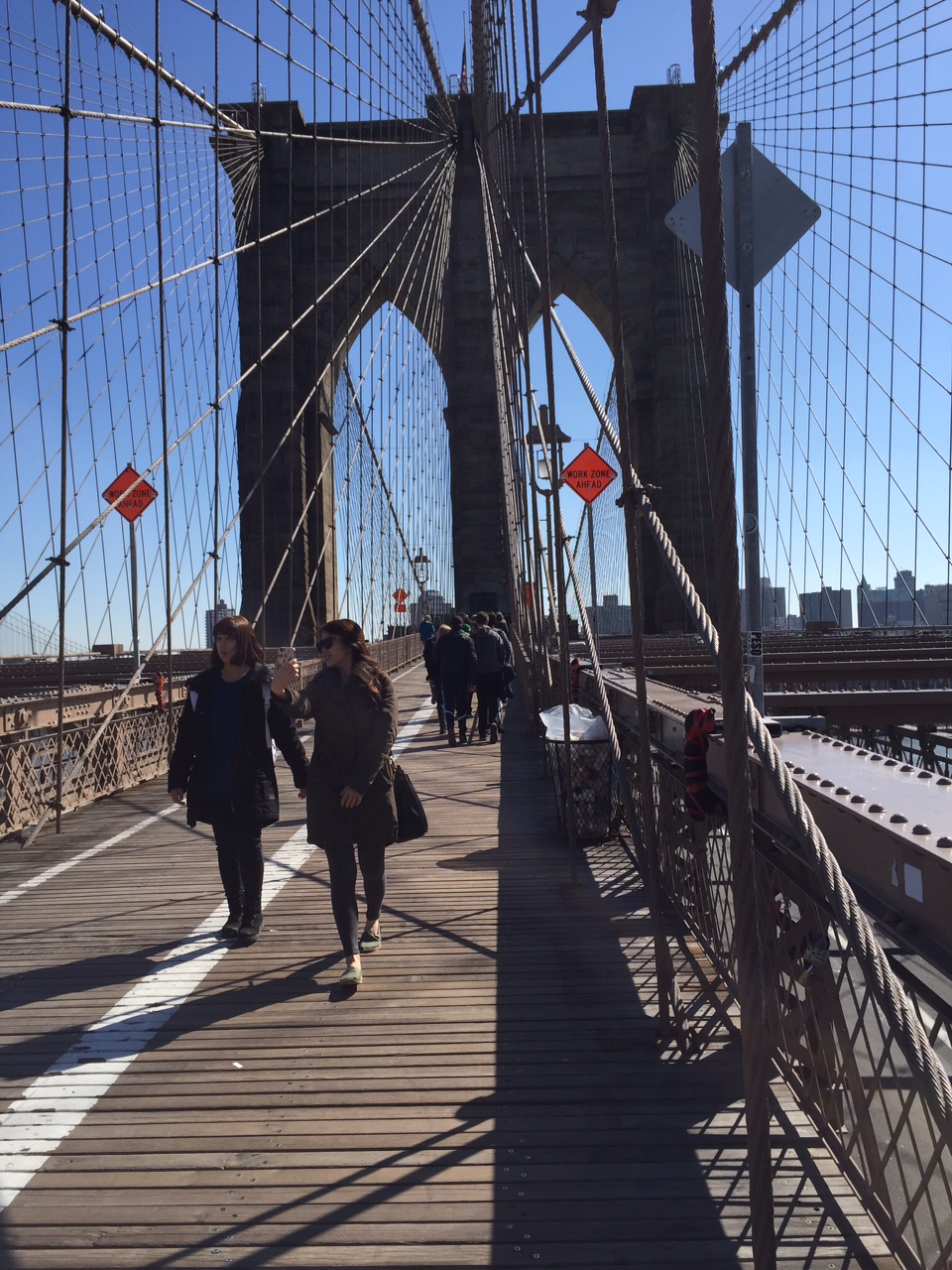
Sunday morning is quiet in New York.  Well, quieter.  When it’s a beautiful day there is no better time to walk across the Brooklyn Bridge.  I thought I hadn’t walked it before, although I’d driven across a couple of times.  But actually I must have walked it,  because I remembered walking on wooden planks.  It seems fitting that on an old bridge the walkway is wood.


SPACES AND TRAINS


At the World Trade Center, the memorial in the foreground, the new winged PATH station in the center

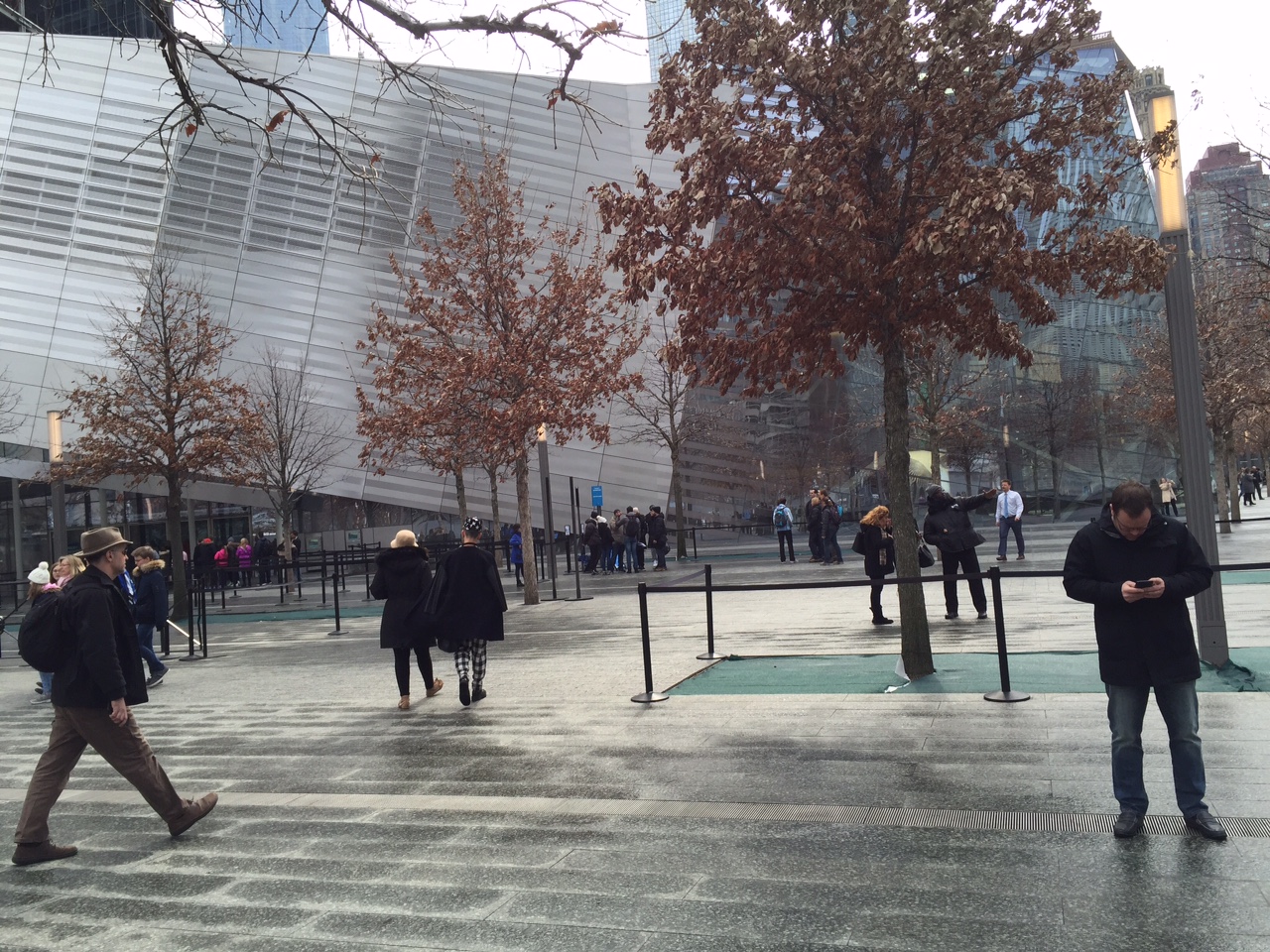
With time to kill the day we were to take the train back we walked a few blocks further downtown from our hotel and found ourselves at the World Trade Center.  We were here in early October 2001, when the debris of the collapsed towers hadn’t yet been cleaned up.  Tourists were still taking photos of themselves hugging firefighters and police.  A strange smell was still in the air and dust lined the street and filled nearby shop windows. A jagged piece of one of the Trade Center’s outer wall was was sticking out some twenty or thirty feet in the air rom a pile of debris.  Left as it was I thought it would make a great memorial. What we have in place now is much different.  When we were here last the new WTC building was still under construction and the museum hadn’t yet opened.  We had  looked at the two square holes, spooky then as now, the waterfalls disappearing into an unfathomable dark pit.  The new museum building captures something of this feeling in its downward slant, as if it were sinking. 


The reflective section of the WTC museum

The opaque part of the museum

The white wings of the new PATH (Port Authority) train station are dramatic, even flamboyant.  I’m not sure how I feel about them.  The project, only just officially unveiled, was called the most expensive train station in the world in an article in the New York Times:  “Santiago Calatrava's Transit Hub Is a Soaring Symbol of a Boondoggle.”  One can understand why.  It cost nearly $4 billion (billion!) and serves fewer commuters than Grand Central Station (46,000 compared with 208,000, daily).  Penn Station, where our train arrived, is a complete joke architecturally.  Actually there isn’t even a building. The once magnificent station completed in 1910 was very grand, inspired by the Paris’ Gare d’Orsay.  Alas, it was deemed too grand in the 1950’s for a declining railroad industry and was completely demolished.   (What were they thinking?  No more trains at all?  Ever?) When you arrive you’re already underground, so you simply exit from the train into the subway. Or climb up to street level.  Madison Square Garden looms somewhere vaguely overhead.  Penn Station serves over 600,000 people daily, and is the busiest transportation hub in all of North America.   You would think it could have some presence above ground. 

It was nice to be able to look backward, and possible as we were in the last car.


Monday, February 15, 2016

WHY ARE THERE ICE FEATHERS?

Or, Up and Down With Winter


ICE FEATHERS (Photo by Chris Huston; not black and white)


The other day, a real bone-chiller (minus 30 on Sugarbush summit that morning) son-in-law and neighbor Chris took a walk in a field behind his house where a small stream winds its frozen way.  He took a photo of what he saw.  


In December we (not only “we”) could have spent a couple of days at the beach, wearing bathing suits practically, had we chosen to, yet a week or so later we donned ski layers for some downhill at Sugarbush and cross country at Rikerts, up Breadloaf way.  Shortly afterward––I’ve lost track of these changes––I heard some commercial maple syrup farmers (do we call them farmers if the crop is sap?) were starting to tap their trees because the sap was running.  Spring.  In January.


Skyler and me on the mountain near our house in January (Note the lack of snow!)

Whenever the snow vanishes it reveals what the dogs have left behind. (You know what I mean.)   For reasons only a dog understands, all the turds are located, appropriately, atop the septic mound.   This is where Skyler and his sister Daisy who’s often here like to sit and view the woods and the field, and where they bark at things no one else can see.  They’ve worn a straight line to what they think of as the back edge of their domain––at least a dozen feet from the invisible fence––where it makes a 90-degree turn and heads to a second spot with a slightly different vantage point.  Creatures of habit.


Halfway up at Mount Ellen, Sugarbush, one good snow day


 It’s hard to know what to do:  outdoors you can ski one day, walk along kicking fall leaves another day. 


Birds accumulating on the bush near the bird feeder one cold day


Is it because of El Niño, the warm Pacific currents that the weather pattern has been so perturbed?  In the Galapagos in December we heard about the disastrous effects of a previous El Niño. This year’s is particularly strong.  I should say, disastrous for some.  Unusual amounts of rain in that archipelago mean tough times for sea lions and some other ocean animals––their food vanishes­––but good times for land animals like iguanas and tortoises.  Deer probably benefit here because every other week the snow melts and they can browse the grasses.  The have only to wait out a couple of days of extreme cold.

One of those warmer days grandson Hans christened the dinghy (plus oars) he’d crafted this fall in the bay in Newburyport.  He arrived here a couple of days later to begin Middlebury College life (he and about a hundred other freshmen are called “Febs”) just in time for the three coldest days.  They spent the coldest day of all at the Snow Bowl where the wind chill was about 20 below (minus 29 Celsius).


Checking out the dinghy in Newburyport, in early Feb


When Chris showed us his photo of ice feathers I thought of hiking over to that stream and having a look.  I wondered whether the conditions were such that every area of frozen water would exhibit the same phenomenon.  I walked around and onto our pond.  It was smooth, the ice covered with a thin film of snow.  But near the overflow that goes beneath our driveway where the water is less likely to be still, I saw the feathers.  Not as beautiful nor as large as the ones Chris saw, but ice feathers nonetheless. This is how they are made: in really cold air wind blows the water away before it can freeze in some places while allowing it build in others.  Some water evaporates, other bits attach to already frozen bits.  The physics of crystals.  Rime ice like this is often seen on the stunted trees at mountaintop level, the ice crystals facing away from the prevailing wind.

Looks cold, doesn't it?  


Why are there ice feathers?  Because they’re beautiful, of course.