Monday, October 17, 2011

OF TREES, MUSIC, AND DEBRIS


The Vergennes Opera House in our town was built as a theater and community center in 1897.  Whether there was ever an opera staged there is doubtful, given that the official history of the building cites all kinds of functions except opera.  Notably, it was the first place moving pictures were shown in Addison county.  It must have grown shabby over the years, because by the early 1970's the theater was shuttered.  It wasn't until 25 years later that community efforts brought about restoration and a new beginning, the opening celebrated with a performance by the Vermont Symphony Orchestra.  I'm mentioning this because a performance of the VSO brought us there again two weeks ago, and another performance by the Champlain Philharmonic had us there again the following weekend.  In such a relatively small space a full orchestra can fill every part of your body with music.  You are inside the music.  The Champlain orchestra had a smaller audience than the VSO and played not on the stage, but on the floor which meant, for example, the soloist in the Saint-Saens cello concerto was five or so feet from me.  I could watch her fingering, see every gesture.  And Beethoven’s Fifth was overwhelming.  It was glorious.

We have also been hearing a sort of music (or is cacophony a better word?) of geese.  Everyone hears geese in the fall, but this is really a lot of geese.  Besides being located on a major sightseeing bicycle route, we’re on a major snow goose and Canada goose migration route.  Dead Creek Wildlife Management Area near us and near Champlain has a viewing area for observing the migration.  Every day we hear the distant honking of hundreds of geese in the western sky, in their rough formations like sloppily lined-up bomber squadrons.  This afternoon, confusingly, several groups looked like they were heading south while several other groups were flying north. But I think they must only have been making a wide sweeping loop before setting their GPS to S.


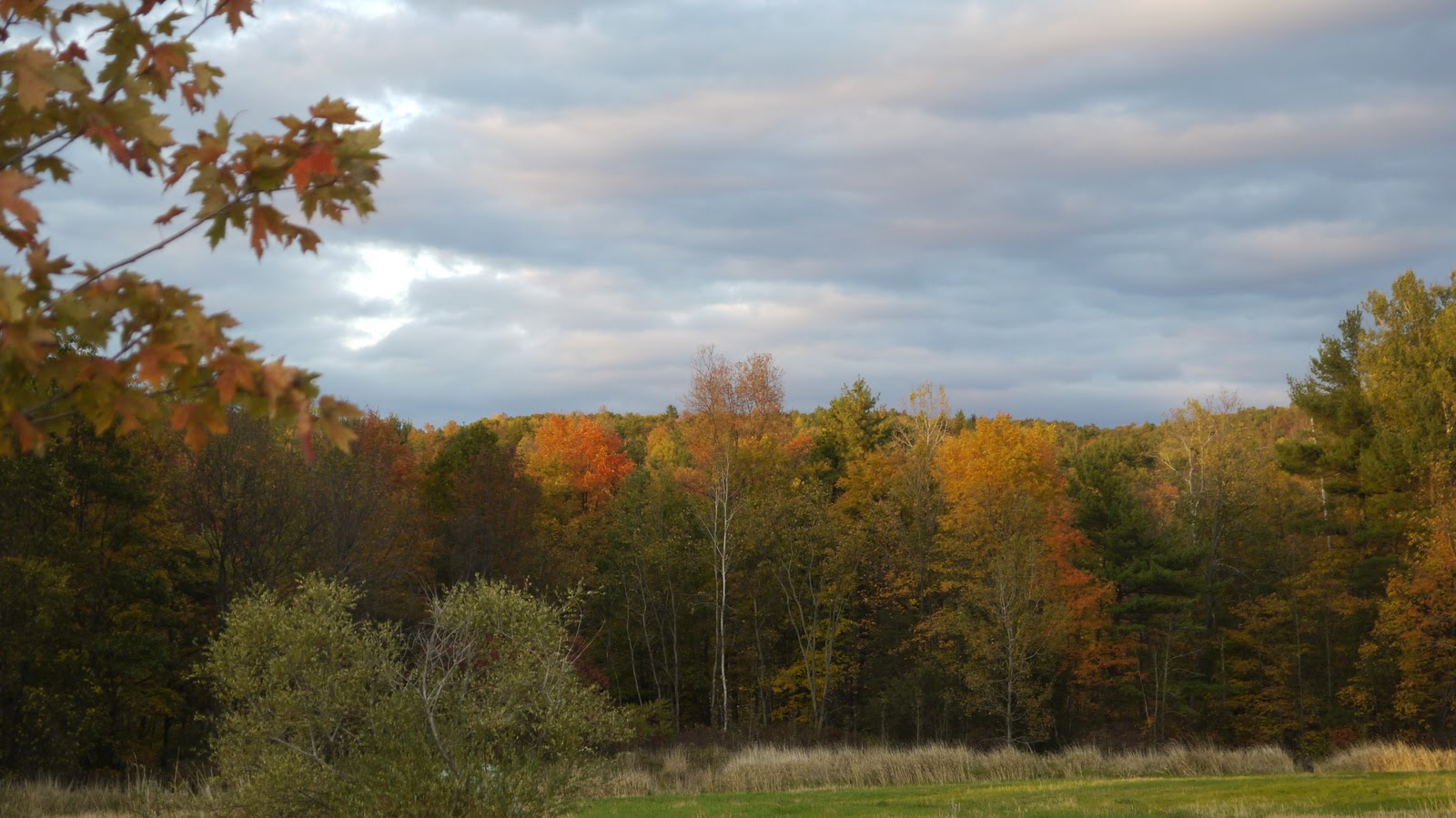
The flames of fall color have come to the Adirondack mountains across the lake.  Here too, the colors are evident on the higher slopes and some low-lying hollows where the cold sits at night.  Right around the house there is more color than there was yesterday, and, it seems, more this afternoon than this morning.  According to an article in the Burlington Free Press foliage colors are about a week late this year.  There is no hard evidence that this is due to climate change, although, like many changes, it certainly could be.  We have had some heavy frosts (frosts that killed only the basil; not the eggplants or raspberries) but the days have become warm again.  I know this is temporary.

Those eggplants (& tomatoes) just keep coming.
Rain is expected again soon.  Eric the bread maker and rice farmer I wrote about during the summer had been planning on a wet start to the season, then a dry time for picking.  (I gathered that in some areas where this rice is grown the fields are drained at harvest time.)  Heavy rain at the end of the season in September wet his rice field and so he wasn’t able to harvest dry as expected; he had to pick the rice from a wet field and is now waiting for it to dry.

Repair of Route 125 near Hancock where much of the road washed away.
Which brings me to the rivers.  Not all rivers, of course as Otter Creek is unchanged, and the New Haven River doesn’t look noticeably different in most places.  It takes a bit of driving around to see the impact of Hurricane Irene.  Trips to Boston, Manchester, and Brattleboro brought us through hard-hit towns like Hancock, Rochester, Bethel, and Newfane.  Roads have been reopened and most bridges–though not all–have been repaired.  What remains are riverbanks piled up to ten feet high with debris, piles of gravel where there shouldn’t be gravel, the occasional house undermined by water sitting abandoned, and fields covered by silt.  Because of heavy economic pressure to repair roads, construction equipment has been placed in streams to mine the streambed for rocks, turning many 
Hastily replaced road and bridge in Jamaica.
roadside streams into unnatural rock-lined channels.  A walk along the Mad River gave us a closer look and a sense of the force of the water, as well as wonder at how all this crazy stuff­–hay bales, tree branches, lumber, and more is ever going to be cleaned up.  The bridge in the southern Vermont town of Jamaica now spans masses of piled up stones instead of the placid stream it once covered.  The giveaway of flood damage is man-made piles of dirt, stones, tree branches, miscellaneous lumber, and car tires.

Shoreline of the Mad River
Along some streams the damage is less obvious (no washed away road or house), but still severe.  We walked along the Mad River not long ago and it's here, close to the river, where you can see the power of the water.  Bushes look as if they have been run over by trucks, there are pieces of hay bales in trees, and the plastic some farmers use to wrap their bales hangs like toilet paper from tree limbs. The tangle of branches and stray lumber is over four feet high.

Monday, September 19, 2011

TRANSITION TIME, aka HARVEST TIME


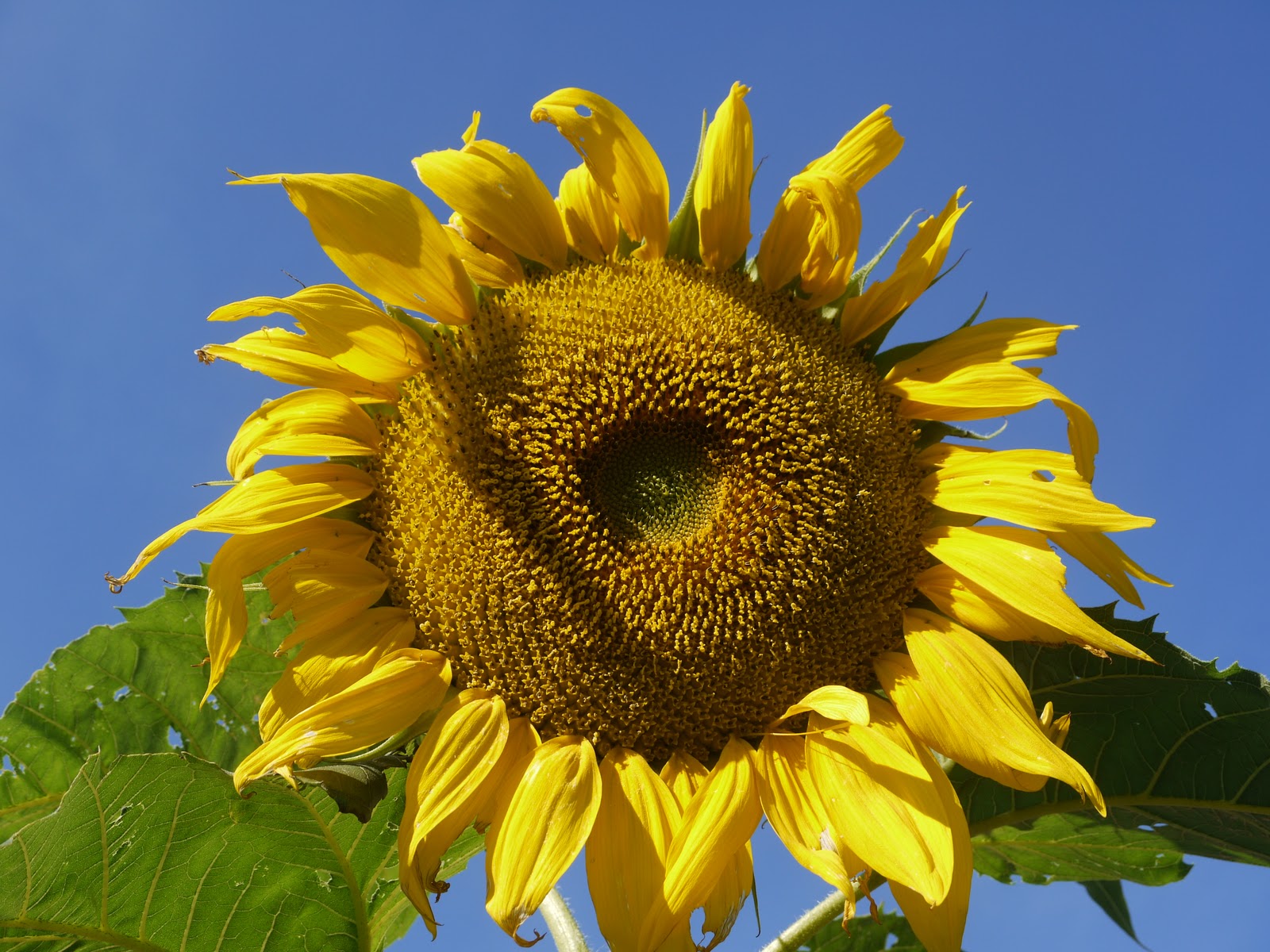
Our single remaining sunflower (after Irene)

It feels like one anyway, a transition.  Yesterday it was summer, and today, just like that, it is fall. (All right, not technically.)   We are looking to the west for the sunset around seven o’clock instead of eight or nine o’clock and I could swear it happened just this week.  


Although it’s been getting colder (suddenly), the garden is still producing great amounts of tomatoes, chile peppers, jalapenos, cucumbers and eggplants.  I have had daily harvests that nearly fill a big basket.  Back in June when I bought the basket it seemed like a frivolous purchase. Why would I need such a big basket for transporting a couple of tomatoes?  Hah!  This soil is something else. We can’t eat them fast enough.  We can’t make enough eggplant dishes.  (There really aren’t that many great eggplant dishes.  Look it up.  You’ll see.)  We can't eat heaps of jalapenos.  Cucumber soup is wonderful, but not for weeks at a time.  Tomatoes, well, they’re a different story.  A tomato dish I made a couple of times captures the essence of summer and is also blissfully simple to prepare (picture a hot day when you don’t really want to cook, and yet you have scrumptious tomatoes):

~12 (depending on size) small tomatoes, cherry or slightly larger
2 garlic cloves
1/3 cup finest quality olive oil
½ cup basil leaves
Sprinkling of salt
Parmesan Reggiano to taste

Quarter or halve the tomatoes, put the garlic cloves through a garlic press, tear up the basil leaves into small pieces.  Pour the olive oil into a small bowl and add the salt, basil, garlic, and tomatoes.  Marinate for one hour or more.  (Don't refrigerate.)  Cook the pasta.  Pour the tomato mixture over the warm pasta and top with Parmesan Reggiano.

Then there are the raspberries.  I thought raspberry season was over.  Not at all.  The raspberries just came into their own about two weeks ago.  What I picked in early August was only a sampling.

Making rows (left rear) and baling (right)
Speaking of changes, our field finally got mowed the other day, and about half of the old hay bales are gone.  The other half may have to wait until all the new hay has been hauled away.  Farmer Dan called around noontime that day to say he’d gotten hold of the guy who made the bales last fall, and they were here mowing and pulling out old bales by one o'clock that same afternoon.  After the newly-cut hay dried for a couple of days after that, he and another guy came by with equipment that tossed the hay into neat rows, then Dan followed up with a baler that sucked up the hay rows and every fifteen minutes or so spit out a giant marshmallow-shaped hunk of hay.  Then he hauled away some of the new bales.  Right  now we have some new bales, some neatly shorn meadow, and some old bales still in place.  Before the mowing, the last time we’d talked with Dan was near the end of July.   As the month of August went by Dan and the guy who left last years’ bales behind were likely taken up with chores more important or urgent than this.  It’s hard to know.  Farmers work in ways still mysterious to me.  Now with the grasses flattened we can walk anywhere in the field.  It gives you a new perspective–no more maze of corridors (made by Ken with our tractor mower) bordered by seven-foot-high grasses. 

New perspective of the sugar house; a hint of green shows where Ken's mowed path was.


Other transitions?  A group of ducks have been visiting the pond nearly every day, six each time.  (Migrating perhaps?  Or fleeing hunters?  It's duck hunting season.)  They come and leave together, never staying for more than a morning, or part of an afternoon.  A heron has been another occasional visitor.  The first time I saw the heron–I’m assuming it’s the same one each time, but I don’t actually know–it made a close pass by the tall front windows above the kitchen counters, casting a startling giant grey shadow.   A couple of days ago Ken watched the heron as it stood immobile near the pond.  With a snap of his head it scooped up not a fish, but a mouse from the grass.  It held the mouse for a minute or so, quite still.  It bent to the water, swished the mouse back and forth a few times, and gulp! down the hatch.  

Friday, September 2, 2011

WATER

I was going to write of other things, but it’s not possible to write about Vermont this week without mentioning water.  A lot of water in a short time poured on us by tropical storm Irene, nine inches in some places.  Since last Sunday, the day of the storm, we have been learning about the damage throughout the state. Each day brought more news of destruction.  It was incongruous, because our early awareness was only of our pond filled to overflowing, and Otter Creek higher and more fast-moving than it had been in the spring rains.  The waterfalls in Vergennes and Middlebury were milk chocolate brown and sounded thunderous.  But we were only sightseers. 

The falls at Middlebury, the day after Irene

An email went out a few days later from the local USDA office asking farmers in this county (Addison) to report crop damage caused by flooding.  So there must be more crop flooding in low-lying areas than we have noticed.  (I wonder how Erik, the rice farmer, fared.  See "Bread.") Bill, living up-mountain in Starksboro off route 17, has had to adjust his commute because of a partial road closure.  A road to nearby Sugarbush is closed.  Harry’s vet mentioned today that the trail to Buck Mountain behind us has some tree damage.  My sunflowers were destroyed.  This is minor, my sunflowers trivial, compared with what happened elsewhere. 

Three covered bridges were lost.  Still, I read that the flood of November 3, 1927 was much worse.  Two hundred covered bridges were lost (out of a total of 1,450 bridges).  Not surprisingly in those times people were happy to replace them with steel.  Wood=old.  Steel=new.  Today there are fewer than 100 covered bridges.  The Pulp Mill bridge in Middlebury, built in 1820 and mightily restored in 1984 and 2002, an unusual double or two-lane bridge, easily survived.  We often cross it when we take Morgan Horse Farm Road home.  It’s one of five covered bridges in this county.  In the many summers I spent in Vermont as a child I never quite worked out exactly why the bridges were covered.  It’s not that I didn’t ask.  But I got answers like “to keep the snow off the bridge,” or “to make it easier to cross in bad weather,” or, more dismissively, “it was the way they built them then.”  Not quite.  They were covered to protect the those elegant massive wooden trusses from the elements.


A week ago we stumbled into a photography exhibit called “Visions of Place: The Photography of John Miller, Peter Miller, and Richard Brown” at the Middlebury Folk Center that brought home a powerful sense of the changes in Vermont culture of more recent times.  Not so long ago, when covered bridges had long been antiques, in the 1960’s, the 1970’s, even the 1990’s, more people farmed, and more people lived more simply than we do now.  I shouldn’t romanticize this because it was a harder life in many physical ways.  It reminded me of a long time ago when I and my family were spending the summer, as usual, in Townshend, Vermont. I must have been about eight years old or so, when one day I went with my mother to a market in Newfane, Vermont where a new butcher had begun work.  I remember standing there listening to him telling my mother his story:  how he and his wife had moved here earlier that year from New York City (before route 91 was built, and New York City was worlds away!), and how harsh their first winter was, and how his frightened wife wept every night for the loss of friends, familiar things, familiar food, and the vibrancy and comfort of city life.  Such contrast:  we are going to Boston for two days next week, just to see a play.  Our friends are all on the internet.


In the 1927 flood eight inches of rain fell in a 36-hour period.  Eighty-five people died in Vermont and 9,000 were homeless.

The trusses of the Pulp Mill bridge

Monday, August 15, 2011

SUMMER FRUITS


If you measured summer by its fruits, this would be the season of the third berry.  Blueberry time is here, but won't last much longer. Strawberries are long gone.  (We had only a few plants growing near the house.)  Our raspberries gave us several pints, but only a few berries remained as of last week. (Note to self:  must remember to cut the stalks for a bigger harvest next year.)  Our small vegetable garden is producing at a pretty rapid clip, the usual tomatoes, cucumbers, squash, eggplant.  There's a pear tree growing wild at the end of our woods with plenty of pears, quite high up, and probably still unripe.  Our apple trees aren't doing much in the way of production.  Hmmm.  Not enough cross-pollination?  Or is this a bi-annual thing?

Among the uncultivated, it’s time now for Queen Anne’s Lace (Daucus carota, suggesting the carrot family) in bloom just about everywhere, blue wild chicory (Cichorium intybus), blooming nearly everywhere. But there’s an interloper, one I hadn’t heard of in Massachusetts – wild parsnip (Pastinaca sativa, another carrot family member; doesn’t that sound like something you’d like to pick?).  If you brush up against this plant in sunlight, you will likely end up with a rash, blisters, and skin discoloration lasting for months.  The effect is called phytophotodermatitus.  Wild parsnip tends to grow along roadsides or in untended fields, and has now mostly turned to seed.  The plant has been known around here for over a hundred years but is only recently proliferating.  No one seems to know why. 

                                                                                **


Another sign of late summer:  the annual Addison County Field Days ended last weekend.  If you didn’t already know, you would learn that cows are rated for the beauty of their udders and the manner in which these are supported by the rest of their huge bodies.  Or you could discover truly beautiful chickens.   


You might find out how much agriculture depends upon humongous machinery.  The top of my head only made it to the top of the tires in this example.  It makes you tremble for the creatures that nest or nestle in the fields among the tall grasses and corn.


You might find out how to hand-scythe, or how much weight Percherons or Belgians can pull, or how they were once employed at one end of a Rube Goldberg-like contraption for sawing wood.  Having seen all that and more, it would be time for maple creemies and a couple of rounds of the Demolition Derby.  If you were Hans, Olin, Carly, Audrey, or Ben there would be time at the fair for hours of whirling, spinning, and zooming.

Tuesday, July 26, 2011

BREAD


When I was about five years old I came to Vermont for the first time.  My parents and I stayed in a kind of boarding inn, I suppose you would call it, by which I mean a place that would now be considered a B&B, a large old farmhouse complete with large red barn and several outbuildings and some hundred acres of land, most of it meadow, across from a covered bridge still in use at the time (even by the logging trucks which ultimately made it unsafe for cars) that crossed the West River. It was a place where people came to stay in the summer for weeks at a time or even the entire summer, and returned year after year.  Like we did.  What made it unusual was that it was run by a Waldorf-Astoria chef and his family, and the clientele consisted solely of Waldorf people and their friends.  (My father was a headwaiter at the Waldorf.)  Everyone, naturally, was from New York City. 

The food was good, I supposed, although I was no connoisseur.  In those days, I understood that eating anywhere besides New York City meant that the food–with notable exceptions, of course–would be just this side of inedible.  Bread, I often heard my father say, they didn’t know how to make outside of New York City.  The lack of decent bread–i.e., the full-bodied European type with a crispy crust, maybe some seeds–was what kept my parents from living anywhere else after my father retired.  I wished they would move to Vermont.  But even in the suburbs of New York they didn’t know how to make bread.

Now there’s no lack of good bread.  There is excellent bread to be had at the Middlebury Co-op, the Vergennes Laundry (a café), at Shelburne Farms, and at farmer’s markets in Vergennes and Middlebury.  We have become especially fond of Good Companion Bakery bread, made just a few miles away.  We met Erik, the baker, at the Vergennes farmer’s market where he was taking orders for “rice-weed-eating ducks.”  That was irresistible.  When we stopped at his farm to pick up the ducks we saw his bread bakery, his sponsored windmill project, and learned of his other projects that included heirloom apples for cider, growing his own wheat, doing his own mowing and all using his own draft horses, raising cows organically, plus a new major project growing rice.  (Really).  Hence the need for weed-eating ducks.  He was featured in the Huffington Report a couple of weeks ago about his rice growing.  (see the link:  http://www.huffingtonpost.com/2011/07/18/local-food-production-vermont-farmers_n_901424.html) As it happens Lesley recently talked with him too, about cows, gathering advice on the topic of raising a beef cow that we’d have a share of for meat. (See “The Social Network” blog entry.)

Erik, with rice plants (Photo: Huffington Report)

Bread, as in money to live on.  There’s not much of that for many farmers.   Not for Erik.  Not for Dan, the farmer who mows our meadow.  You have to love the life, and they do.  Dan stopped by the other day, and stayed a while.  He was hoping to mow, and get rid of the old bales, the next morning, but the weather was only going to cooperate for the next two days, and I guess he needed three. So it's still unmoved.  Dan has well over 100 acres to mow in all.  There was so much rain in the spring (a boon if you have some wet land and you want to be a rice farmer) he didn’t get started sowing corn until late, like a number of other farmers near here. Corn should be knee high-plus by now, but it’s barely that.  He won’t get much reward from this haying, as it’s late in the season for quality hay, and the old bales he has to remove aren’t worth much. Plus it will be a pain in the neck to mow and remove bales at the same time. He needs the hay though, as his cows can use about 400 of them a season.  Last September he had a terrible accident in the barn, fell and tore a muscle right off the bone, and so he had to leave the mowing­–and the tractor and motor repair, and other jobs he does to keep going–to others or let them go undone.  Mostly they were undone.  Medical bills pretty much ate up whatever money was left.  

The weather, not cooperating

Wednesday, July 6, 2011

Not-So-Idle Days, Idyll Evenings


The view from Snake Mountain, the lake in the background
Much of our time has been spent doing chores of one kind and another.  Well, for me, two kinds, mostly:  painting, and weeding.  The painting that relates to the porch is now pretty much done. The weeding, I’ll admit, will never be complete.  In the long garden it’s a battle against staggering odds.  A hike up Snake Mountain, the mountain we see from our porch to the southwest, was a break from all this.  It was hot, but Harry, thirteen now, managed quite well.

Harry admiring the view


The days have been warm and warmer, interrupted somewhat regularly by thunderstorms, and the nights, soft and balmy.  A picnic supper and swim with the Huston gang at Kingsland Bay on Lake Champlain marked the official beginning of summer as far as I was concerned.  The night of the fourth of July (well, actually it was Sunday, the 3rd) was one of those summer days.  After a dinnertime downpour (which downpoured inside the screened porch as well as outside, thanks to a long-awaited but still-not-completed roof covering, and the rain had Ken scurrying to keep the kebabs on the grill, and himself, from getting soaked) the fireworks went off under a cloudless sky. A good display for a small town, with the same kind of starbursts I oohed and aahed about in the Boston version.  A brass band–the one that plays in the gazebo on the Vergennes Green from time to time–played every piece of march music known to man, ending at last with “The Stars and Stripes Forever” while the rockets got fired up.  It felt very intimate; there were acres of space available for laying out blankets or setting up chairs, not a single thing to block anybody’s view, everything happening directly in front and overhead, and the wind blowing all the smoke in the opposite direction.  In other words, it was just right.

The night before had been just about right too.  A night of music (rocking blues) on a sweet summer’s night.  The event was indoors, though, at the Vergennes Opera House.  Headliners were a couple of musicians from New Orleans (including a blind keyboard player who looked like Stevie Wonder; we have been very into the music of New Orleans after watching a season of Treme on HBO).  Leading off was Panton Flats, a local five-man group that got the place jumping.  It was easy to get moving to this music.  The place was sold out, but there weren’t enough chairs for everyone (most of us were sitting around tables that took up a lot of space), so about a third of the audience was standing, making it that much easier to dance or just move to the beat.  Besides the 30-somethings and 40-somethings I figured would be there, we saw plenty of children, old people (that’s us, I guess), and very old people.  Dancing, too.  A local bar was selling everything from cokes to whiskey.

Nights are beautiful.  Last week I woke around 3AM for no particular reason.  At that moment it occurred to me that I didn’t really know this place at night.   So I got out of bed and wandered downstairs without turning on any lights.  I realized I know the house well enough now to navigate it in the near dark, my way lit by the myriad green and blue and red equipment gear–the TV, stove, smoke alarms, clocks, etc.  (Is any house ever completely dark anymore?)  Outdoors there was a kind of monitoring light too, the meager shine from a slit of moon, the distant glare of a farmyard light, and among the grasses:  fireflies.  Looking at this through the screen door wasn’t good enough, so I got myself a glass of wine (at 3 AM!), went onto the front porch and sat in one of the Adirondack chairs.  I listened to the tree frogs and the bullfrogs and other unidentifiable sounds.  But for these, all was still.  This was just right.


Thursday, June 16, 2011

Doings in Gardens


The frogs have quieted down, settling in, I liked to think, with their chosen mates.  Not.  That may have been true the other day.  Now they're restless again.  I’m beginning to realize frog sounds have something to do with the weather. 

The grass isn’t growing an inch a day any more, so we’re no longer raking up haystacks of clippings.  But in the meadow the grasses are as tall as a person, nearly hiding the old hay bales. 

The sugar house is almost hidden behind grass.  Fortunately Ken cut trails through the meadow in several directions.
The hay bales are actually a problem, because the farmer who usually mows the field will have a devil of a time mowing with old hay bales in the way.  He wasn’t the one who left them there in the first place.  A Department of Agriculture guy we talked with downtown in Middlebury a month ago, when we were still trying to figure how who did what, was pretty certain the bales hadn’t been left by that farmer.  “Not good mowing practice.  He wouldn’t have done that, I don’t think.”  Last week the farmer told me he hurt his leg last fall and had this other guy from a shoddy-looking farm up the road do it in his place.  That guy did it all wrong, mowing too late in the season, leaving the cut hay to get rained on, mowing the whole thing all at one time, and then abandoning the bales because by then the ground was too wet to pick them up.  I think this is the same person the previous owners told us hit the well head besides.  Bales mowed the way these were, and left out all year, aren’t good for feed any longer, just for bedding.


 My plantings are settling in and sending up new shoots.  They were planted in clay, clay being the basic soil of Addison County, leavened somewhat by compost, but 99% clay nevertheless.  I keep on being amazed that delicate roots can find their way through this stuff, but apparently they do, quite happily too.  They had a rough start. First it was so wet they were nearly flooded (and with clay the water just sits there for days), then they got blasted by heat, then beaten by wind, followed on by cold.  Maybe it makes them tougher. 

There wasn’t anything much here in the way of perennials other than the black-eye susans that  re-announced themselves recently, only the stubborn remains of about fifteen giant sunflowers.  In the location I figured an herb garden should be, or maybe once was, I planted the usual assortment of herbs (parsley, sage, rosemary, thyme, mint, coriander, tarragon, basil, chives, little onions), and further on some perennials (lavender, euphorbia, reed grass, coneflowers, monarda, an aster variety, alium , yarrow,  peonies, Joe Pye weed, daisies, false sunflower, salvia, day lilies), sowed some giant sunflowers, and started a couple of vegetables (tomatoes of various kinds, cucumbers, jalapenos, ancho chilis, eggplant, squash), all of this in one fell swoop.  The season was marching on.  I had to get stuff in the ground

Last Sunday I realized everything I’d done in the garden so far was merely a beginning.  It was raw, unformed, definitely minor league.  Lesley and I went on a Middlebury area garden tour that set a standard few could reach.  Granted, having several hundred acres, a couple of huge ponds and lots of money wouldn’t hurt.  So much to be done.  But it was inspirational.

On the garden tour: this house is only the potting shed.


Another garden, and Lesley.   Yes, it was raining yet again.