Tuesday, June 13, 2023

THE NATURAL POOL MEETS ITS END


The natural pool is dead, expired, failed, collapsed, foundered.  


Having praised the idea – still probably a viable one, under the right conditions – I figured I should report on the end of this experiment.  I didn't know it would be an experiment.

Its best year was probably its first year.


Summer, year one.


A Worthy Idea


This is what I said about the idea of having a natural pool in my blog post of May 2017:  "Pools, for just about everyone, generally have hard-formed shapes made with concrete, tiles, plastic, with clear blue water and, of course, chemicals to keep the water clear and blue.  It's what most people swim in if they're not near the ocean or lake.  (Or even if they are.)  Not everyone likes swimming in rivers or ponds.  But I do." *  

I still like the idea of swimming in rivers and ponds, but it's become a bit harder to do that. My favorite, and nearest, swimming hole was the New Haven River, about a fifteen minute drive away at New Haven Mills. There was a photograph of it in that May post. A nice spot that you approached across a bridge to a dirt road where there was a small parking area. It was never crowded, and almost every time I was there there were no other people. But one day the parking area was blocked off; it had always belonged to the people who lived in the house across the road, and apparently the owners had decided to reclaim it.  I could only guess why; maybe there was trash left behind, or dog poop (it had been a good place to take your dog), or maybe someone partied there once too often. It's not that there aren't other beautiful places, but they can be crowded, and, well, you need to drive to get there. They're not right there

i wanted a swimming hole right there.

The schematic for a natural pool is simple, or at least it looks simple: plants filter the water, so chemical filtration isn't needed.  The frame is made of wood, wood that is kept permanently under water.  A plastic liner is underneath, covered by gravel and stones. Plants line the sides. 


What could go wrong?


Algae Battles


It was only a year before the first sign of trouble.

At the beginning of that season I noticed a few small clumps of floating algae. Being an algae naif, I was surprised. I turned to a water expert recommended by the people who built the pool and got expert advice.  I ordered a couple of gallons of "good bacteria" and understood that I needed to have some at hand, always.  Almost overnight the good bacteria ate the algae.  I hadn't even bothered to find out what kind of algae it was.  All I knew is that it was benign, not uncommon. and easy to get rid of.  

Little did I know that this was to be only my first battle with algae.  

The next year I found string algae.  String, or filamentous, algae consists literally of long hair-like strands.  Much of it can be pulled out of the water, sometimes easier said than done.  The larger the body of water, the more work.  (My pool is 12' by 20'.)  It's hard to eliminate it completely without using some sort of algaecide. The upside is that the water around remains clear, so if you can get rid of it all, the result is clear water.  Since the pond bottom consists of gravel and many rocks as in an actual pond, by eye you won't know whether you've gotten all the algae or not. 

More algaecide needed.  Eco-friendly algaecides.  Good bacteria wasn't enough. Pretty quickly I learned that there are many kinds of algaecides and that all algaecides are expensive. 
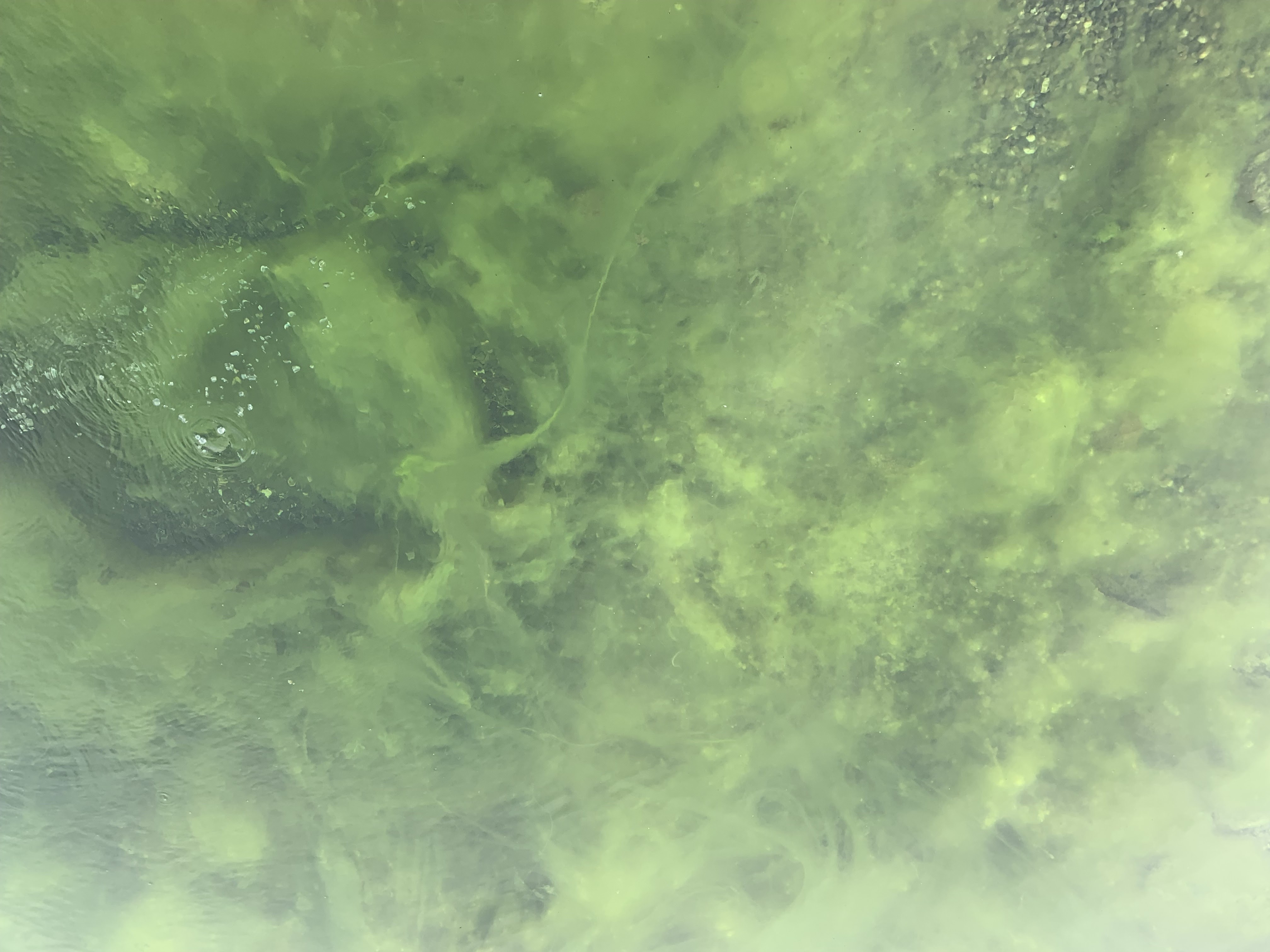

String algae in situ


To deal with algae I had to turn to the internet. There I found many stories of battles with algae.  Most of the algae stories are about issues with chlorinated swimming pools.  When you look up natural algaecides you find the issue is algae in small koi ponds so the advice generally doesn't scale up well.  Using the total amount of water in the pool, give or take 11,000 in this case, gives you the starting point for how much you need, but still, it's hard to know just how much of the stuff, how many applications, will solve the problem and not hurt the wildlife, the frogs, newts, and insects that have colonized the pond.  

Recommendations for getting rid of algae in eco-friendly ways included using barley straw.  But here's the thing: barley straw doesn't exactly kill algae; by releasing a chemical it inhibits further growth.  (The mechanism "isn't completely understood.")  I tried it anyway, floating some in the pond for a while. It was hard to tell whether there was any effect on the algae.  Was it growing?  Was it stable? There was another effect, however, a rotten smell that came from the wet barley straw.  Yuck.  I fished it out.  Other suggestions including baking soda and vinegar.  (Hah!)  Good for koi ponds, maybe. I began to suspect that eco-friendly may also mean mild.  It was time for heftier algaecides.

There are plenty of organic products out there for pond clearing. Each has a proscribed algae enemy.  That means you have to know what you're dealing with. String algae is easy to identify, but other types – and there are plenty without going beyond the benign group – are a bit more challenging. 


String algae up close

Did I say challenging?  Turned out there were various other kinds of algae, and, unwillingly, I was learning more and more about them.  

Another kind of algae visits!


There are at least two 
varieties here, maybe more.


As time went by, algae problems multiplied.  One kind would be done away with and another appear.  I had to be on the lookout through the summer.  Depending on the weather – hot and sunny guaranteed algae blooms – I had to be hyper aware.


Moss-like algae on the bottom, slimy algae in the plant area at top, a combination
hard to beat.


Plant Battles


Are there too many plants?  Or not enough?  Is the ratio right?

Plants were happy from the start, and grew and spread.


The frogs were happy, too.  And there was no shortage of them.


The plants were so content they grew and multiplied.  And multiplied.  Some of the reeds were so vigorous they tried growing through the wood frame.  One year they were so enthusiastic they drooped over the water and needed to be trimmed.  Another chore!   The meadow seemed to encroach and overpower the plantings around the pool.  Weeding was about to get added to the list of chores.

Reset!

Enough was enough.  Time to make a clean start: more and better filtration, clean the walls and the rocks and gravel.  Refresh. Refill.

 
You'd think this would do the trick.


Refilled, and okay, but I'm still checking...


The fresh start never seemed fresh enough.  There were continuing issues with water clarity. I checked the water quality constantly, needing it to be stable. But there were constant ups and downs. Managing algae had not gotten any easier and there were so many different kinds.  One after the other, each seeking its place in the sun.  Hard water made it especially challenging to keep a constant pH. I could not let a day go by without a pH check and algae check.

By the summer of 2022 the pool was making me crazy.


Yikes, the water is green! 


One day the water was green throughout. I've forgotten when that happened.  After a couple of shock treatments, it turned brown. And I had plenty of good advice during that time.  But nothing worked. I stopped swimming.  I was done.

By the end of that summer I had come to the point of deciding that this hole full of water needed to become an ordinary, standard, chlorinated swimming pool.  I was ready to join the other side.

Reflections on the Water


I still believe in the concept of natural pools.  Although I could easily falter.  I've read that they are still popular – although how popular statistically speaking I've no idea – in several European countries.  Some of them must work out just fine, mustn't they?  There is a gigantic public natural pool in Minnesota, the Webber pool in North Minneapolis, that I'd first heard about in 2017.  I checked it out onlline recently to see if it was still working. I learned it has been suffering from a number of recent closures because of poor water quality. (!)  The cited reason is duck poop contaminating the regeneration (i.e., plant) zone.  Little wonder, as regeneration habitats are nothing short of idyllic for frogs, birds, and wildlife in general – as I can testify.

Frogs proliferated in my pond from the start, as did newts and probably any number of other creatures.  Each year some of the frogs tried to overwinter in the pond and not all met with success.  In the spring I have had to fish out four or five dead – and, alas, decomposing – frogs that left me wondering whether more could be somewhere underneath rocks I couldn't see.  Hmmm.  And I often wondered why they would choose the pool to overwinter when an actual pond with a frog-friendly muddy bottom was only yards away.

To make my pool work, it's possible that my regeneration area could have been larger, not just more plants but a larger area of plantings. Maybe the filtration should have been better from the beginning.  Maybe I should have been better schooled in algae control from the outset. Not being smart about these things didn't help.

This is how it looks right now.  I have let everything go:  no filtration at all, no water added (the wood frame should be underwater), no restaining of the deck.  The water is murky and brown, a look only the frogs and the newts could love.
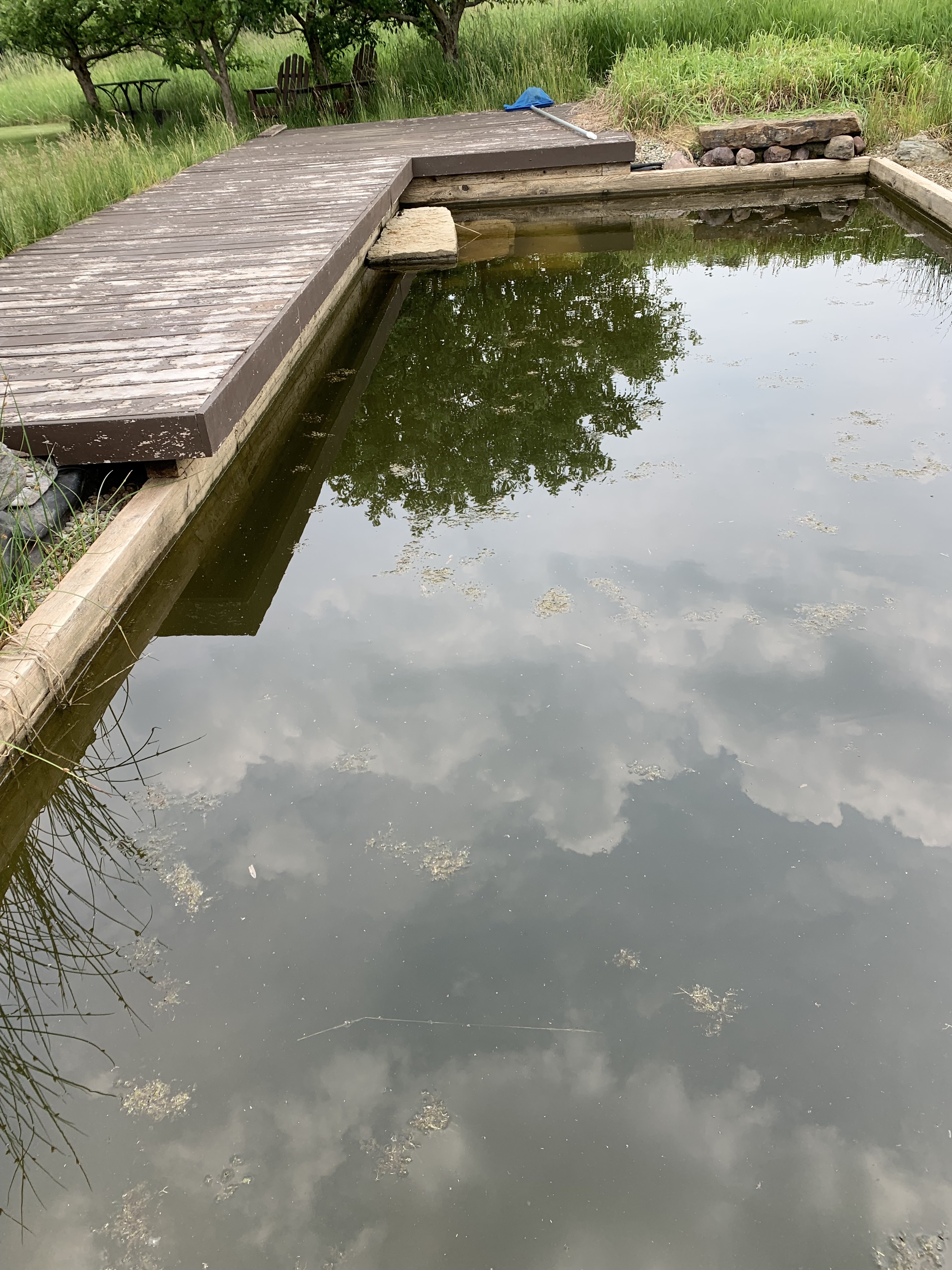


Steps into the murk. turned over to the frogs for now.


When it was good, it was very good.  When it was bad, it was awful.  


*The post was called "Coming Attraction:  A Natural Pool," 5/29/2017

Wednesday, February 22, 2023

SUGARING TIME, VERY LOCAL VERSION


The sugar shack behind my house


The sap started running more than a week ago, what with the weather reaching into the 50’s, holding to that temperature one day as late as ten o’clock at night.  The untimely warmth would have been surprising but for the fact that we’d been getting used to seesawing temperatures. There was snow. Then there was no snow. Two weeks before it had been nearly 20 below zero. There will surely be snow again before it's gone for good.  With a rush to put in taps and begin collection, we* had several barrels full in no time. There are about 60 taps in all this year, my trees and the Hustons' combined. This first collection was to be boiled down in the first sugaring weekend. Keep in mind the ratio of sap to syrup is about forty to one. 


The sugar shack circa 2015.


Sugaring had been done here by the previous owners–we’re talking about pre-2010–and they left behind a few barrels and tubing for sap collection that were a help getting this operation going.   


INSIDE


 Art wall


The evaporator at work.  Note charred woodwork around the chimney, right.


A syrup supervisor at work.  (Ben, home from college
for a weekend of sugaring)


OUTSIDE 


Sketchy chimney


The sugar shack looks better in some respects than it once did, and is slightly more comfortable; that is, no more standing in the rain if you need to get away from the steam, a choice of seating, and–well, that's about it, really.  Most of the time spent in the sugar house consists of ladling in fresh sap, keeping an eye on the color, adding wood, and making sure the whole thing isn’t going to burn down.  (I refer you to the chimney, above.)  


Choice of seating, sheltered from the weather, mostly.


Plans are afoot (i.e., being talked about) for an upgrade.  What we need, I learned, is an arch.  I wasn't quite sure why, and checked out the roof, figuring it had something to do with the construction, inhibiting the flow of the steam and smoke plumes in some way I didn't understand.  If we're going to upgrade, why not replace the chimney?  


Anyway, I looked up "sugaring arch."  Back in the 1800’s, according to a local's memory as recorded by the Woodstock History Center, “people went off into the woods to sugar with only the following tools, viz., an ax, a neck yoke, gathering pails, and two five pail kettles.  They would chop down two trees, dig out the snow from between them, put up two crotches [trenches?], make wooden trunnels [pins for fastening timbers], hang on the kettles and build a fire.  And they would make wooden troughs and spouts or spiles [spigots], and tap the trees with their ax.”  Sounds like fun.  But that description said nothing about arches.  A major improvement on this primitive sugaring a bit later in the century was the building of a stone arch.  This still didn’t explain exactly what an arch was in this context, but after thinking about it, it seemed there was nothing else in the design that could be described as an arch except for the stone, or the brick or whatever it was–maybe the trench described above?–that contained the fire.  Hence, the current “arch” in the shack–and this definitely needs to be in quotation marks–may be the enclosure of the fire within concrete blocks.  Which blocks, by the way, tend to disintegrate over time due to the intense heat. 


Hard to imagine that I wouldn’t have known as least some of this stuff, given that sugaring has been going on here for the last ten years.  


A modern arch with evaporator on top, complete with its own chimney.


No olde neck yoke needed


More time-passing activity, Ben chopping.  Does this give the impression
Ben was the only one on duty?  Not!  In reality grandson Hans was too,
as was Lesley, and Chris who really does most of the sugaring work. 

SOMETIMES IT'S MAGICAL


Keeping an eye on the sap often lasts into the night.


Passing time waiting for the sap to thicken and darken can be beautiful and perhaps introspective. Interesting things may happen. There may be interesting sounds.  And not only at night.  On the first day of sugaring, family members tending the fire were loudly serenaded by a whippoorwill, and following that, a barred owl (who-cooks-for-yoooou). In the afternoon a very large coyote streaked across the field in front of the sugarhouse after crossing my lawn–yes, that close!  We all think it may have been the one we’ve seen around here before, the same one that stood not 15 feet away from–and looked directly at–my insanely barking dog a while ago, and the very same one who left a big scat right next to my house last week.  


I, by the way, was either indoors and heard nothing, or was outdoors distracted by my apple tree pruning, and missed all the sounds and sightings. Alas.


Our local coyote, photo from Chris Huston's wildlife camera


Robert Frost, not surprisingly, was moved by the hours spent sugaring.  I looked up Frost to see if he’d had something to say about sugaring, as indeed he had.


EVENING IN A SUGAR ORCHARD


From where I lingered in a lull in March

Outside the sugar-house one night for choice,

I called the fireman with a careful voice

And bade him leave the pan and stoke the arch:

‘O fireman, give the fire another stoke,

And send more sparks up chimney with the smoke.’

I thought a few might tangle, as they did,

Among bare maple boughs, and in the rare

Hill atmosphere not cease to glow,

And so be added to the moon up there.

The moon, thought slight, was moon enough to show

On every tree a bucket with a lid,

And on black ground a bear-skin rug of snow.

The sparks made no attempt to be the moon.

They were content to figure in the trees

As Leo, Orion, and the Pleiades.

And that was what the boughs were full of soon.


WHAT IT'S ALL FOR


It all boils down to this, a kettle full, ready to pour into jars.


And ultimately, this.


In the steam:  Chris Huston, chief sugarer and guru


Whenever I say ‘we’ I am using the royal we. I do almost nothing, no lugging of barrels, no setting of taps, and no supervising of the boil. The work is done by the Hustons with occasional assistance from other family members or whoever else happens to visit.   


Sunday, October 30, 2022

A Minor Report From France


(Moi? Non!)


As I hadn't been in Paris for a really long time, it felt good to see the central city looking pretty much as it always has. Unlike London, where the tall and glossy new are sprinkled throughout the shorter and old, creative designs are often derided by the public with nicknames like the Shard, the Accordion, the Cheesegrater, the Prawn and the Gherkin.  No pickles here, however!

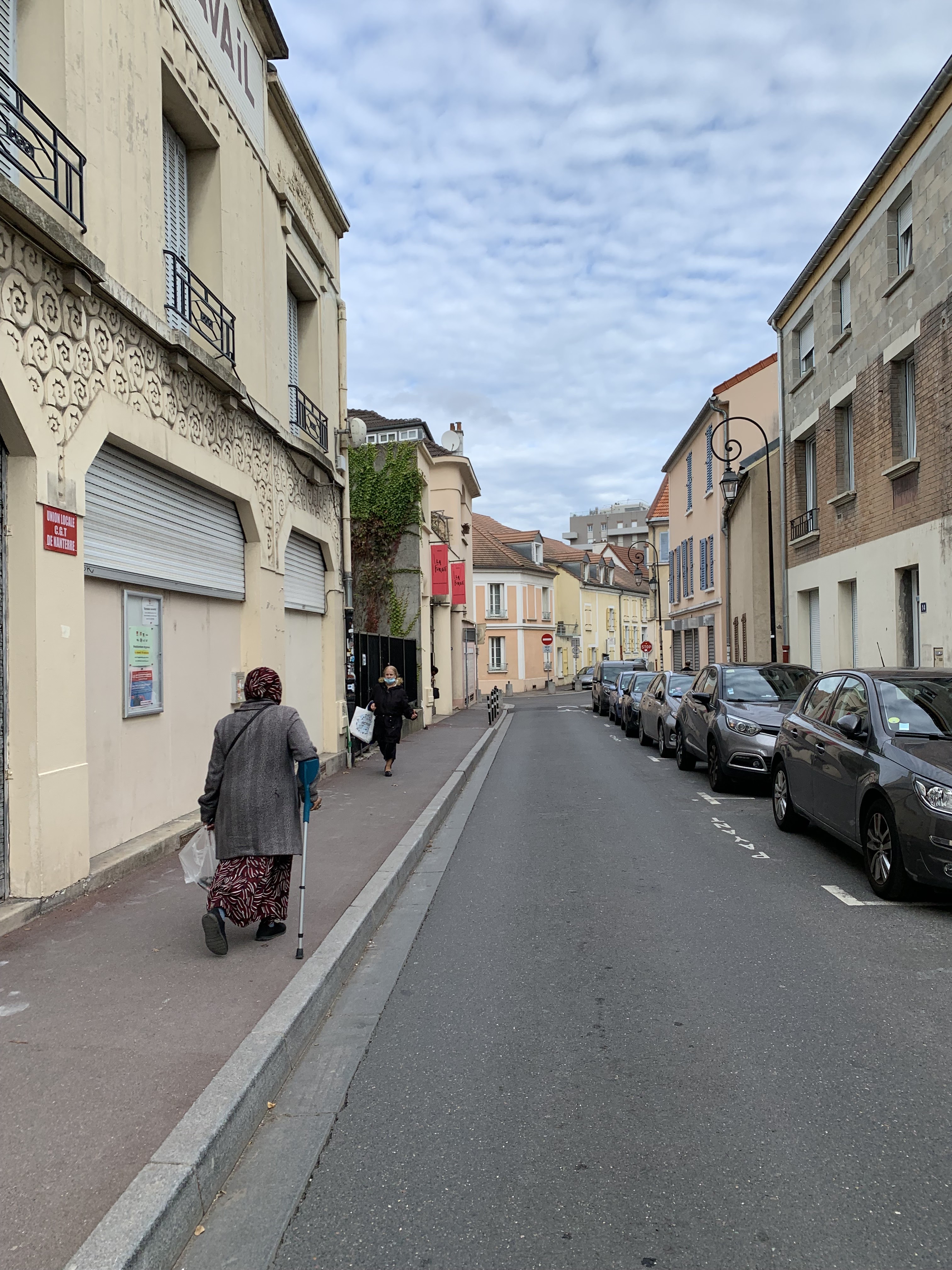
When you climb high enough in Paris, the Pompidou Center for example, you can see those new tall buildings popping up here and there at the edges of central Paris.  The only notable grouping of skyscrapers on the horizon is in Nanterre.  From the Pompidou vantage point I saw this as a sort of front wall of Nanterre, because once you get to the other side of those tall buildings you will be in the old town of Nanterre, narrow streets and all. A surprise.  I would not have been likely to find my way there if it hadn't been for staying briefly with my friend's cousin who lives there half the year (the other half in Palo Alto).  But that visit was at the end of the trip.  The first days were in the central first arrondissement.


The view from the café atop the Pompidou Center, Marais district.  Nanterre's tall buildings loom in the distance.

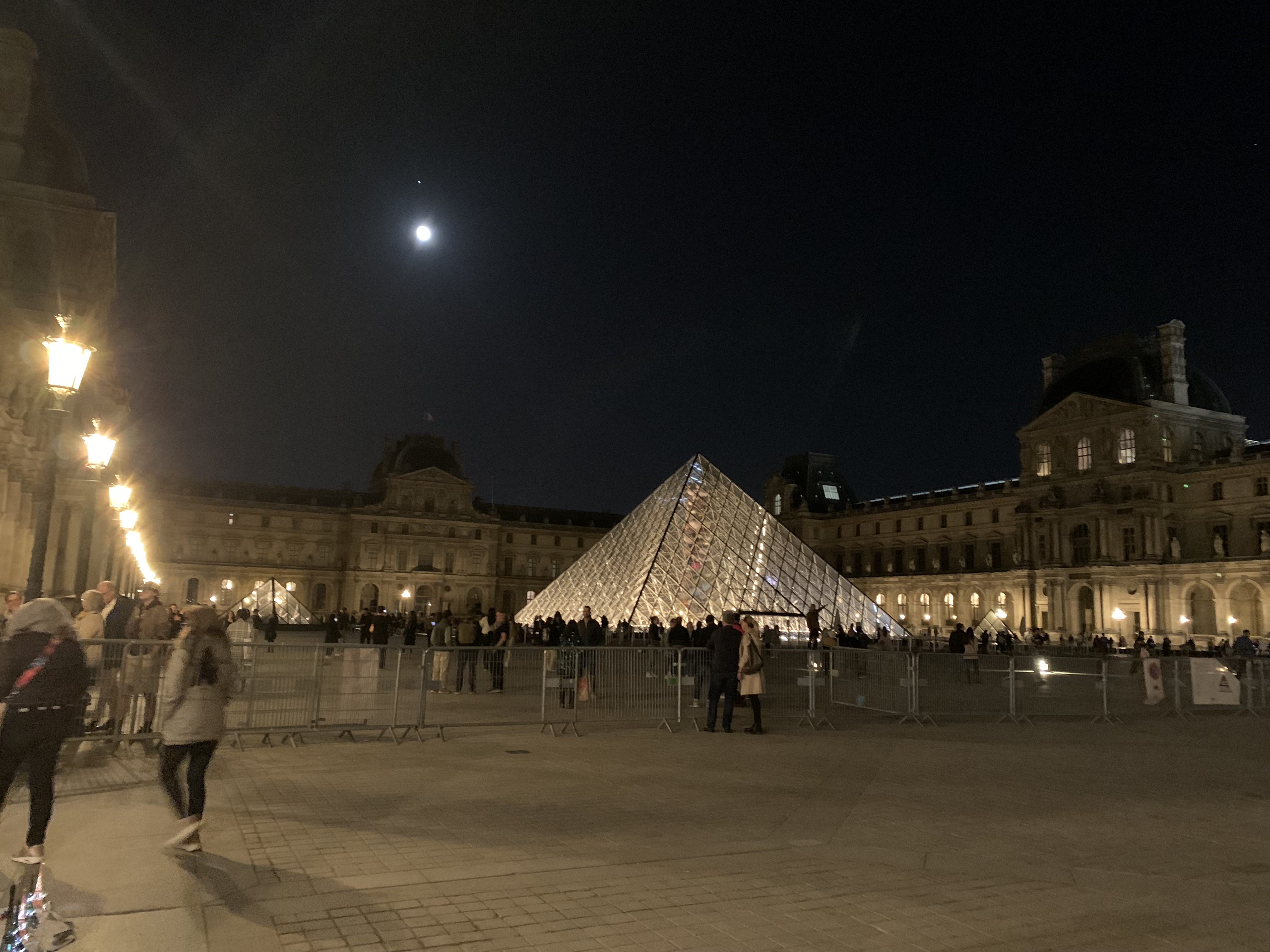
Paris was filled with sunshine while we were there, the cloudy day visit to the Marais on my last day.  With a visit lasting only a few days, we decided to stay at a tiny hotel tucked into a small street behind the Louvre, as central as it was possible to be.  Also, oddly, the area where all the chaffeurs in Paris seem to congregate while they wait for their riders.  The Louvre was where we spent much of a second day, guided by my granddaughter Audrey who is in Paris for the semester, and topped off by terrific late afternoon food and drink on the Terasse at Café Marly.  


The cute hotel


The Louvre.  So many people.  So much art.  So many galleries.  And so many humongous paintings, created to memorialize great events real and/or imagined that needed to be hung in grand spaces. I was impressed, if that's the right word, by their enormity.  The work below––not in the Louvre!–– is one I saw a week later in a gallery in St. Remy in Provence. It was only about 3 X 4 feet.  Still, I felt it was related.

Flying bodies, not at the Louvre.  

After looking at so many of those giant paintings I felt as if I'd overeaten.  It was a relief to see this old yet so modern work by the same painter of many of those other heroic epics, Jacques-Louis David. 


"The Death of Marat," actually a copy by the artist's studio, 
the original in a Belgian museum. (Although David was from Brussels, 
the subject of Marat is embedded in French history,
making for a sort of equality of ownership I suppose.)

The work below wowed me, and how could it not:  "The Hermaphrodite," an ancient Greek sculpture of a hermaphrodite body, amazing in itself, and placed on a mattress sculpted by Giovanni Bellini in 1620, several years after the discovery of the original sleeping figure in Rome.  The mattess is so realistic I longed to sit on it, lie on it, caress it. As, I imagine, does everyone who sees it


With Audrey in the Napoleon Gallery


Discordant notes.  I couldn't make myself take photos of homeless people. This is the closest I allowed myself to get. Even that felt rude.  There were many like this, too many, some people with tents but most without, especially in the most tourist-rich parts of the city.  Most were immigrants.  Immigrants were also hustling taxi rides, Eiffel tower models, or, more wretchedly, begging.  Almosts everyone walked on by.  Maybe they see the same people in the same places every day.  It seemed far worse than in San Francisco.  Maybe I'm wrong.


There's the tent.

On main roads into the city there, especially around underpasses, there were makeshift encampments.  There was also graffiti, the cartoon style favored in New York in the 1970's and 1980's. It was all over the railroad lines and many highways, even the occasional building in Provence.  In some places nothing was immune from being tagged.  I felt self-conscious photographing that, too.


Graffiti like this shows up covering every bit of exposed surface along highways and rail lines. But 
I saw none on historic buildings, and none on any variety of train car. But I can't say I looked everywhere.

The Luxembourg Gardens was one of many other beautiful places in the city we walked around.


It's lights out in the City of Light at 11:45 to save energy.  The Eiffel Tower lights go out with some fanfare.

We headed to St. Remy de Provence in our neon orange Renault after a trip on the TGV to Avignon. I had never driven a Renault and so had no idea it shares eccentricities with the now-discontinued Saab, the only car I'd ever been unable to even start because it had an ignition located–unintuitively!–on the floor.  For a manual shift car the Renault looked pretty standard, so we drove off, until a few kilometers from the rental office when it dawned on me that I probably would never be able to find my way into reverse.  None of what I thought of as normal methods worked. The car would only move forward.  Clearly, negotiating turns and parking are not simple matters when you can only move forward.  Need I add, there was no operating manual in the car.  With luck I managed turning around and we headed back to the lot. It's like this, the guy at the rental lot said irritably:  you put your hand gently like so, and pull up the sleeve of the gear stick, and voilà!  Yeah, voilà!


The car that wouldn't let me reverse.


In St. Remy, a quiet street 

Another street.  Quiet here, but all the cafés are filled, and just around the bend...

Now able to drive like everyone else, we were able to explore the countryside around St. Remy.  All we wanted to see was near at hand.  (With the exception of parking in St. Remy itself, an issue that took about three days for us to suss out.)


If not wine growing, it will be olives––everywhere.  Also very present are reminders of Van Gogh.


The Saint-Paul Asylum, a short drive from St. Remy, where Van Gogh was a self-admitted patient from May 1889 until May 1890, and made many of his most famous paintings.  The field is planted with lavender.


Van Gogh's room, as he may have left it.

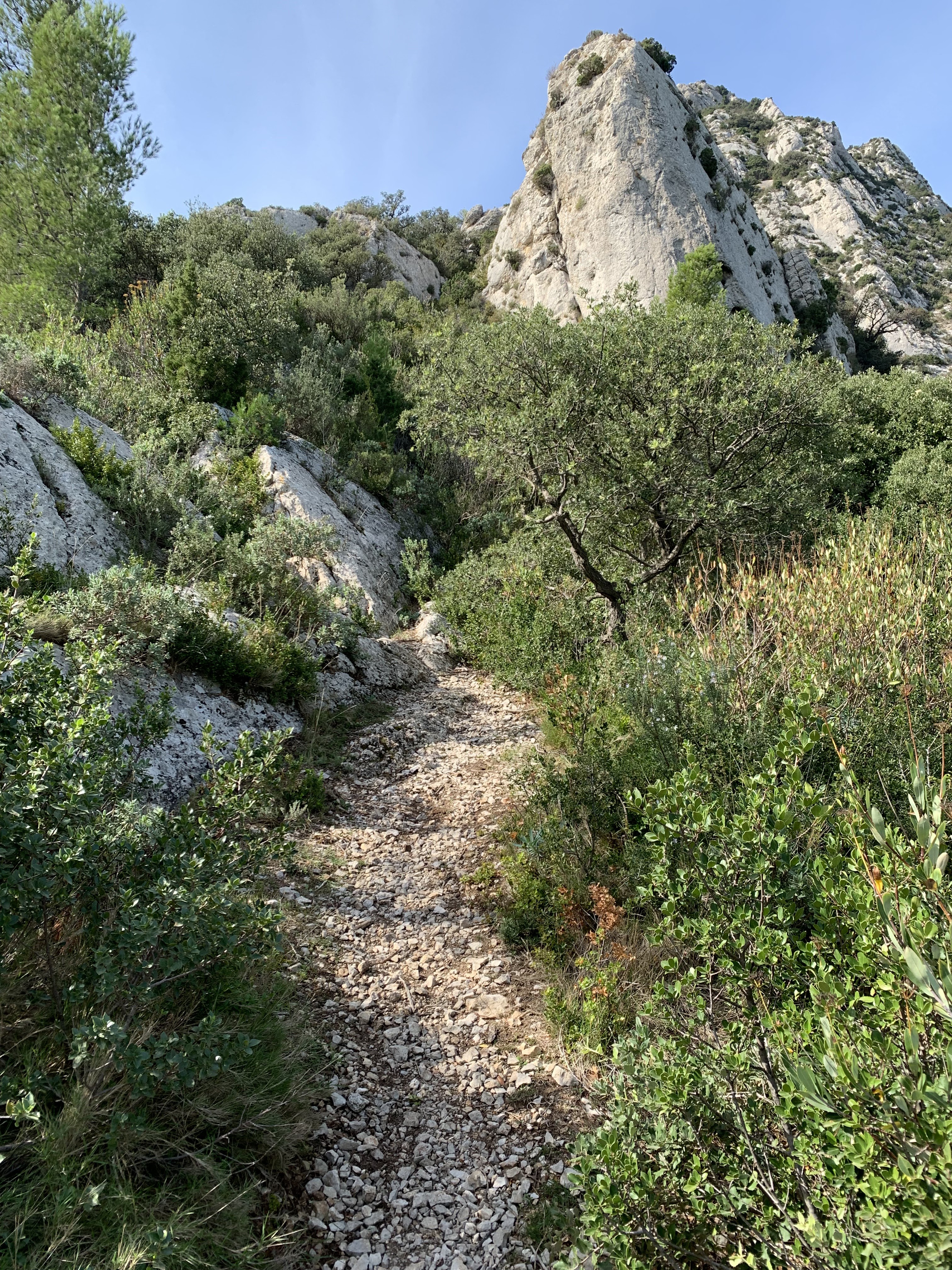
A distinctive geologic feature of the area around St. Remy is Les Alpilles mountain range, small in size, but dramatic in its protruding limestone peaks.  Rising abruptly from the Rhone Valley it is only 15 miles long and a mere six miles wide.  The highest peak reaches only about 1,600 feet, making hiking to the heights an easy matter.  (For comparison, Buck Mountain near my house in Vermont is some 1,400 feet tall, not nearly so dramatic a mountain but with a spectacular view.)  


The trail to the highest (?) peak of Les Alpilles


Having reached this ridge I was met by a sign that read, translated,  "Big Game Hunting in Progress, Watch Out for Bullets."  I didn't see any bullets flying through the air, and given the small size of the area being hunted, I wondered how many wild animals––deer? boar?––might be here to be shot.  Nevertheless, with my co-traveler Susan waiting below, I turned around.

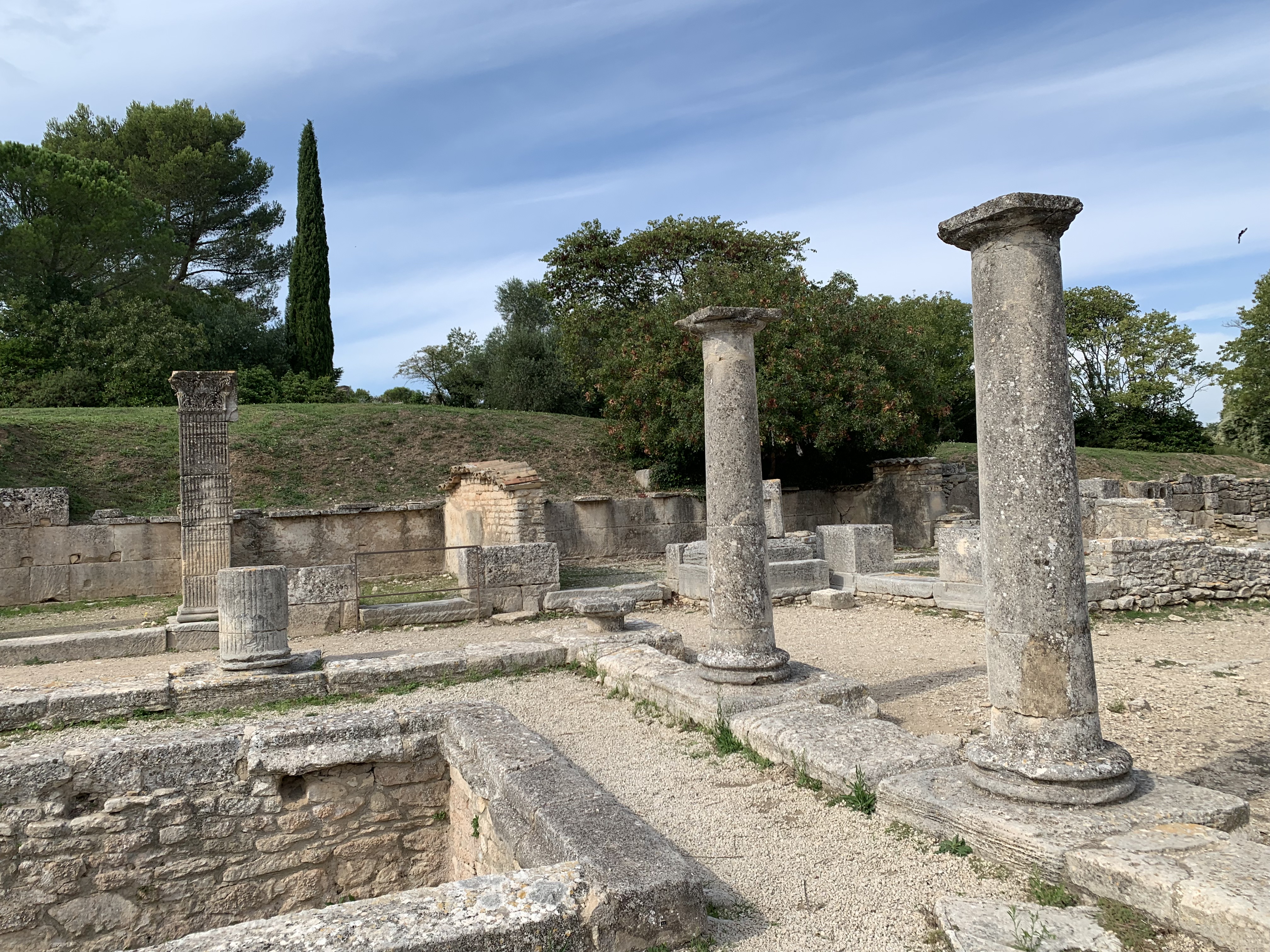
Then there was Glanum, a once-wealthy Roman city a short walk outside St. Remy.  Where I had expected to find only traces of early Romans, perhaps a column or two, the size and scope of this site this amazed me.

Glanum was originally settled by a Celtic-Ligurian tribe in the 4th century BCE and built around the source of a spring that it was believed had healing properties. The spring became a shrine to Glanis, a Celtic god.  The spring is still intact, and had been protected and honored by a temple the Romans built over it.  The early settlement was heavily influenced by contact with the Greek colony of Massalia (today's Marseille).  Glanum became a Roman town after its capture by Julius Caesar in 49 BCE, and remained a wealthy and impressive town until 260 CE when it was destroyed by the Alamanni, a confederation of Germanic tribes, after which it was abandoned.  With its drains and sewers lacking maintenance as it sat derelict, the ruins eventually flooded and became covered with mud and silt, offering a kind of natural protection. This didn't prevent the removal of many stones, however, that were used to build St. Remy.  The site wasn't excavated until 1921.


As the temple ruin (above) looked when first built.


Mausoleum and triumphal arch right outside Glanum center, dates to around
40 BCE and some time before 14 CE, respectively. 


Ancient writing has such immediacy, like a note written to the present.


The sacred spring.  The gold spot below is a carp.


If you were to look at this photo from a different angle, putting the rectangular pit in the center...

...you might recognize the rectangular pool (#2) and the columns behind it in this drawing of a drainage system. The top pool collects rainwater which overflows into a tank (#3) that in turn flows out (#4) to clean the latrines (#5, beyond the drawing).  The #6 refers to addition of columns by Romans to what was originally a Greek house.

It's also about the food, of course.  I wanted to bring all of it back home.  But alas. Here I find myself once again at the Processed Food Store for basics, and then do my best to find stuff that resembles the stuff pictured below.  Where else have I ever seen gorgonzola dished out like ice cream?  (See the scoop in hand in the fifth photo below.)

In a tiny cheese shop, Provence.


Champagne at prices I'll likely never see here.


At the Sunday market, Nanterre


At the Wednesday market in St. Remy


Coming home from the Sunday market in the old section of Nanterre.  Here there were no visible
homeless or beggars. Immigrants here seem to have found what those in the central city have not.


Speaking of food, restaurant menus in St. Remy de Provence had much similarity to one another, but surprisingly, although plenty of fish was sold in the market, it didn't make it to many menus, despite the relatively short distance from St. Remy to the Mediterranean.  This menu from Gus Restaurant there was untypical as they offered seafood.  Plus the best oysters!  (The Ostra Regal.)*

The oysters, the Ostra Régal, were among the best I've ever tasted.

The most charming town was Eygalieres, a hilltop town we stumbled upon the day we hiked in the Alpilles.  And where I enjoyed the best lunch of canard foie gras, a savory crème brûlée and onion chutney with local white wine in a lovely café on a beautiful day.  Here in Eygalieres we ran across Vermont Bicycle Tours–again.  We had already seen their support van twice in St. Remy.  

The tables were packed minutes before.

View from the top of Egalieres, looking back at Les Alpilles

It was a good time.


*Here’s what I read about later re those terrific oysters: “Grown by La Famille Boutrais, of French oyster fame, this is the cadillac of the Boutrais oysters, but–c’est un scandale!–it’s actually an Irish oyster, confirming the worst-kept secret of French oysters: Ireland has the terroir superieure! (All Boutrais oysters are Irish, actually.) Seed is grown in Clew Bay, on the west coast of Ireland, for a year, until the oysters are about an inch and a half, and then the rock stars (less than 5% of the candidates) are transferred to Bannow Cove for two more years to complete their transformation into, well, rock stars. Only the heaviest, roundest, curviest oysters are used. They are given lots of space–just two oysters per square meter–so they can feast on the rich springs that feed the bay, which has a very narrow opening to the sea, allowing it to fucntion like a giant natural claire. By the time they come to market, they are four years old and filled with dense, sweet, mineral meats."